Jeremy Nell, Marcel Jahnke, and China - Part 3
Part 3 - Propaganda
Introduction
This is the third article in a four-part series. The first two parts considered Chinese visa requirements and the Pepe Escobar documentary filmed in China, in which Nell claims to have participated, as well as the role of Marcel Jahnke as a likely funder of that project.
Returning to Nell’s trip to China, we can revisit my claim that he was “willing to report favourably on China […] in ways that were scarcely differentiable from foreign propaganda, supposedly in the name of ‘getting beyond Western propaganda.’”
Responding to that claim, Nell writes “I don’t think he actually listened to much of what I said, then.” Nell accuses me of falling into a “Sinophobic trap” and of “parroting the anti-China narrative” with which I have supposedly been “programmed.” “Instead of creating some vague, overarching ‘mystery’ about my trip to China,” he adds, “why not simply point to something specific I’ve said or done?”
This is a good opportunity, therefore, to look in detail at Nell’s videos filmed in China. As it turns out, the evidence of Chinese propaganda in those videos is stark, as one might expect given that three out of four of them revolve around the opinions of Carl Zha.
Zha was born in China and lived there during his early years. Nell describes him as an “American-Chinese journalist.” In Part 2 of Nell’s China series, Zha states that he is a US citizen and not a Chinese citizen (22:20); in Part 1, he claims to have been “a US citizen for decades” [41:10]).
Multiple commentators have long suspected Zha of being a CCP propagandist. According to Leta Hong in 2020, for instance,
I personally suspect that Carl Zha (again, an American citizen!) may be financed by the Chinese government, though I have no proof. Just look at the public support he gets on Twitter from Chinese state news agencies CGTN and now, China Daily.
Isobel Cockerell claimed in 2020 that Zha’s Twitter account was linked to hundreds of coordinated accounts which “appear to be inauthentic” and “all spout Chinese propaganda.”
Michael Ginsburg recently described Zha as “particularly aggressive in posting or amplifying CCP propaganda, including official statements from the PRC government.” It is worth looking at the long list of examples Ginsburg provides, which include a threat to “nuke” any country that “dares to intervene militarily in Taiwan to prevent unification.” Like Cockerell, Ginsburg notes that Zha “regularly interacts and amplifies other pro-PRC ‘commentators.’”
So… Nell went on a trip across China that required approval by the Chinese Ministry for Foreign Affairs in the company of a suspected CCP propagandist. It is not “Sinophobic” or “anti-Chinese” to point out the obvious.
Readers can view the results for themselves on the UK Column website where Nell’s videos from China are hosted. To assuage Nell’s concern that I have not properly attended to what he actually said and did, I offer my interpretation of those videos below.
The Nell/Zha double act follows a crude formula: Nell criticises Western double standards and stereotypes about China while Zha rehearses the CCP line on virtually everything. Nothing much bad is said about China, other than that the regulations around political cartoons are a bit tight. Any criticism of China is dismissed as Western propaganda.
Part 1
According to the show notes for Part 1, “By travelling across the country, speaking to locals, and documenting the experience, Jerm is testing the propaganda against lived experience.”
Yet, we never get to see him speaking to locals, nor does he refer to any interviews he has done with locals. Instead, the view of China that is presented is essentially that of Carl Zha, with Nell offering embellishments plus criticisms of the West.
In Part 1, an onscreen annotation by Nell refers to “China’s censorship (but not really)” (07:00). According to Nell, anyone smart enough to know how to install a VPN can access the Western internet (16:30). This is a questionable claim given that the Great Firewall is designed to make VPN use difficult. The extent of Chinese censorship is deliberately downplayed.
In any case, the Western internet is, in Nell’s view, “degenerate and immoral with people celebrating the death of Charlie Kirk,” etc. – something the Chinese government would not allow, according to Zha. Hurrah for censorship of Western degeneracy!
The purpose of censoring the internet, Zha explains, is purely to prevent the United States from staging a colour revolution. In other words, the Americans are to blame for Chinese censorship, it has nothing to do with controlling the population.
Nell and Zha admit they could not make a living as podcasters in China because of controls around what can and cannot be said. But, Nell contends, they could at least discuss whether or not Hitler was a good man and whether the Holocaust was a hoax, something which is banned in many European countries (19:20). There is an obvious anti-Western tone to the conversation, and the addition of Nazi themes to the idea of Western degeneracy is troubling.
“Am I willing to concede some government control so I know that my child and my wife are safe?,” Nell asks (46:15). Compared to the dangers of South Africa, China seems appealing in terms of security. Zha similarly thinks that it is “a legit trade off with giving up a certain degree of control for safety.” The security state is thereby endorsed, and as with Covid it is all for our “safety.”
Westerners complain about the Chinese surveillance state, Nell remarks, but something even worse is being built in the West by Palantir (50:00). Even so, the Western model is ineffective: “China is exceptionally safe,” while the United States is “very violent.” It seems to escape him that a totalitarian algorithmic ghetto is coming for us all, no matter which model of surveillance one chooses.
Zha sings the praises of the Chinese surveillance state without challenge from Nell. A decade ago, he explains, Chinese people would jay walk and traffic lights were seen “more as a suggestion” (52:10). But now “behaviour is changing, and some people attribute that to the presence of cameras,” which they “do not find a bad thing.” Nell adds “And it’s not really in your face either.” It is an open endorsement of surveillance-based behaviour change.
Any connection to totalitarianism is quickly brushed aside by Nell’s comment that no one is going to get shot for riding a motorcycle without a helmet, as they allegedly would in a totalitarian state.
Nell makes the point once more: “China is not this totalitarian hellhole, but it’s also not utopia. [...] It is a normal country with its own unique set of problems and solutions” (1:19:20). It is a claim that appears to have come directly from Zha himself, in an interview he gave to Nell in August 2025, shortly before their trip. The title of the interview was “China is neither totalitarian nor utopian.” The idea is obviously to normalise China and disguise its role as what Iain Davis (2022) calls “the world’s first Technate,” i.e., the incubation site for global technocracy.
It is not clear why the trip was necessary in the first place, given that the key talking points were already discussed in the August 2025 interview. Nell has repeatedly claimed that one cannot properly understand China unless one has been there, but that is a fallacy known as the appeal to authority. He expects his audience to defer to his first-hand experience of China without noticing that the “real” China which he and Zha present looks an awful lot like the CCP version.
China turns out to be better than the United States at basically everything. For example, its economy is larger than that of the United States in absolute terms when measured by PPP, and even when measured per capita, an eventual rise to 50% of that of the US will equate to an economy twice the size, because the population is four times larger (1:03:50).
Whereas Trump implements tariffs and threatens wars everywhere, and while over 900 overseas US military bases surround Russia and China, China only has one such base and is peace-loving (1:08:00).
Chinese influence in Africa is better for Africans than US influence, because at least they get some concrete infrastructure out of it, rather than just an IMF loan (1:10:00). China’s development model fits with multipolarism, whereas Washington’s “one size fits all” model does not (1:18:00).
According to Nell, “Westerners project their own worst fears about their own society onto this imaginary place called China,” but in reality people can earn a lot of money in China, buy Apple products, and consume Western drinks while listening to Western music (56:40, 1:06:00).
Food is cheap and healthy, meaning there are “very few fat women” (1:20:00). Cycle hire, too, is cheap and simply requires a QR code scan on a smartphone. The air pollution in Shanghai is much reduced, etc., etc.
In sum, China is painted as safe, secure, prosperous, peaceful, and healthy. It is emphatically not totalitarian, and despite Nell’s claim that he would not want to live there because of regulations around political cartoons, no significant downsides to living in China are presented.
The United States, in contrast, comes across as awful in just about every respect. It is violent, exploitative, degenerate, in decline, etc.
Given this crude, binary distinction between China and the West, it would seem that the content of Part 1 is indeed “scarcely differentiable from foreign propaganda.”
Part 2
Part 2 is filmed in the back of a car. Over the course of nearly two hours, the viewer gets to see very little of China, nor are any locals interviewed. A South African conversing with an American in the back of a car could have been staged anywhere; it does not feel like authentic on-the-ground reporting. Indeed, it does not feel very different from Nell’s online interview with Zha a few weeks earlier.
Most of Part 2 is spent discussing the Uyghurs, a contentious issue when it comes to international opinion. Zha predictably rehearses the Chinese official narrative. As the show notes put it, he asserts that “there is no Uyghur genocide but that the Chinese government did crack down on what it deemed radical Islam, backed by Western intelligence agencies like MI6.”
Although Nell would almost certainly have a problem with a comparable “War on Terror” narrative in the West, he does not challenge Zha’s assessment that China engaged in a legitimate crackdown on radical Islam.
Particularly with “politically sensitive” issues such as these (a term which Nell stresses), there is no way that any deviation from the official line will be allowed by the Chinese Ministry of Foreign Affairs. Once more, it is hard to avoid the impression of propaganda.
Before getting to the Uyghurs, however, there is a half hour discussion that was apparently inspired by a conversation with an anonymous US economist living in China. The economist wants his son to have Chinese, not US, citizenship, because the United States is “going to a very dark place” (09:00). He would “choose Xi Jinping over Trump any time” – “a great endorsement,” according to Zha (12:00).
Unsurprisingly, the economist’s pro-Chinese views fall precisely in line with Zha’s. For example, even though US GDP currently stands at $32.3 trillion vs. $20.9 trillion for China, Zha and the economist use other metrics to claim that China’s economy is already two to three times larger.
Nell complains that “It’s always China that’s accused of being a mass surveillance state,” even though Palantir is doing terrible things in the United States and Israel (15:40). Zha agrees: the image of China as a mass surveillance state is “100% projection,” given that Big Tech companies are taking over the US government. The economist’s observation that US visas are being made dependent on social media checks is cited (23:00).
The three men are not wrong about the technocratic takeover of the United States. However, as usual, any negative image of China appears as merely the product of Western paranoia.
Nell and Zha do recognise the existence of “a lot of surveillance” in China, including a “huge amount” of cameras (which Nell claims not to like), as well as metal detectors and security guards at hotels (17:50).
However, Chinese surveillance proves to be benign: “Chinese people do not feel it is oppressive,” Zha explains, and it makes places “much safer.” For example, Zha left his camera charging in a community centre for an hour and a half, and when he returned it was still there. “Today’s China is very safe,” whereas the West “not nearly as safe as China” (20:00). It is all so formulaic: West bad, China good.
According to Zha, “The Chinese government actually do[es] want to reduce crime. I just don’t think the US elites care that much.” Crime in the United States has not been reduced for the last 30 years (25:00), he claims, while Nell is keen to stress the allegedly mind-blowing increase in security in China over the same period.
There is no attempt to differentiate by types of crimes, or specific locations, or cite evidence, or discuss the reliability of official crime statistics. This gives the lie to Nell’s claim that “I am here to understand nuance” (12:30).
Zha, whose “criticism is not of censorship in general,” opines that censorship has been necessary to prevent US colour revolutions, but that “the censorship right now is too strict.” “Our economist friend,” he notes, thinks that the next Chinese president will loosen the reins on censorship, and he, too, anticipates a future in which censorship will relax (26:30).
Yet, it is unclear why any authoritarian government would want to relax censorship. Rather than ask any critical questions, Nell makes a lame joke about wanting to see “more censorship,” for instance against the Back Street Boys (29:00).
Nell then turns the discussion to NGOs, and the roles of George Soros and the National Endowment for Democracy (NED) are criticised for fomenting colour revolutions (30:50). The NED funds the Uyghur genocide narrative, according to Nell. Maybe so, but the door is thereby opened for Zha to explain the “huge misunderstanding” around the Uyghurs, rehearsing the official narrative (37:20).
According to Zha, China’s opening up in 1978 led to young Uyghur men going to Pakistan, where they were radicalised and fought alongside the Afghan Mujahideen. They later came back to China claiming to bring “pure” Islam, and terrorist attacks began happening in the 1990s (01:02:00).
In 2008, an “ethnic pogrom” (Zha’s phrase) occurred in which Uyghurs attacked Han, killing 200 and injuring 2,000. Even burka-wearing women, allegedly, wielded sticks and beat people up. Security in the Xinjiang region has been exceptionally tight ever since.
In 2013, Zha continues, a group of Uyghurs drove a van into a crowd in Tiananmen Square. 5,000 Uyghurs joined the jihad in Syria before China cracked down on the flow. From 2017 on, the government launched a province-wide campaign of deradicalisation. Its success can allegedly be judged by the fact that it is now safe for gay Uyghur men to be out and for women to wear tight-fitting clothes.
Thus, over and over, the Uyghur population is associated with violent, radical Islam, which the Chinese state has successfully combatted through poverty alleviation and counter-terrorism. It is just a Chinese variant of the “War on Terror” narrative, which no independent thinker should accept at face value. But Nell does not challenge it.
Allegations of political persecution of the Uyghurs (unrelated to genocide) and forced labour camps are ignored. Even had they been addressed, they would probably just have been dismissed as “Western propaganda.”
Nell claims “We have engaged with a pile of Uyghurs and it has been absolutely normal” (01:30:00). It is a shame that viewers never get to meet any of them or hear directly from them, as one might expect from “on the ground” reporting on the Uyghur issue.
This seems to be a pattern. In a 2020 article titled “Pro-Beijing influencers and their rose-tinted view of life in Xinjiang,” Isobel Cockerell claims to have asked Zha if he had actually spoken to any Uyghurs. He replied that he had been part of a WeChat group of Uyghur and Han people from Xinjiang in 2015, which soon went defunct, and that he had “not had a conversation with any other Uyghurs, either living in Xinjiang or abroad.” He does not seem interested in hearing the Uyghur voice, only in painting coverage of Uyghur oppression as a psy-op designed to incite tension between the United States and China.
The rest of the discussion deconstructs what Zha calls “the over-inflated so-called Uyghur genocide narrative in the West” (01:30:00). Xinjiang is nothing like Gaza. There are no Uyghur refugee camps across the border. Claims that China was selling Uyghur organs to Saudi clients stem from the Falun Gong, which is funded by the US Agency for Global Media.
This is all well and good, but “bad US” does not mean “good China.” For example, Zha admits that it is likely that the Chinese government went overboard “in some instances” in its treatment of the Uyghurs. But we do not hear any more about that. There is no scope for discussion of state abuses. The government’s counter-terrorism narrative is accepted without question.
In sum, Part 2 writes the surveillance, censorship, and Uyghur scripts the way the Chinese Ministry of Foreign Affairs would have wanted.
Part 3
In case the propagandistic nature of the state-approved trip across China could not get any more obvious, Part 3 is filmed in Kashgar and involves a trip to one of the few remaining statues of Chairman Mao on the 76th anniversary of the founding of the PRC.
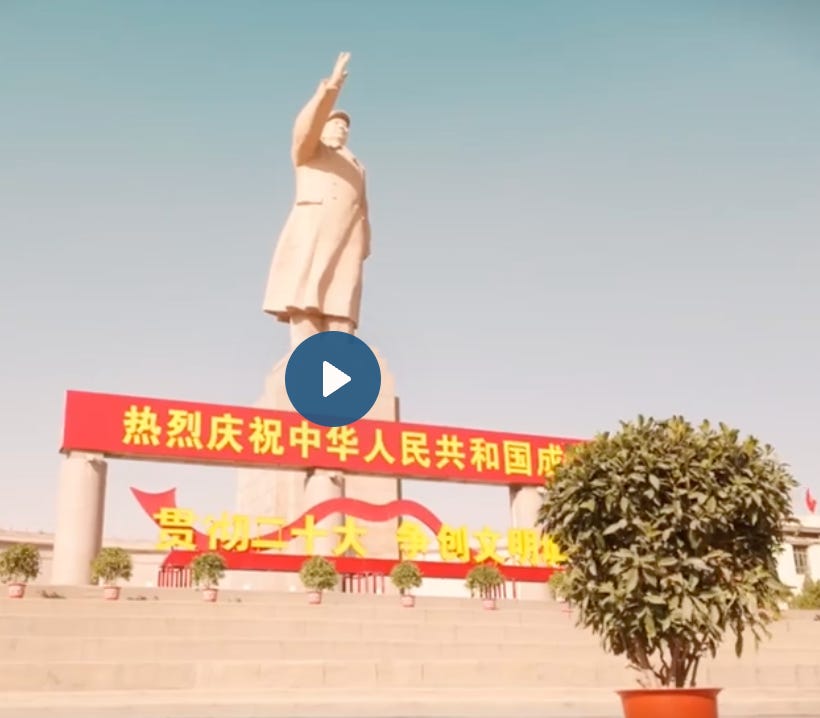
Again invoking the pretext of getting beyond Western propaganda, the show notes promise
a more nuanced view, pushing back against the mainstream hysteria and oversimplified tales by highlighting overlooked truths like how Mao rallied China against foreign domination, ignited rapid industrialisation, and laid groundwork for unity and progress, even as his bold moves sparked massive upheavals often exaggerated by the West.
Those “bold moves” involved starving 30 million people to death over three years, as Zha notes at one point, causally adding that Mao may “not have known” about the deaths in the first year (49:45). Nevertheless, the show notes emphasise that many Chinese today see Mao as “a visionary who transformed a fractured nation into a powerhouse.” The famine was just part of the “era’s harsh realities.”
The overall tenor of Part 3 is to rehabilitate Mao’s legacy. Whatever took place during the Cultural Revolution (jokingly [?] referred to by Nell as “a positive” at one point [59:30]) and the Great Leap Forward was just the preamble to the rise of China as an economic powerhouse today. Mao did the necessary groundwork to enable this to happen.
“Today the memory of famine and cultural revolution [is] fading,” Zha explains (01:01:50). Young people know only the triumphs of the present; they are “result-oriented” and “not as affected as much today” by what took place in the past. Instead, they “see Mao as the man who unified China after the century of humiliation.”
This is historical revisionism, aimed at whitewashing atrocities that took place on an almost unimaginable scale.
Nell states that “Mao is revered” (59:30). Had Mao died in 1949, Zha claims, he would have “died a saint.” Had he died in 1956, before launching the anti-rightist campaign (1957-1959) and the Great Leap Forward (1958-1962), he would have been remembered as “a flawed hero.” Had he died in 1966 (the start of the Cultural Revolution), he would still have been seen as “a great man with a complex legacy.”
A “saint,” a “hero,” a “great man” even after the Great Leap Forward. This is out and out propaganda. Zha even cites the official line that “Mao was 70% good, 30% bad.” “Unfortunately Mao died in 1976,” he adds, prompting lots of laughter, as though Mao’s legacy were in any way amusing.
“Let’s say Mao made some mistakes,” Zha proposes, trivialising the deaths of 30 million people. The Great Leap Forward and the Cultural Revolution were merely “great setbacks, a big distraction” in China’s rise to a position of power and prosperity.
It is hard to imagine more obvious Chinese propaganda than what we encounter in Part 3.
Conclusion
In my Guide to Identifying Camp 2, I expressed concern about journalists accepting paid trips to Russia and China and then reporting favourably on what they experienced. I asked, in theoretical terms, how exactly this differed from foreign propaganda.
Despite Nell’s indignation and public attack on me for mentioning his name in that context, I believe I have demonstrated, in empirical terms, that his trip to China did indeed result in content that is scarcely differentiable from Chinese propaganda, disingenuously packaged as “getting beyond Western propaganda.”
It is unsurprising that this is so. Nell simply coupled some plausible critiques of Western power with giving free rein to a man who has been suspected on multiple occasions, and for many years, of being a CCP propagandist. Being a foreign journalist in China, he was not allowed to question Zha’s pro-CCP views.
The fourth and final part of Nell’s China series, titled “Pepe Escobar on the importance of BRICS,” is less overtly propagandistic, but is still a defence of multipolarism, a concept which Hrvoje Morić has done an exemplary job of critiquing as globalism by the back door. With a South African interviewing a Brazilian in China, this was perhaps to be expected.
Part 4 contains lines such as “They don’t realise how powerful China has become.” Escobar claims that a centrally planned economy with successive five-year plans was necessary for China’s rapid rise. Chinese SUVs, smart phones, and hotels are “better than anything the West has to offer, for excellent prices.” There is a “stark choice between what the [US] empire wants and what most people want.” “My next car will be Chinese,” Nell promises. It is wearily predictable.
Nell’s China-friendly, pro-multipolar approach has since continued in such pieces as “Why it is okay to be pro-China,“ “Is It Really China Trying To Control Africa?,” and "Why Multipolarity is better than sliced bread."
He also seems to be quite friendly towards Russia, judging by his interview with Simon Roche, who, according to the show notes, “reflects on the nostalgia and warmth he felt in Russia, contrasting it with stereotypes often portrayed in the West.” Roche “expresses admiration for the Russian people’s morality and orderliness, which he finds appealing compared to Western perceptions.” He observes “the sophistication of Eastern civilisations compared to the West, particularly the United States, and discusses the cultural and economic decline of the West.” Russia good, West bad: it is the same modus operandi.
Part 4 will deconstruct Nell’s hit piece on me, showing for the record how weak it was and asking what motivated it.
Support My Work
If you valued this content and are not a paid subscriber, please consider leaving a one-off tip for an amount of your choosing.
If you would like to make a one-off or recurring donation to help fund my work in general, I would be most grateful. There are numerous ways of doing so, including wire transfer, Paypal, crypto, UK cheques, and BMC.
If you have not done so already, please consider taking out a subscription to davidahughes.net or upgrading an existing one – free, paid, or gold-tier.