Jeremy Nell, Marcel Jahnke, and China - Part 1
Part 1 - Chinese J Visas and the Escobar Project
Update
Unfortunately, I have decided to publish new content simultaneously on my website and on Substack, sending the notification through Substack. This is because, after four months, the view counts on my website are only 20-25% as high as they were on Substack. Consequently, I am struggling to expand my reach.
However, all paid subscriptions will still go through my website, not Substack, and the comments section will be available for paid subscribers on my website, not Substack.
Introduction
On the morning of Monday March 2 (beginning at 06:34 GMT), I received a hostile series of emails from Jeremy Nell (aka Jerm Warfare), aggressively trying to get me to come on his show the next day.
Replying that the emails were unprofessional and narcissistic in tone, and that it felt like the kind of ambush the BBC would attempt, I declined the invitation and did not mention it publicly.
16 days later, Nell published a hit piece on me titled “Dismantling the ‘three camps of awareness’ nonsense.” Noting that I had declined his invitation, he claimed that he would not divulge my reasons out of respect for my privacy. Well, now you know the reasons.
The strapline of Nell’s hit piece read: “A former guest on my podcast, David Hughes, wrote a bizarre article in which he questioned my independence—hinting that I might be controlled opposition.”
The reader might be forgiven for thinking that I had written a hit piece on Nell, not vice versa, and that its main theme was him (“my podcast,” “my independence,” “I”).
In reality, in my 5,500-word Guide to Identifying Camp 2, I mentioned Nell’s name once – not by way of personal attack, but in identifying a trend of commentators in the “alt media” who had recently accepted paid trips to Russia and China and reported favourably about what they had experienced there. Given the tight reporting restrictions on foreign journalists in those two countries, I asked how such reporting differs from Russian/Chinese propaganda.
In this four-part series, I not only respond to Nell’s hit piece, but I also dig deeper into his trip to China. In this part, I consider Chinese visa requirements for foreign journalists and the Pepe Escobar documentary project in which Nell was participating. In Part 2, I consider the role of Marcel Jahnke as a likely funder of the project, as well as his widespread stealth involvement across the “independent” media. In Part 3, I analyse the content of Nell’s videos filmed in China. In Part 4, I deconstruct Nell’s hit piece on me.
Applying for a Chinese J-2 Visa
In the part of my Guide to Identifying Camp 2 where I mentioned Nell, I asked a very simple question:
Particularly for countries like China and Russia, from which Western journalists may only report with state approval, who arranged the necessary visas, to what end, and in what sense can the “journalism” produced still be deemed “independent”?
For example, for a South African journalist to obtain a Chinese J-2 visa required for a stay of 180 days or less, it is necessary to obtain a
Visa Notification Letter by the Information Department of the Ministry of Foreign Affairs of China or other authorized units in China and an official letter issued by the media organization for which the journalist works.
This requirement renders it virtually impossible that any reporting by a foreign journalist from China will be critical of the regime, particularly when it comes to politically sensitive topics. The restrictions on foreign journalists in China are well known.
Accordingly, contrary to Nell’s claim that he “had the freedom to share [his] opinion—both good and bad,” his reports from China do not display any meaningful “independence.” There is no substantive criticism of the regime, not even when it comes to 30 million deaths under Mao (just part of "the era's harsh realities"). The furthest he goes is in expressing a dislike of all the CCTV cameras, but even that is couched in reassurances about how “safe” he felt in China compared to South Africa.
The other part of the above requirement for a J-2 visa is for an “official letter issued by the media organization for which the journalist works.” In Nell’s case, this was presumably UK Column, where his reports were published.
The Escobar Project
Nell’s explanation for why he was in China (not that I ever asked or cared) is that
I was part of a team creating content—available on my UK Column page—for Pepe Escobar’s upcoming book and documentary about the history of the Silk Road and Belt & Road Initiative, which is why we went into the desert and villages of Xinjiang.
So, although he does not say so in his four video reports, he was part of a project that appears aimed at promoting the Belt & Road initiative. Again, the CCP would not have allowed that project were it intended to be critical or negative.
The scale and cost of the project can be gauged from snippets of Nell’s reports. For example, after he and Carl Zha get out of their transport vehicle in Part 2, Nell pans the camera to reveal that it is part of a convoy (01:25:00).
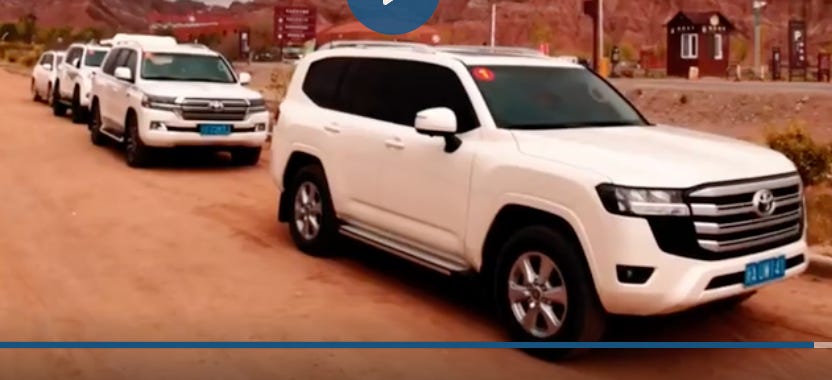
How many people were involved in the project? Along with Nell, Zha, and Escobar, there is reference to a “tour guide,” a “film crew,” a Russian photographer, and someone getting into trouble for sending up a drone. Each vehicle must have had a driver.
Zha’s use of the term “tour guide” is telling, and Nell was quick to interject “You said tour guide, but it makes us sound like we’re in North Korea [...] This is a private tour group, not a state-sanctioned tour group” (01:27:50). An unfortunate slip of the tongue, perhaps, but it does little to alleviate the impression of a state-sanctioned project backed by private finances.
At one point, it is made to look as though the group might get into trouble with the authorities (01:28:30). Drones were not allowed to be flown with Xi Jinping in the region at the time, and police made sure the group’s drone was quickly taken down. “The cops just drove past, which is why I dropped [lowered] the camera,” Nell claims, as though he were doing something subversive. It is all rather embarrassing.
How much did it cost to transport, feed, and accommodate all the people in the convoy, not to mention vehicle hire and petrol? The distances covered were vast: at one point, Nell mentions driving across the desert for 11 hours. Is this the kind of project that independent journalists could pay for?
Although Nell and Zha go to a cheap diner in Part 1, they emerge from a fancy-looking hotel in Shanghai. Money does not seem to have been an obstacle to whomever was paying.
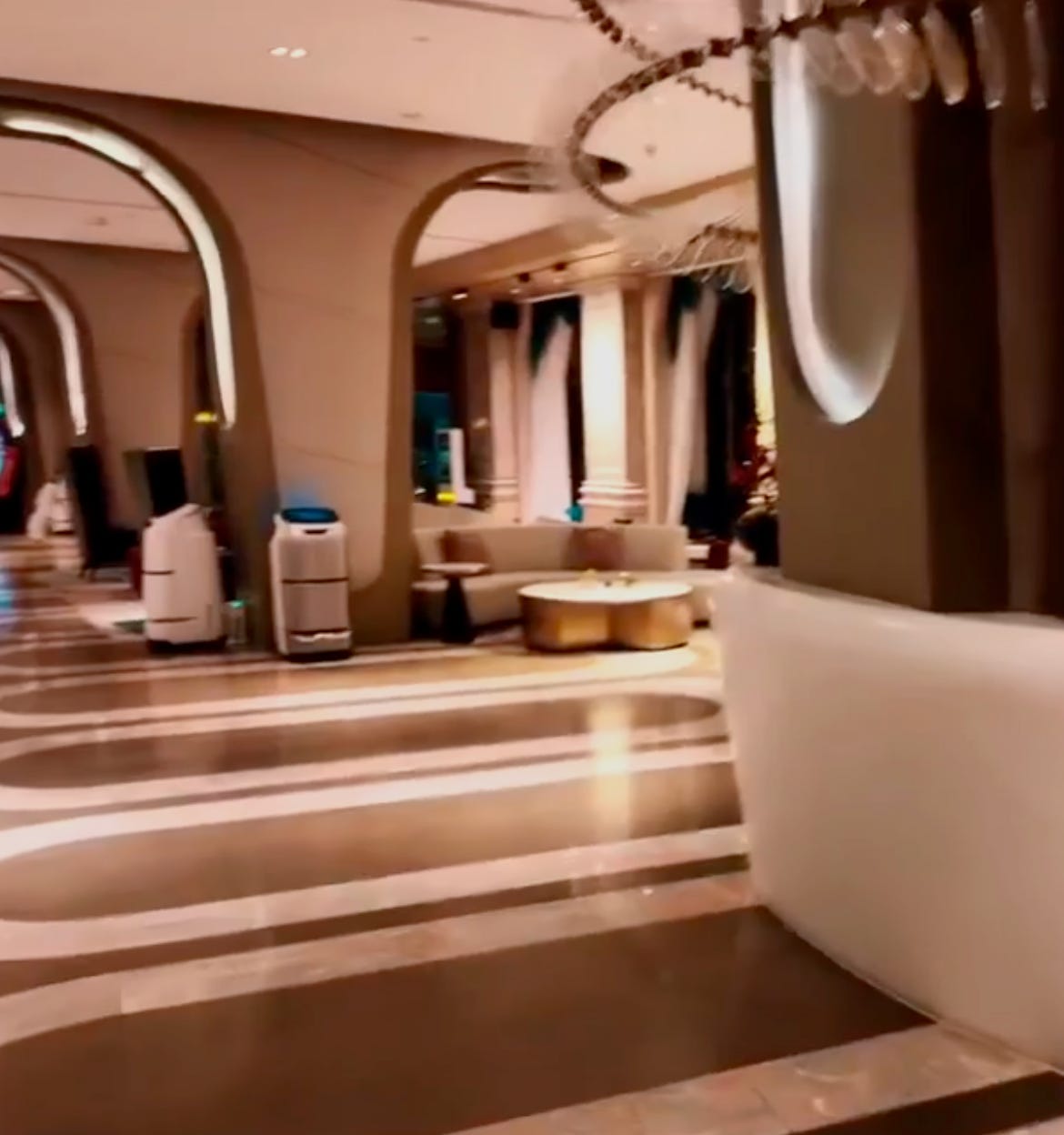
At one point, Nell claims “We’re flying multiple flights within China.” That was presumably in addition to a return flight from South Africa. He later claimed to have been in China for a month.
Despite taking umbrage at me for mentioning his name in a section of my Guide to Identifying Camp 2 titled “Paid Trips Abroad,” at no point has Nell denied that his trip was paid for, nor has he claimed that he paid for it all himself. So, who did pay for it, and to what end?
Support My Work
If you valued this content and are not a paid subscriber, please consider leaving a one-off tip for an amount of your choosing.
If you would like to make a one-off or recurring donation to help fund my work in general, I would be most grateful. There are numerous ways of doing so.
If you have not done so already, please consider taking out a subscription or upgrading an existing one – free, paid, or gold-tier.