Where the Weapons Located that Destroyed the Twin Towers?
Conventional nuclear weapons were not used, yet some of the observed effects were similar. What does this mean?
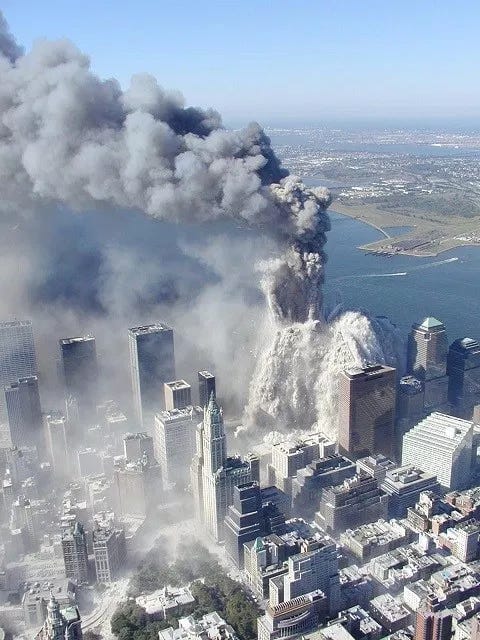
Introduction
The evidence compiled by Dr. Judy Wood in Where Did The Towers GO? (2010) points strongly towards low energy nuclear reaction (LENR, colloquially known as “cold fusion”) technology having been used to destroyed the Twin Towers.
One question which Wood does not address, however, is where the weapons that destroyed the Twin Towers were located. There is, nonetheless, plenty of evidence that can be examined when it comes to ascertaining the locations of those weapons.
Wood rejects the “mini nukes” hypothesis (Wood, 2010, pp. 121-22), and it certainly true that conventional nuclear weapons of whatever size were not used on “9/11.” Unlike such weapons, whatever destroyed the Twin Towers generated no searing heat, blinding light, or ionising radiation, and there was no massive blast crater or large seismic signal.
That said, many of the observed effects of the destruction of the Twin Towers did resemble those of nuclear weapons, and this probably explains why the “mini-nukes” hypothesis has persisted despite the evidence against conventional nuclear weapons having been involved. Those effects include:
- massive releases of energy
- dust clouds that appear to resemble those from previous nuclear weapons tests
- ejections of material that appear to resemble rocket exhaust trails
- “fountain”-like patterns of destruction appearing to emanate from a single point.
Again, to be clear, conventional nuclear weapons were not used on “9/11.” But whatever was used to destroy the Twin Towers did bear certain similarities to such weapons.
Given that Low Energy Nuclear Reaction technology is a form nuclear technology, it should perhaps come as no surprise that a weaponised version of such technology would, in certain respects, resemble conventional nuclear weapons while differing in others.
Contrary to official claims that “cold fusion” does not exist, we know that LENR was on the books as a potential form of weaponry pre-”9/11” from leaked NASA slides dated June 2001:
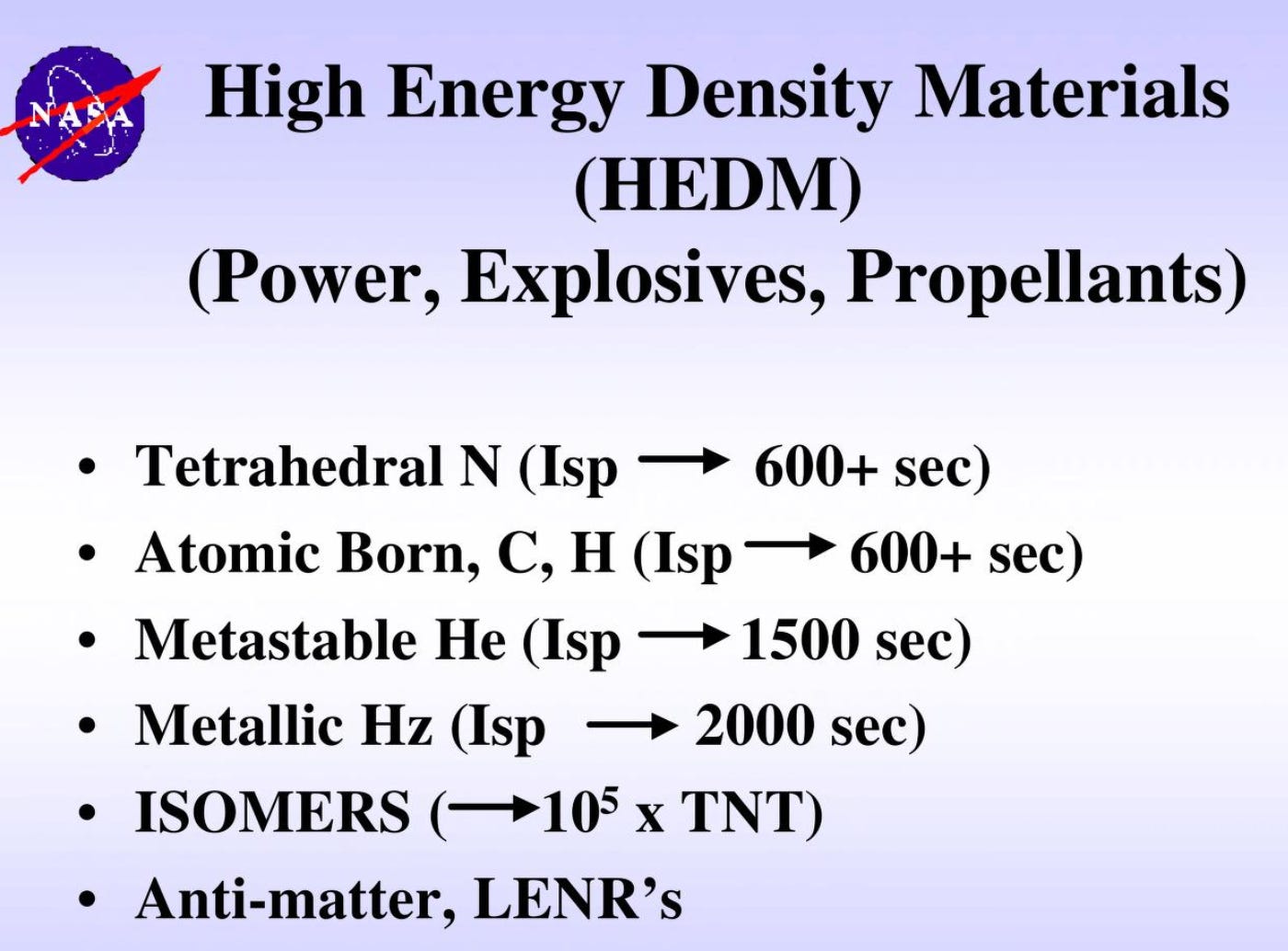
My contention is that LENR technology was placed at the bottom centre of each tower (possibly underground) and that it operated much like conventional nuclear weapons in terms of a massive upwards energy release, although it evidently lacked most other signatures of such weapons.
Superficial Similarities to Conventional Nuclear Weapons
To see why critics have suspected that conventional nuclear weapons were used to destroy the Twin Towers, consider the following evidence.
“Rocket Exhaust Trails”
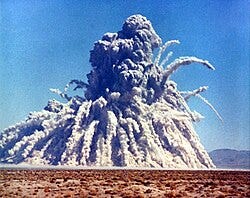
Critics have drawn attention to possible rocket exhaust trails generated during the destruction of the Twin Towers. For example, here is the Storax Sedan test in Nevada in 1962:
And here is a 110-story steel-framed skyscraper being mostly turned to dust in mid air on September 11, 2001:
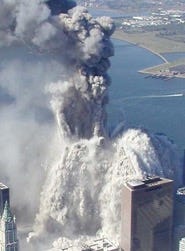
The similarities are unmistakable with the upper cloud rising from the centre while material is ejected upwards and outwards with phenomenal amounts of energy.
Dust Clouds
Here is the dust cloud generated by the Met test in 1955:
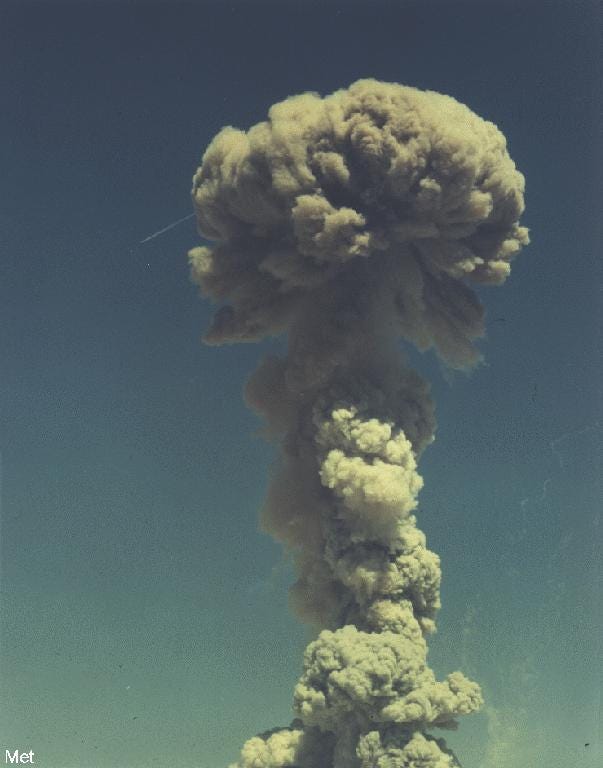
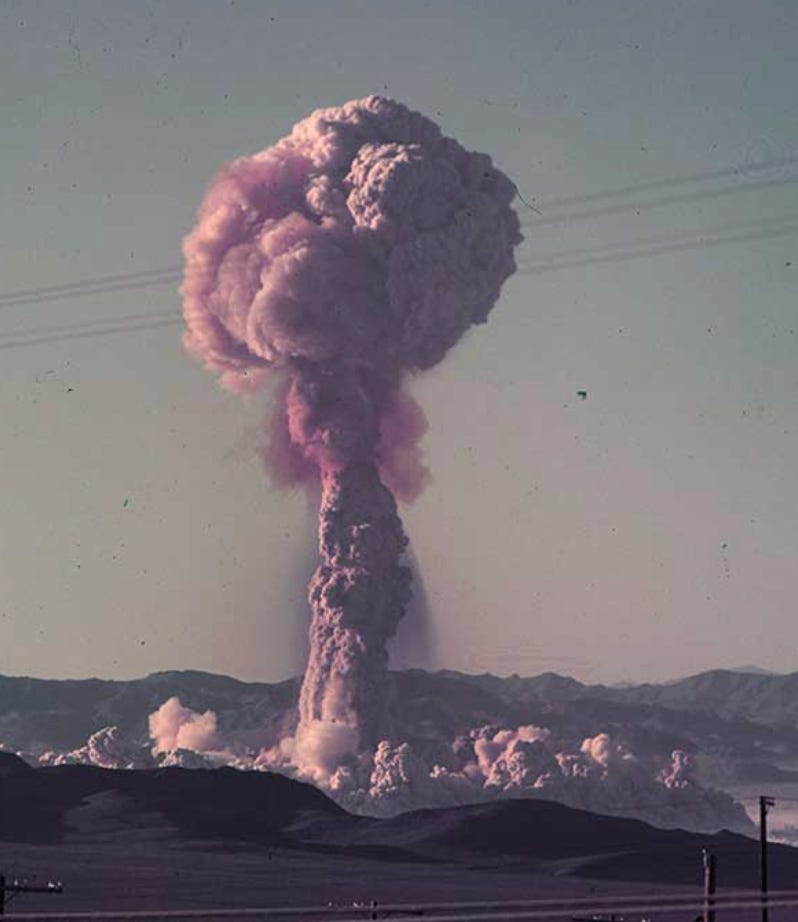
It resembled the cloud from the Plumbbob test of 1957:
Below is a series of images of the destruction of WTC1 captured by NYPD’s Dave Fitzpatrick from detective Greg Semendinger’s helicopter:

The “mushroom cloud” appearance is undeniable, even though we know that conventional nuclear weapons were not used.
Although WTC7 is not the subject of this article, Heinz Pommer additionally draws attention to the dust cloud generated by the destruction of WTC7:
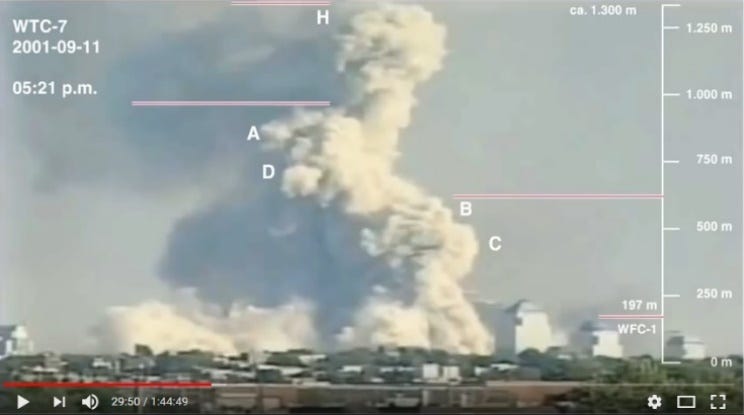
He compares the WTC7 cloud to the Nancy test of 1953:
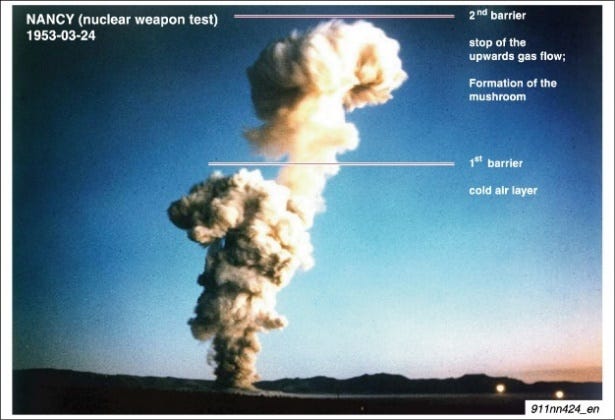
At the very least, there was a gigantic release of energy when WTC7 was destroyed, and the dust did not simply settle down to the ground as it does in controlled demolitions.
Evidence of Detonation from a Low Central Point Within Each Tower
Despite superficial resemblances to conventional nuclear weapons, whatever destroyed the Twin Towers lacked most of the key signatures associated with such weapons, thus ruling them out as the cause of destruction.
Although I am going to draw further on Pommer’s work, an important caveat must be provided. Pommer proposes a model of uranium-based nuclear fission requiring a reaction of thousands of degrees Fahrenheit. That is obviously not credible based on observable primary empirical evidence regarding temperatures (see my section on temperatures here).
Nevertheless, Pommer does present some important and valid observations regarding the physical aspects of the destruction of the Twin Towers, some of which I include below. I share his belief that whatever weapons were used must have been placed at the bottom centre of each tower.
To see why, let us work our way from top to bottom down the towers as they were destroyed.
The Upper Floors
Whatever destroyed the Twin Towers was powerful enough to separate the top 30 or so stories of WTC2 from the rest of the building, which then rotated eight degrees (i.e. acquired torque) before disappearing into the dust cloud.
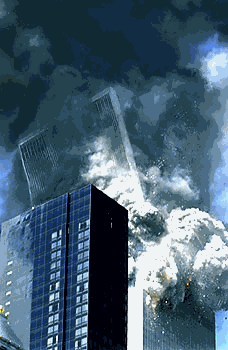
This is consistent with a massively powerful upwards force knocking the top section clean off the rest of the building.
For WTC1, the destruction of the upper floors appears to have proceeded along a mostly vertical axis).
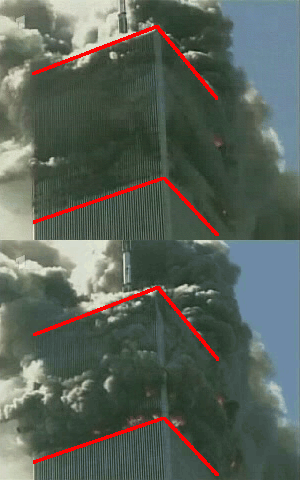
The upper floors were not blown apart with the same kind of horizontal and even upwards force (in the ringed area below) as the lower floors.
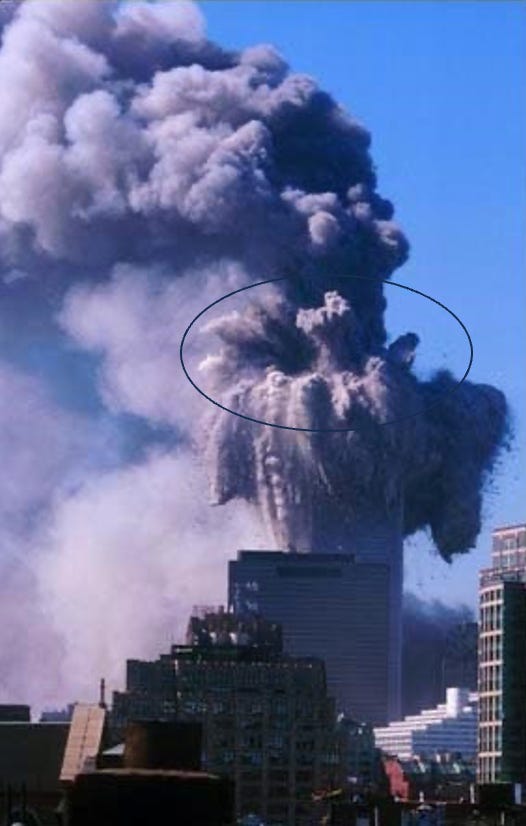
This is consistent with an extremely powerful upwards stream of energy that dustified the upper floors while escaping at the points of the “plane” impacts. One gets a sense of this from Pommer’s diagram below:
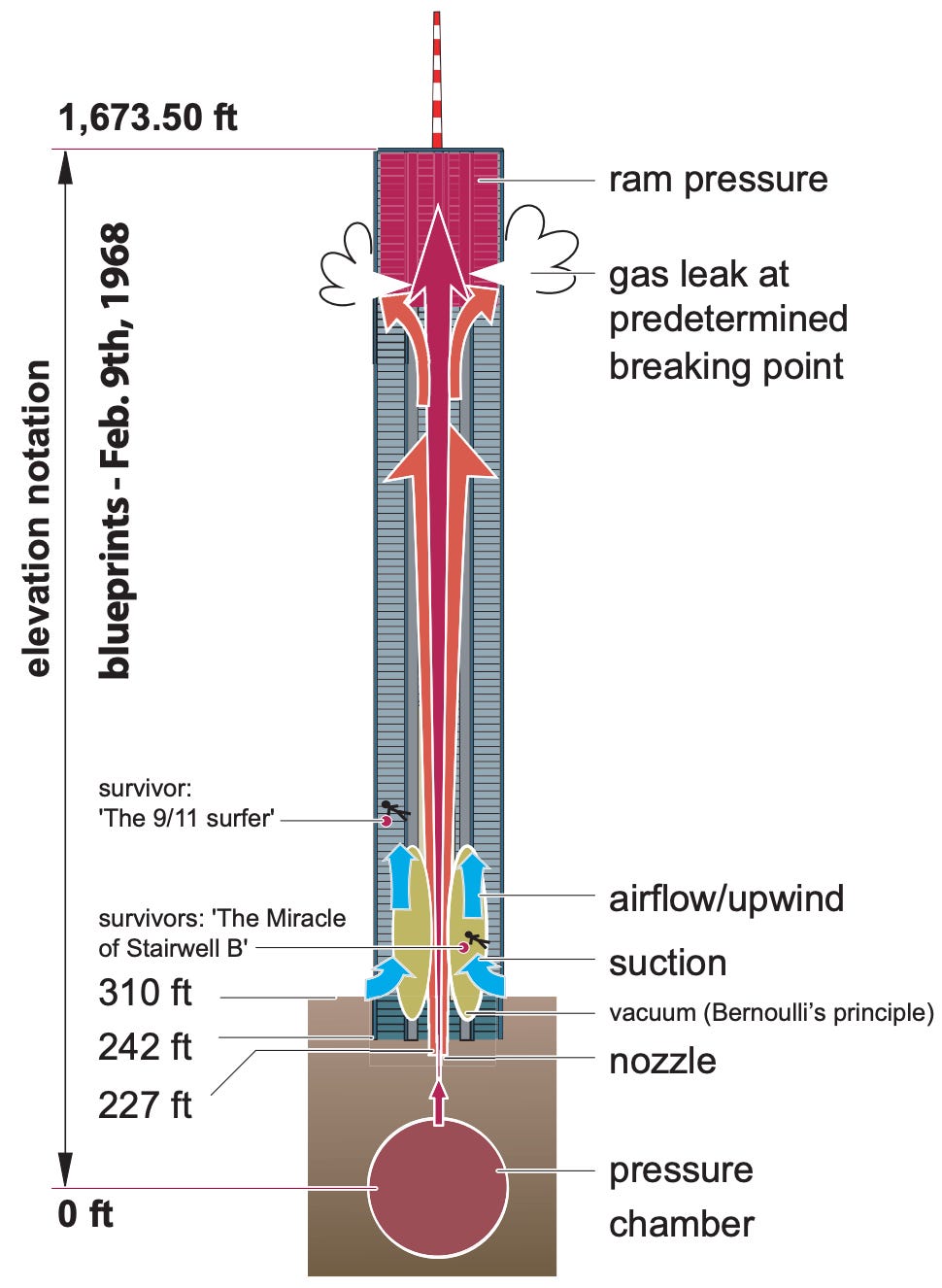
One need not subscribe to Pommer’s view that some kind of superheated reaction was taking place to see that the vectors shown make sense.
The differences between the destruction of the upper and lower floors is important, because they indicate that the Twin Towers were not destroyed in a uniform manner, e.g. by field effects acting similarly on all parts of the towers.
Floors Being Blown Out
Pommer makes an important point with respect to the appearance of explosions detonating rapidly downwards as each tower is destroyed (46-47 mins):
A serious analytical error in the 9/11 research is the interpretation of the observed destruction of the individual floors, which are usually cited as proof of a synchronously controlled ignition of hundreds of explosive charges. As a matter of fact these are NOT explosive charges that were detonated with a short time delay from top to bottom. Rather, it is the delayed structural failure of the individual, outer steel segments. (Pommer et al. 2020, p. 84)
Those segments, Pommer notes, resist the growing internal pressure, per floor, for about a tenth of a second and are then torn apart segment by segment.
Again, this makes sense if a massively powerful force emanating upwards builds the pressure inside the tower, which finds release at the “plane” impact levels, dustifies the upper floors that are directly in line, and then proceeds to blow apart the rest of the tower in a top-down manner.
The massive volume of rapidly expanding dustified material inside blows the weakest sections of the outer walls out, which are always the ones at the top, since they are attached to nothing above.
The Fountain Effect
The Twin Towers were symmetrically blown apart from a central axis with incredible force, generating a “fountain effect” following the destruction of the upper floors.
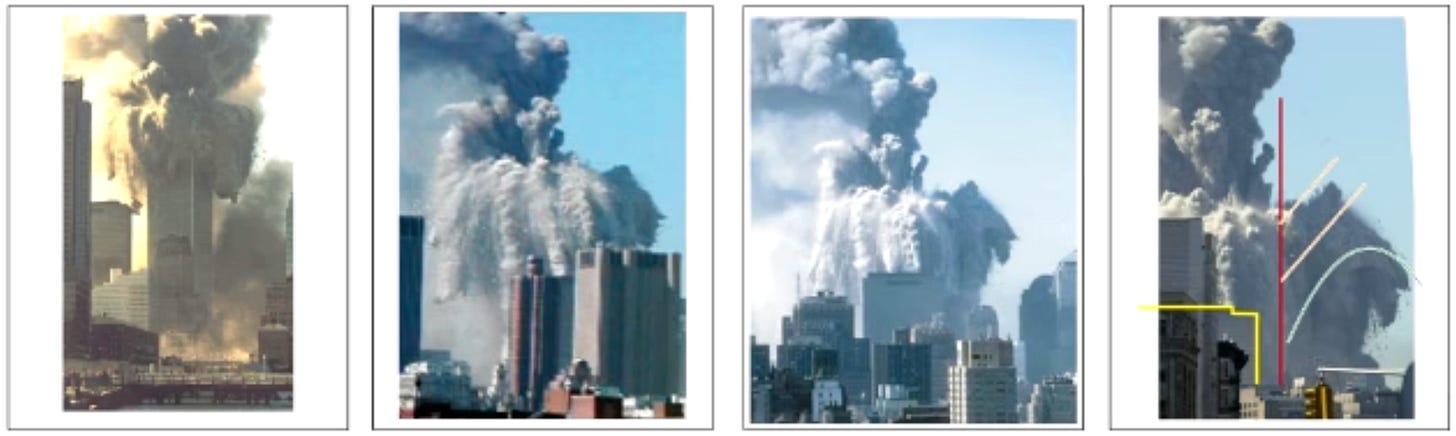
As Pommer notes,
We see a clear eruptive behavior, material is shooting up and out —forming a giant fountain of dust and debris. In physics we call it: a vertical momentum upwards in a gravitational field. (Pommer et al. 2020, p. 40)
The “vertical momentum upwards” requires an upwards vector of force.
The fountain-like pattern of destruction is especially evident in the lighter dust in the photograph below, with massive amounts of material being ejected upwards and outwards before falling to the ground. (The darker dust in the middle behaves differently.)

The “Spire”
An upwards blast hypothesis is consistent with the momentary appearance of “the spire,” an outer wall (not core column) segment shaped in accordance with the v-shaped blast pattern before quickly losing molecular integrity (Pommer et al. 2020, 169-70).
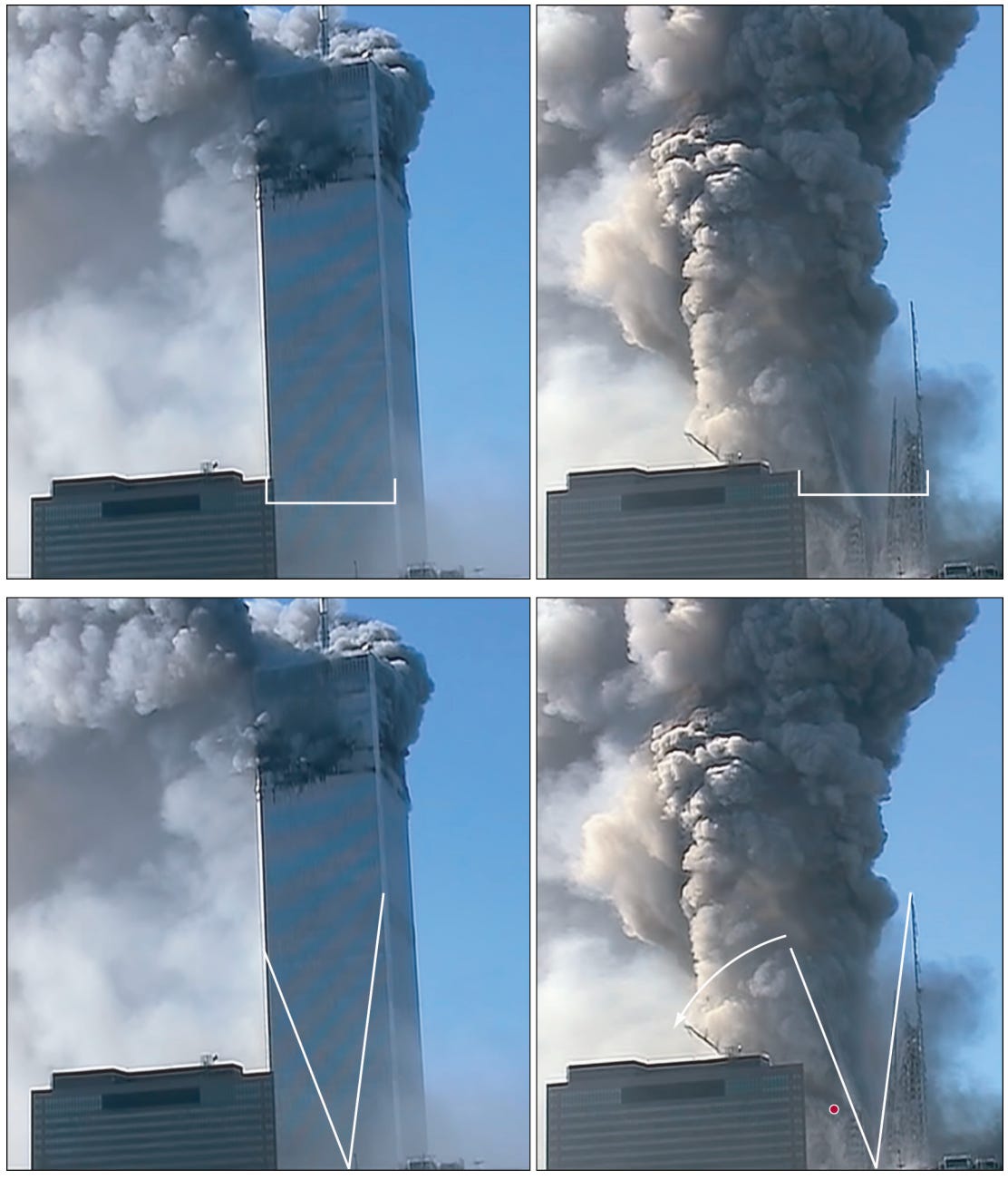
With the outer walls gone, the dustification of the core of the towers was clearly visible. In the photograph below, there even appear to be lines of destruction emanating from a central point towards the bottom:
Survivors on Stairwell B
Weapons placed near the bottom centre of each tower could explain the survivors on Stairwell B of WTC1, who were about “30, 40 feet” above ground (cf. Wood 2010, pp. 181-84).
The basic idea is captured in the following snippet from Pommer:
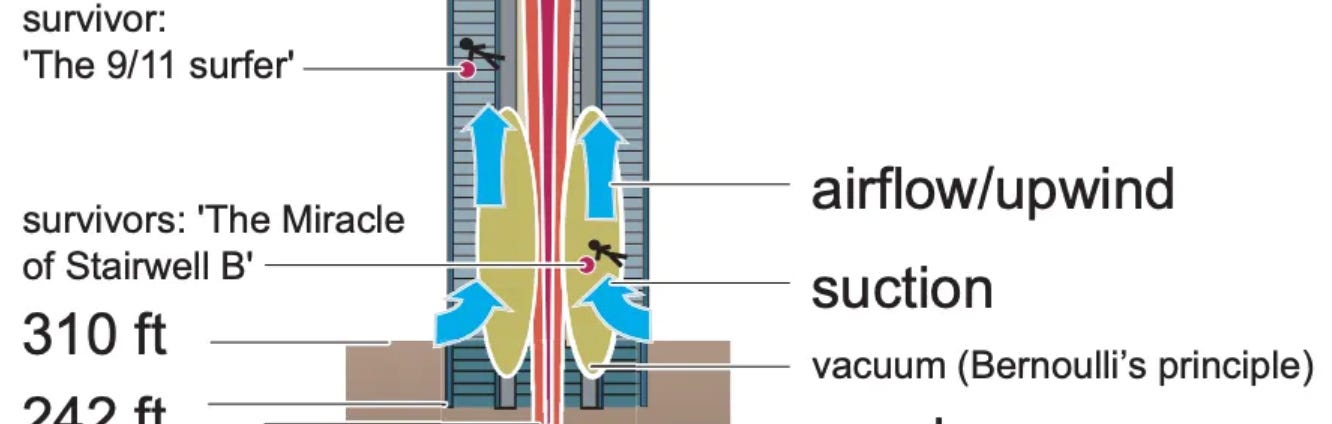
The “surfer” in the diagram refers to Pasquale Buzzelli, who claims to have been on the 22nd floor of Stairway B when WTC1 was destroyed and to have ended up as one of the Stairwell B survivors. Genelle Guzman-McMillan, who was with him at the time, claims they were on the 13th floor.
The remains of Stairwell B were barely higher than the lobby, as shown below:
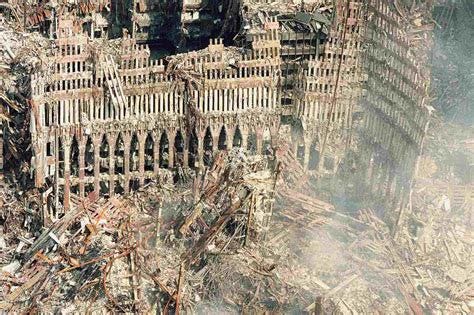
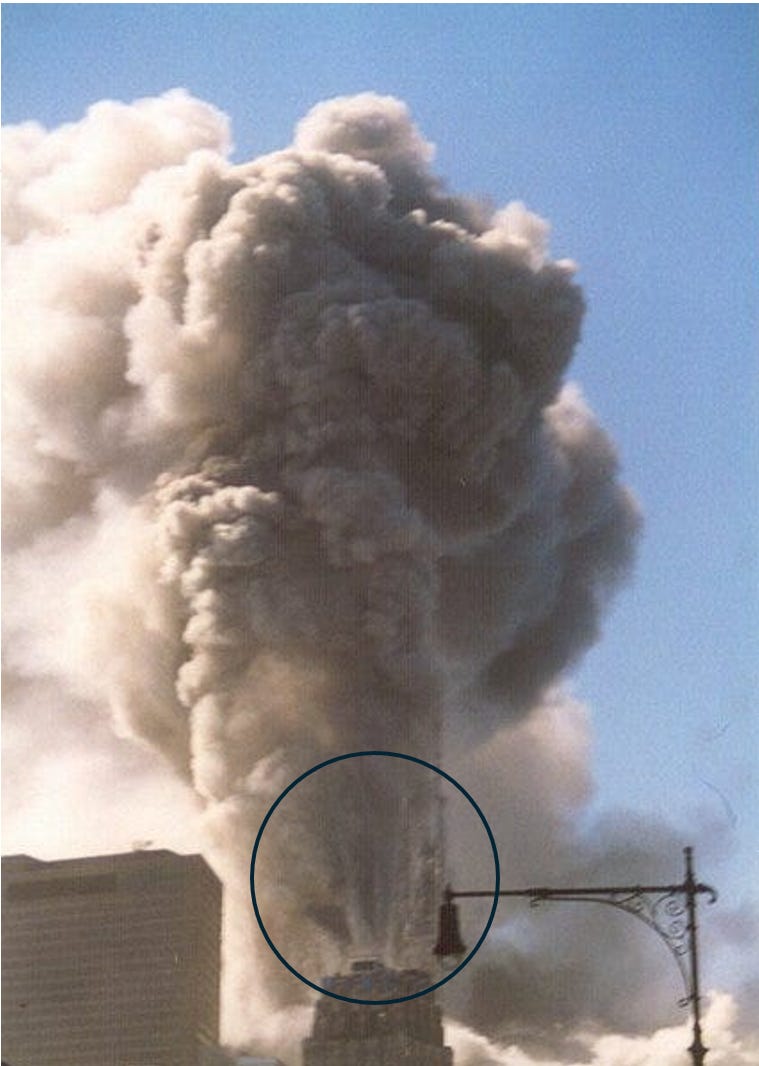
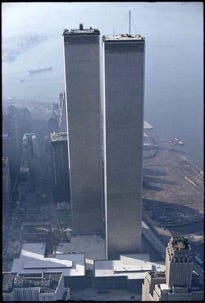
The survivors on Stairwell B were therefore located very low down in relation to the height of the building (only the fourth floor, according to Port Authority Police Lt. David Lim, who was one of the survivors). To give a sense of scale, the lobby area of WTC1 (with the antenna) is almost invisible beneath WTC6 in the photograph below.
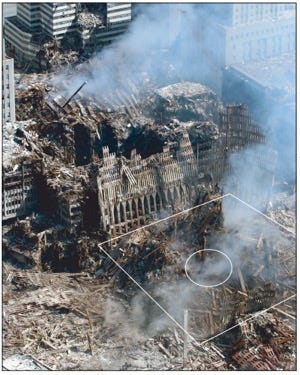
It thus becomes possible to see how an upwards blast of energy (at 23 mins) spreading outwards from a central point at ground level (Pommer’s circle below) could not only have missed the Stairwell B survivors just off to the side but may even have shielded them by ejecting dustified material above them upwards and outwards.
One of the Stairwell B survivors, Mickey Kross, recalled that, having reached the third floor,
I heard this very, very loud noise above me. It was just a tremendous roar….it sounded like it was coming towards you. And then the wind, a very, very fierce wind. It started lifting me up off the ground.
That uplift is again consistent with a force acting upwards.
The Lower Outer Walls
An upwards blast of some kind would also explain why lower sections of the outer wall were left standing instead of buckling or being crushed by the force of the building coming down (or indeed being blown apart by “explosives”).
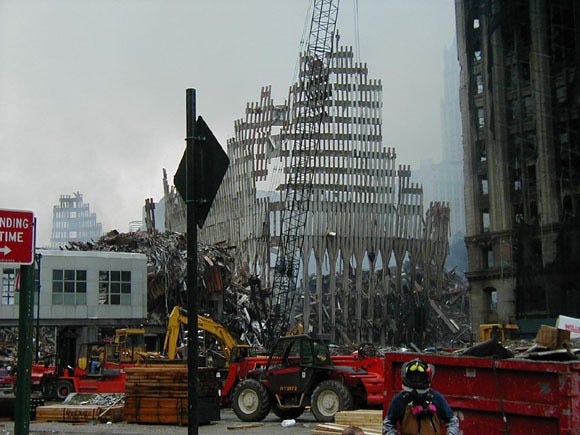
These remnants were evidently not crushed by a “collapsing” building “pancaking” down upon itself. Indeed, had 110 stories of material really undergone a gravity-driven collapse, with the mass of each successive floor progressively adding to the downwards momentum, ploughing through the path of maximum resistance until most material was “pulverized” at the bottom, there is no chance that the trident beams would have survived.
In contrast, weapons placed at the bottom centre of each tower firing upwards would make the lowest parts of each tower the least likely to be damaged.
Where Exactly Were The Weapons?
Despite the above evidence that the weapons used must have been placed near the bottom centre of each tower (possibly underground), we can rule out the most obvious location, which would have been at the bottom of Stairwell B in the place ringed below:
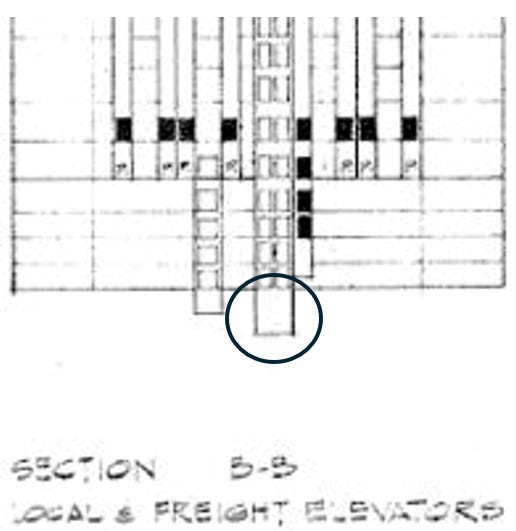
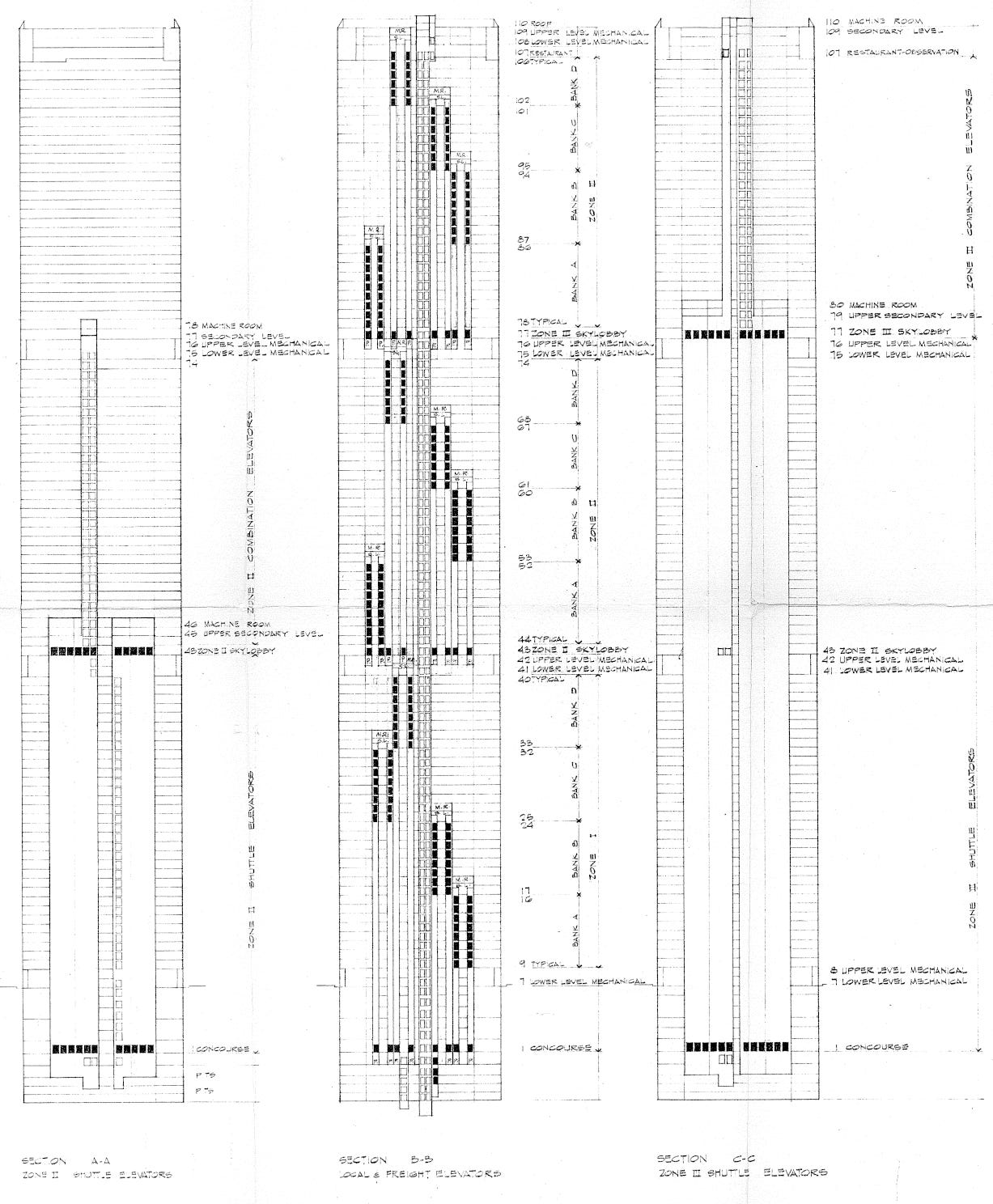
As can be see from the full schematic below, Stairwell B extended from the very bottom to the very top of each tower:
It was almost exactly central:
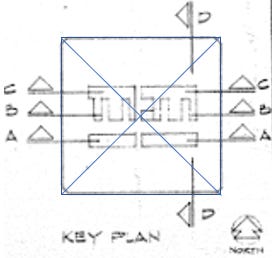
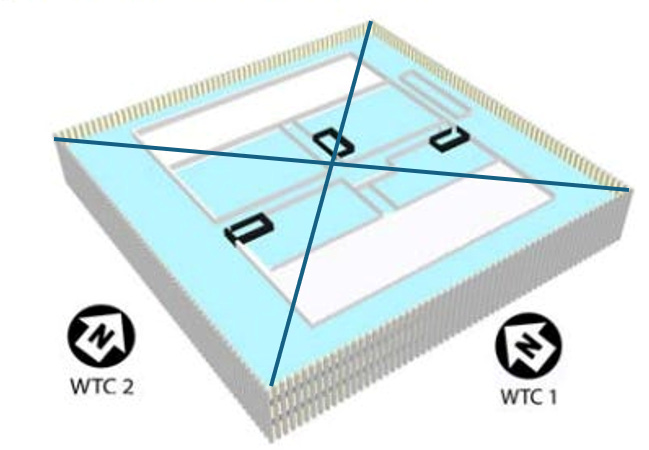
The only horizontal motion involved on Stairwell B was on Floor 76. Otherwise, it ran straight from top to bottom, close to dead centre. Below it is marked in purple.
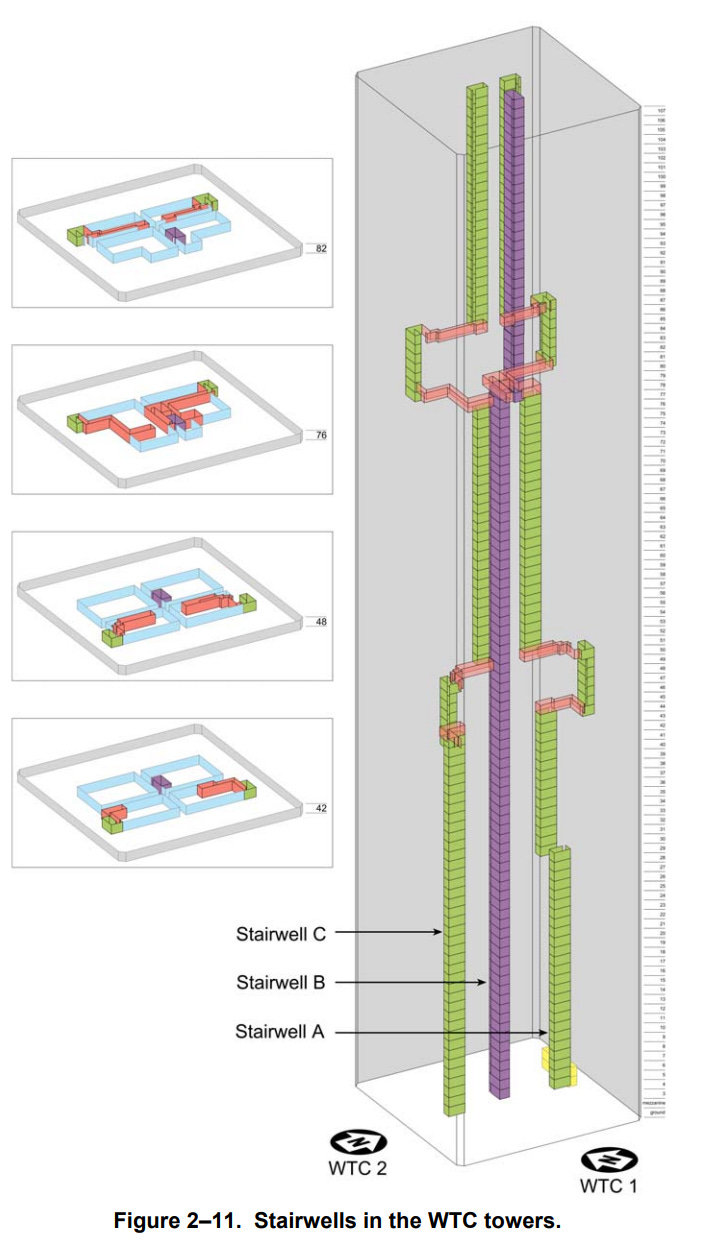
However, we know that the bottom section of Stairwell B of WTC1 survived, along with some survivors whose accounts are mutually corroborating and supported by additional evidence such as FDNY Ladder 6 Company Operations Report from the day itself. Therefore, we must rule out Stairwell B as the “chimney” through which the energy from the weapons passed.
Logically speaking, the next closest “chimneys” to the centre of each tower would be the local elevators marked on cross-section B-B above. These are easier to see on the below diagram from NIST.
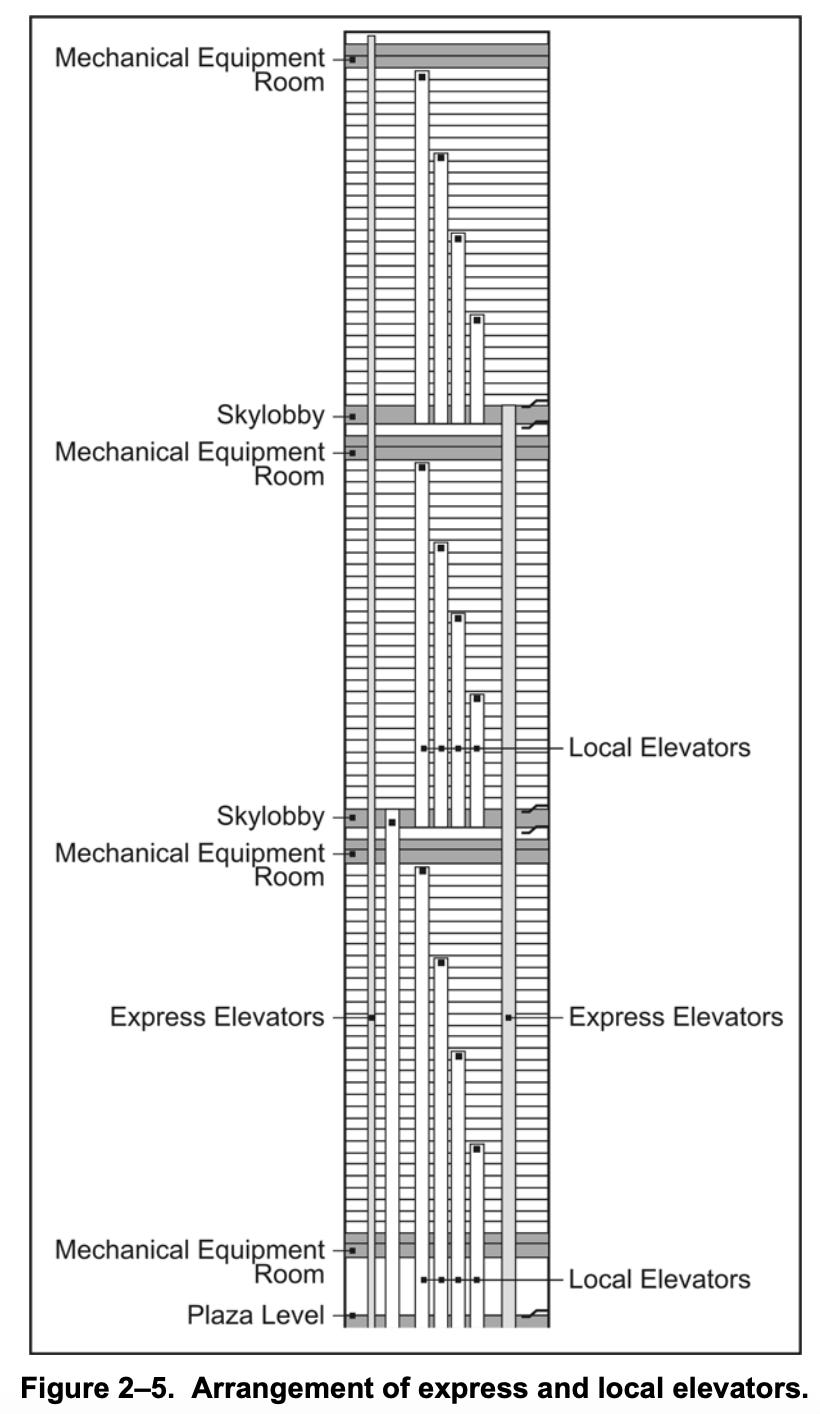
Pommer proposes that explosives may have been used to create a “chimney” between the central elevator shafts.
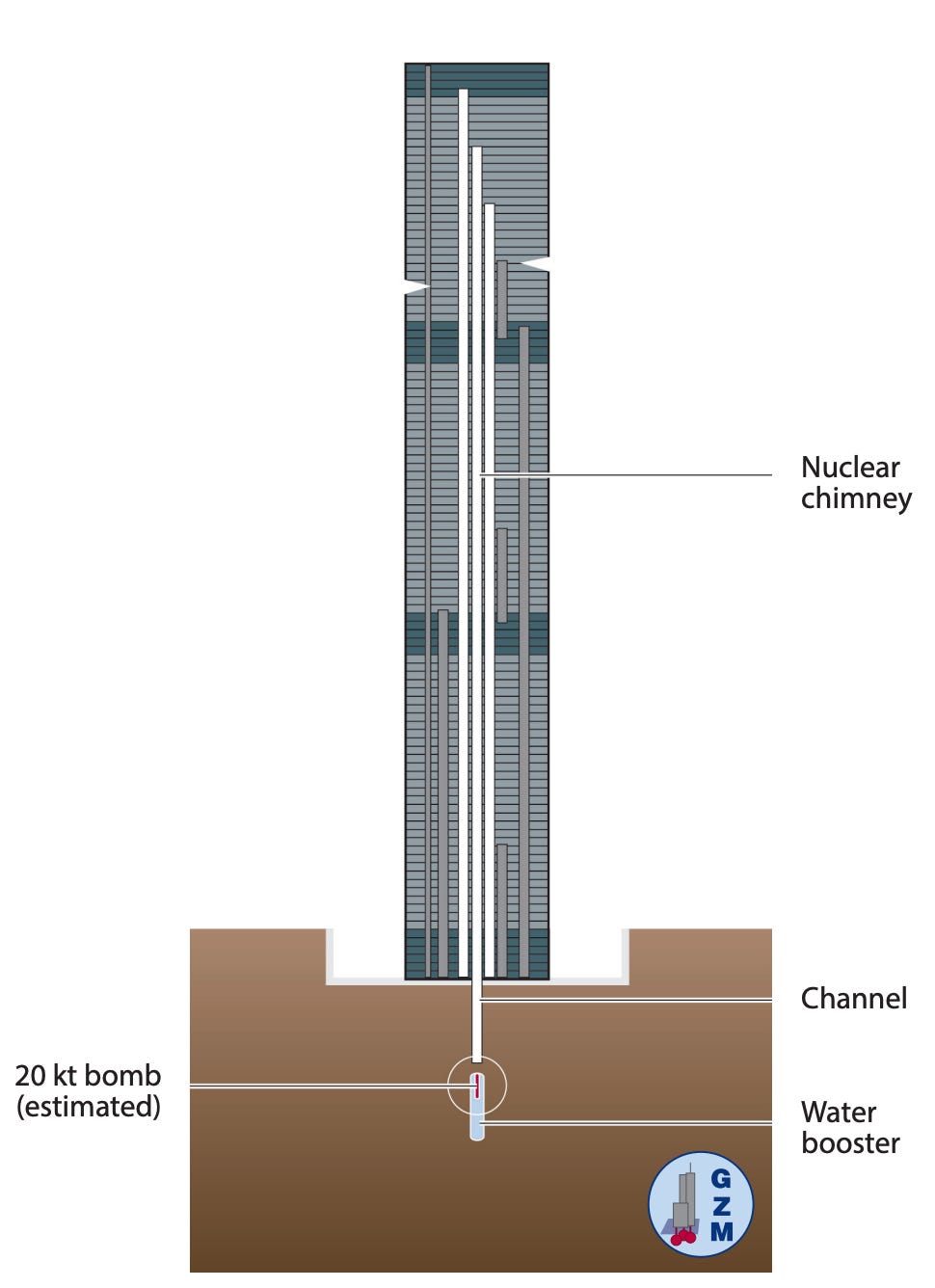
The use of explosives to create a “chimney” would be consistent with reports of explosions prior to the destruction of the Twin Towers, although this is somewhat speculative.
Conclusion
A quarter of a century later, it is troubling that we still do not know how exactly the Twin Towers were destroyed, or by whom. This speaks to the power of the transnational deep state, not only to carry out such operations, but also to manage public perception successfully so that all that is left of the “9/11 truth movement” is infighting, name-calling, and deliberate distraction.
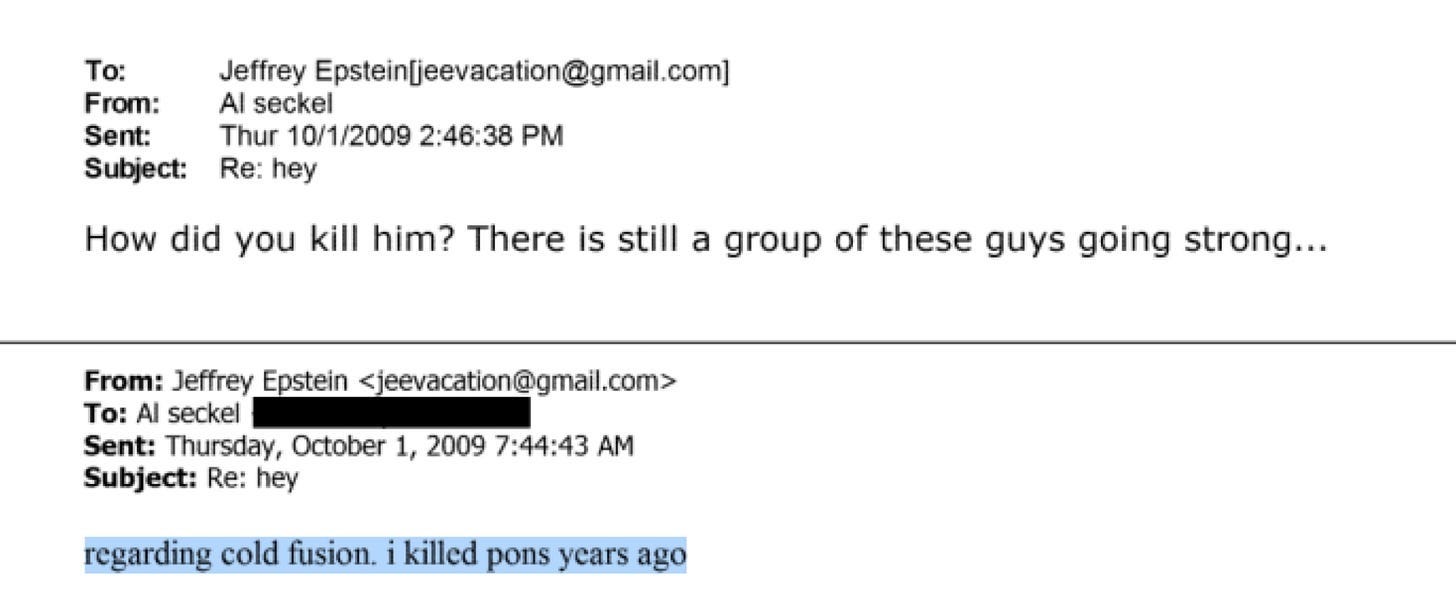
For those interested in the deep state aspect, I would recommend Sayer Ji’s article about Jeffrey Epstein’s role in the suppression of Stanley Pons’ cold fusion research. It is beyond doubt that public knowledge regarding cold fusion/LENR has been deliberately suppressed for years, for reasons I have previously discussed.
For those who remain serious about getting to the bottom of what was arguably the seminal political event of the 21st century, there is plenty of evidence to examine and plenty of work still to do.
It seems to me that Judy Wood and Heinz Pommer both present important insights into the destruction of the Twin Towers but talk past one another. For supporters of Wood, the fact that some kind of energy weapon was used means that any evidence associated with conventional nuclear weapons must be dismissed. Pommer, for his part, attacks so-called “wild theories” such as cold fusion and the Hutchison effect (2020, pp. 47-49).
Yet, why is it so difficult to comprehend the possibility that a weapon premised on Low Energy Nuclear Reaction might have certain features in common with conventional nuclear weapons but not others?
The weapons used to destroy the Twin Towers were not conventional nuclear weapons, yet they evidently created phenomenal amounts of energy and fountain-like patterns of destruction emanating from a lower central point. It would come as no surprise whatsoever if the military had developed such weapons by crossing tactical nuclear weapons with classified developments in LENR.
Support My Work
If you valued this content and are not a paid subscriber, please consider leaving a one-off tip for an amount of your choosing.
If you would like to make a one-off or recurring donation to help fund my work in general, I would be most grateful. There are numerous ways of doing so, including wire transfer, Paypal, UK cheques, and Buy Me A Coffee.
If you have not done so already, please consider taking out a subscription to davidahughes.net or upgrading an existing one – free, paid, or gold-tier.