Review of a Review – Kit Knightly on Where Did The Towers Go?
A bland recycling of caricatures, misreadings, and other people’s arguments
OffGuardian’s Kit Knightly is publishing a book review of Where Did The Towers Go?
The first part of the review was published on Saturday and warrants some remarks.
It is structured around seven “anomalies” identified by Wood:
- Hurricane Erin was underreported and behaved abnormally.
- There was unusual electro-magnetic activity in the atmosphere on the day of 9/11.
- The destruction generated a smaller than expected seismic signal.
- The “bathtub” – the subterranean wall built to prevent the Hudson River flooding lower Manhattan – was undamaged.
- Cars and other vehicles exhibited strange damage not explicable by known means
- Structural steel was “dustified”.
- The destruction of WTC1 and WTC2 produced considerably less rubble than one would expect.
Knightly challenges Wood on all seven anomalies, and we will get to those.
Wood’s “Rough Hypothesis”
First, however, Knightly claims that
From these purported anomalies, Dr Wood pieces together a rough hypothesis:
The towers were destroyed by a directed energy weapon (DEW) developed during the Star Wars beam project in the 1980s and potentially in orbit over New York on 9/11. This “DEW” utilises low-energy nuclear reactions (LENR) or “cold fusion” to create and/or siphon the energy from hurricanes, specifically Hurricane Erin which was off the North-East coast of the US in the days immediately before and after 9/11.
The harvested energy is used to create a “giant Tesla coil” which, as a result of “the Hutchison effect”, can create a “field effect” which causes metal and concrete to dissociate at the molecular level – a process she calls “dustification”.
One of the strengths of Knightly’s review (apart from the fact that he has actually read the book, unlike most of Wood’s critics…) is that he generally provides exact quotes with page numbers.
Yet, when presenting Wood’s “rough hypothesis,” there is no direct quote and no page numbers. That is because Wood never said or wrote the lines in question. Knightly thus immediately presents a straw man.
Far from providing a “hypothesis” or theory about what kind of weapons were used, where they were located, how exactly they worked, etc., Wood presents evidence and asks us to consider its implications.
Knightly’s opening caricature is clearly intended to make Wood appear ridiculous, a common but dishonest tactic among her opponents.
The “Space Beams” Smear
It is notable that Knightly reaches straight for the “space beams” smear that has been repeatedly deployed by Architects and Engineers for 9/11 Truth (AE911T) and others.
It goes back to Wood’s 2006 article with Morgan Reynolds titled “The Star Wars Beam Weapons and Star Wars Directed-Energy Weapons (DEW).” The article began as follows:
The name of this article was chosen as a reminder that energy weapons do exist and have been developed over 100 years. Most of this technology is classified information. It can also be assumed that such technology exists in multiple countries. The purpose of this article was to begin to identify the evidence of what happened on 9/11/01 that must be accounted for. In doing so, the evidence ruled out a Kinetic Energy Device (bombs, missiles, etc.) as the method of destruction as well as a gravity-driven “collapse.”
Thus, Wood and Reynolds explicitly did not claim that “space beams” destroyed the Twin Towers or that a DEW was in orbit over New York on 9/11. Rather, their claim was that energy weapons, which are known to exist (mostly in classified form), must be considered as one possible means of destruction, which cannot be accounted for by kinetic energy alone.
So, what does Knightly have by way of more substantive critique?
Anomalies 1 and 2 – Hurricane Erin, Magnetometer Data
Interestingly, Knightly begins with the two minor challenges to Wood’s work that I first presented in 2024, regarding Hurricane Erin and the magnetometer data. Obviously I agree with him on these points, and he also adds some worthwhile new evidence to substantiate the critique.
There was nothing unusual about Hurricane Erin from a meteorological perspective, nor was Erin “almost totally unreported” or “treated as a carefully kept secret, much like a state secret,” as Wood claimed (pp. 480, 410).
Magnetometer data similar to that from September 11, 2001, can be found on other randomly chosen days. Knightly and I have both demonstrated this independently.
The rest of Knightly’s critique is far less convincing, however.
Anomaly 3 – Seismic Signals
Wood famously contrasted the destruction of the Seattle Kingdome with that of the Twin Towers. Despite being much smaller than either tower, the Kingdome demolition produced a reading of 2.3 on the Richter scale, the same as that registered for WTC1 and larger than that registered for WTC2 (2.1).
The obvious question is why the fall of two 110-story skyscrapers, weighing an estimated half a million tons each, did not produce far higher readings.
Knightly does not have much useful to offer in this section. “I do not know enough about seismology, or converting potential energy to seismic signals, to offer an opinion,” he admits.
He is, however, willing to cite known bad actors such as Greg Jenkins (see the section titled “Ambush” here) to make Wood’s calculations appear questionable. He does so claiming that it is “in fairness.”
Knightly appears to come down on Wood’s side to some extent when he writes that the Twin Towers
fell not as one piece, but as millions of pieces distributed over a vast area, and a large percentage of their weight WAS turned to dust – and it stands to reason this would dissipate the shock applied to the ground to some extent, whether explosives or “directed energy” weapons (or both) were the initiating cause.
This passage still suggests that the whole of the Twin Towers “fell” in however many pieces, yet we know that much of the dust was extremely fine and rose up into the atmosphere. It would be interesting to know from Knightly whether explosives could have released enough energy to generate that effect.
Knightly notes Wood’s contention that the seismic data released by Columbia University’s Lamont-Doherty Earth Observatory at Palisades, New York, may have been manipulated. Why rely on unreliable data, he effectively asks, concluding that “it might be that we are all wasting our time trying to draw any conclusions from the seismic data at all.”
This attempt to sweep the seismic data under the carpet founders on the simple fact that there is no seismic data which corroborates the official version of events. Why not? Why were much larger signals not recorded? Why did NIST’s Shyam Sunder claim that “there wasn’t anything that gave us pause in terms of that being a significant seismic event”? If the data was manipulated, why manipulate it down rather than up?
The seismic data is clearly anomalous, as Wood argues, and even Knightly seems to turn to dustification to explain the anomaly.
Anomaly 4 – “Toasted Cars”
Knightly provides convincing photographic evidence that what Wood calls “toasted cars” on “9/11” look a lot like cars from other contexts, such as those which have suffered engine fires, or been close to an exploding volcano, or been bombed in war-torn areas such as Mogadishu, Baghdad, and Beirut.
He concludes that the “toasted cars” on “9/11”
just look too similar – indistinguishable in most cases – to cars destroyed by arson, explosives, shells or the pyroclastic flow from a volcano. More importantly Wood supplies no evidence why these known methods of destruction should be ruled out.
Is Knightly here suggesting that the “toasted cars” on “9/11” may have been destroyed by arson, explosives, shells, or pyroclastic flows? If so, who was selectively setting fire to and blowing up cars, and why? If the dust clouds were “pyroclastic flows,” why were the thousands of people caught up in them not badly burned?
The key question that Knightly does not address is what did “toast” the cars on “9/11”? For example, why exactly would the destruction of the Twin Towers do this?
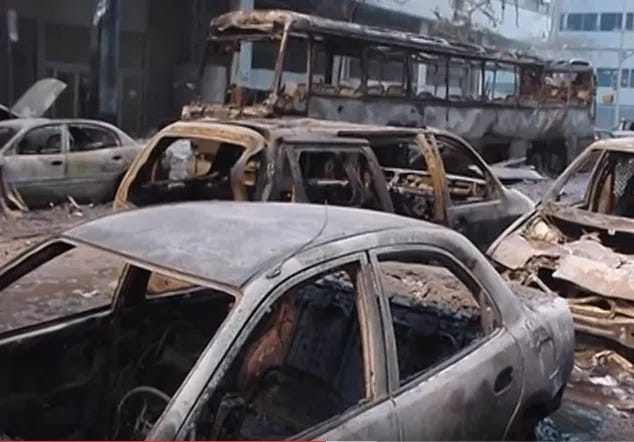
Or, several blocks away, why were some cars “toasted” while others appeared undamaged (see my earlier presentation)?
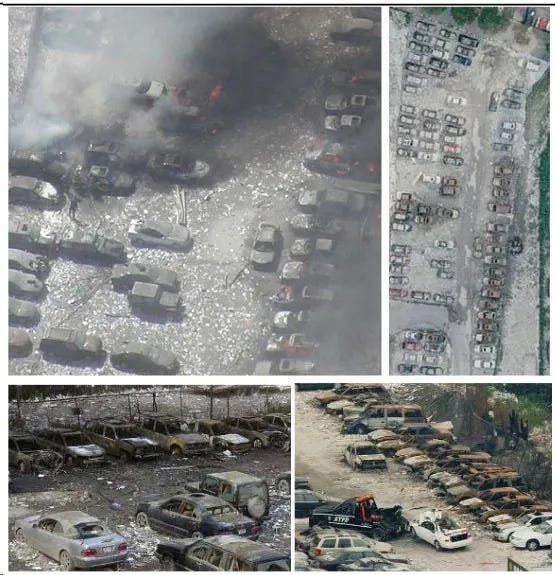
The “toasted cars” are not “one of the weakest aspects of Wood’s book,” as Knightly claims. They represent genuine anomalies that require explanation.
Anomaly 5 – The Bathtub
Knightly notes Wood’s claim that the bathtub (the below ground concrete structure built to keep out the Hudson River) was “not significantly damaged” by the events of September 11, 2001.
How damaged was the bathtub, Knightly asks, and how damaged should it have been? Apparently, Wood “never asks these questions, let alone answers them.”
Is that so? At the start of her chapter on the bathtub, Wood writes:
If the building had been destroyed by a gravity collapse, certainly the foundation would have been destroyed or at least severely damaged by the entire 110-story building crashing down onto it (p. 45).
Moreover,
The bathtub mysteriously remained without significant damage despite two quarter-mile-tall towers allegedly collapsing onto it. How did the bathtub avoid significant damage despite a million tons of WTC material supposedly slamming down on it? Even if no material had directly hit the bathtub, serious seismic impacts on bedrock would have damaged walls, wall corners, and tunnels under the WTC [...] (p. 46).
And again:
The big bathtub thus suffered only minimal damage. There was no functional damage [...] (p. 52).
Wood’s point is obvious: had the Twin Towers really “collapsed,” the resultant fall of a million tons of material would have done catastrophic damage to (“destroyed”) the bathtub, rendering it dysfunctional.
Instead, the damage to the bathtub, such as it was, was minor in comparison. Wood discusses that damage in her chapter.
Knightly ignores virtually all of that and accuses Wood of “unquantifiable subjectivity” in her assessment of the damage to the bathtub.
But is it merely “subjective” to claim that if the structures shown below had “collapsed,” the bathtub would have been destroyed? Or is it self-evident?
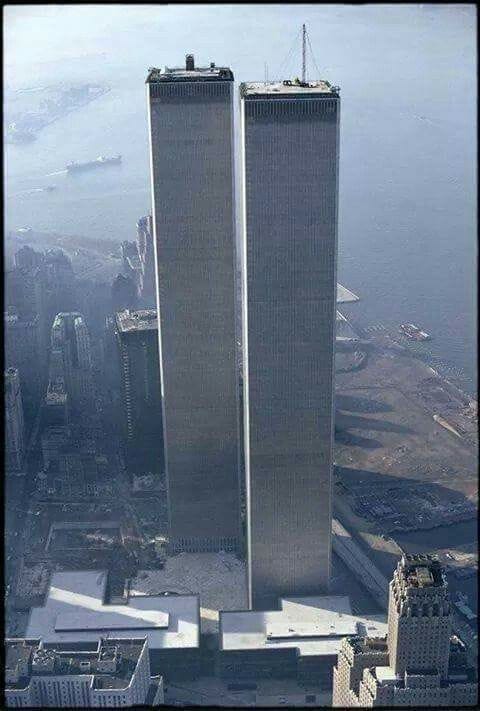
“The bathtub certainly was damaged to some extent,” Knightly recognises, and he cites similar sources to Wood to demonstrate that.
But the straw man he uses is to argue that such damage contradicts Wood’s claims about “only minimal damage.” Yes, there was damage to the bathtub, but it was trivial relative to the catastrophic damage that would have been expected were the official account true.
Knightly claims that the bathtub’s “resilience” was demonstrated by the failure of the 1993 WTC bombing to damage it. The Wikipedia page he links to includes the following diagram:
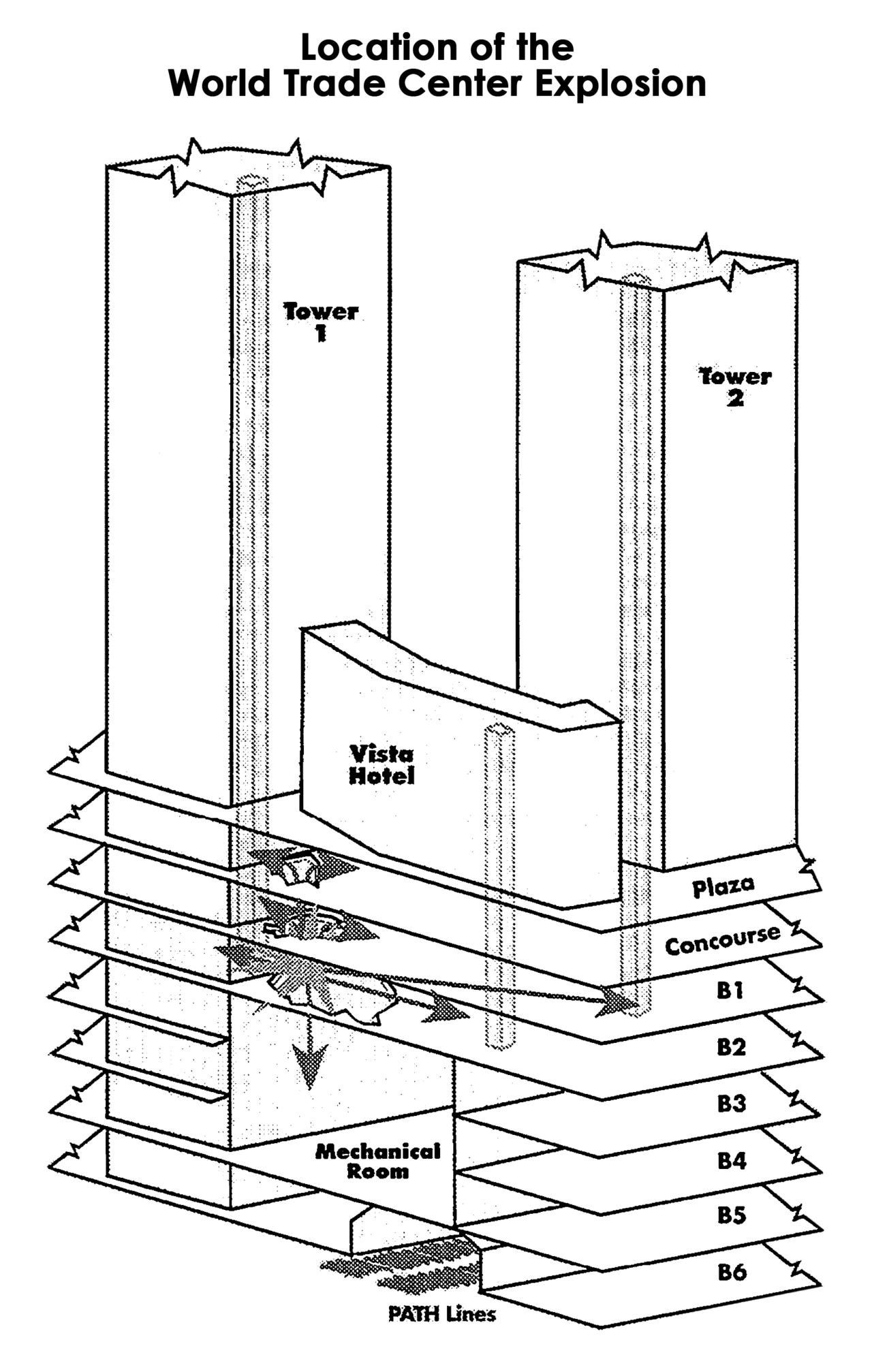
The 1993 bombing tore a hole through four levels of the underground structure. But that is nowhere near the same as imagining the whole of WTC1 slamming to the ground, and WTC2 doing the same, and the impact that would have had on the bathtub.
Knightly takes issue with Wood’s claim that “More damage was done to the bathtub by earth-moving equipment during the clean-up process than by the destruction of more than a million tons of building above it.” His view is that “the bathtub was already so unstable because of the destruction of the buildings that any further disturbance by heavy equipment might worsen the damage or cause it to fail completely.”
On this view, the destruction of the Twin Towers brought the bathtub precisely to the point of instability without destroying it. What are the odds?
Or is it more plausible to suggest, as Wood does, that the bathtub never did withstand the complete collapse of two 110-story skyscrapers, that large areas of the underground structure were relatively undamaged, and that the heavy machinery subsequently working to hollow it out – something for which it was never intended – may have contributed to the weakening of the concrete structure?
Anomaly 6 – “Dustified” Steel
According to Knightly,
Nobody disputes that a sizeable amount of the WTC’s mass (mainly lightweight concrete and gypsum wall boards) was indeed pulverised – or “dustified” if you prefer – by one process or another.
Wood disputes this. She is very clear about the importance of language and using the correct terms. “Pulverisation” is not the correct term, for how can anything be “pulverised” when meeting only air resistance? “Pulverisation” is not interchangeable with “dustification.”
Knightly argues that “concrete, gypsum etc.” were dustified but that structural steel was not. As evidence for this, he cites a study in a toxicology journal, which in turn cites a table from a separate source, indicating that iron levels account for only 0.23%-1% of dust samples – “in line with the known chemical composition of pulverised concrete.” He also cites USGS surveys of the dust which found iron present at only “minor or trace levels.”
Much rides on the reliability of sources. Is the original source for the 0.23%-1% figure publicly available for inspection? From what I can see, it derives from a single paper – one of 14 – presented in a 2003 symposium, rather than anything peer-reviewed. Who took the measurements, how, using what methods?
The other source, the USGS, should be treated with suspicion. This is the same organisation that published imagery showing alleged “hot spots” that did not correspond to photographic evidence.
A 2026 analysis of a WTC dust sample by Bob Greenyer (see 51:30) reveals significantly higher concentrations of iron (Fe):
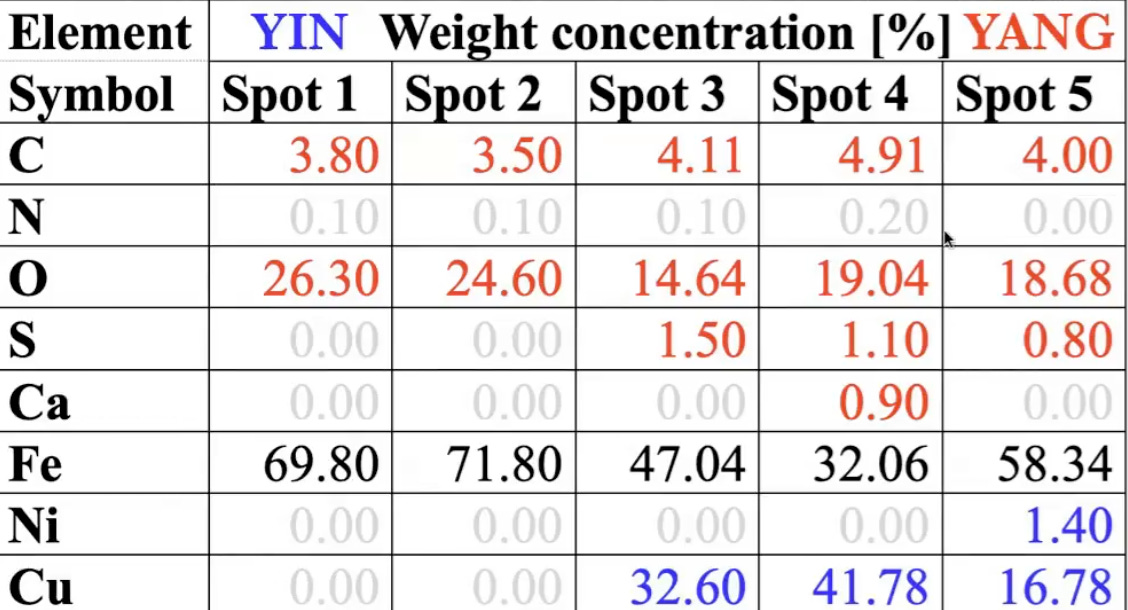
So, which source, if any, are we to trust?
Assuming the reliability of his two sources, Knightly asks us not to believe our own lying eyes. He includes a video – primary empirical evidence – showing “the Spire” visibly turning to dust, but promotes the AE911T line that “the video simply shows the spire collapsing, leaving behind the dust that had settled on it during the earlier stages of collapse.”
As Knightly should have known as a reviewer, Wood dealt with such objections in her book:
If so, how did the dust get there? How long did it take for the dust to get there? And how did it stay there? […] If the dust had come from the destruction of the building, how could it settle so quickly and yet be fine enough to stay aloft? The tallest column in the ‘spire’ does not appear even to have a horizontal surface for the dust to accumulate on. (p. 135).
What exactly did “the Spire,” whose tallest column was ca. 70 stories high, collapse into? Or, if it buckled, what caused it to buckle and where is the evidence that it did so?
Anomaly 7 – Missing Rubble
Two 110-story steel-framed skyscrapers and all their contents were standing one minute. The next, they had disappeared, leaving a debris pile barely higher than ground level (see 16:20 and 28:40).
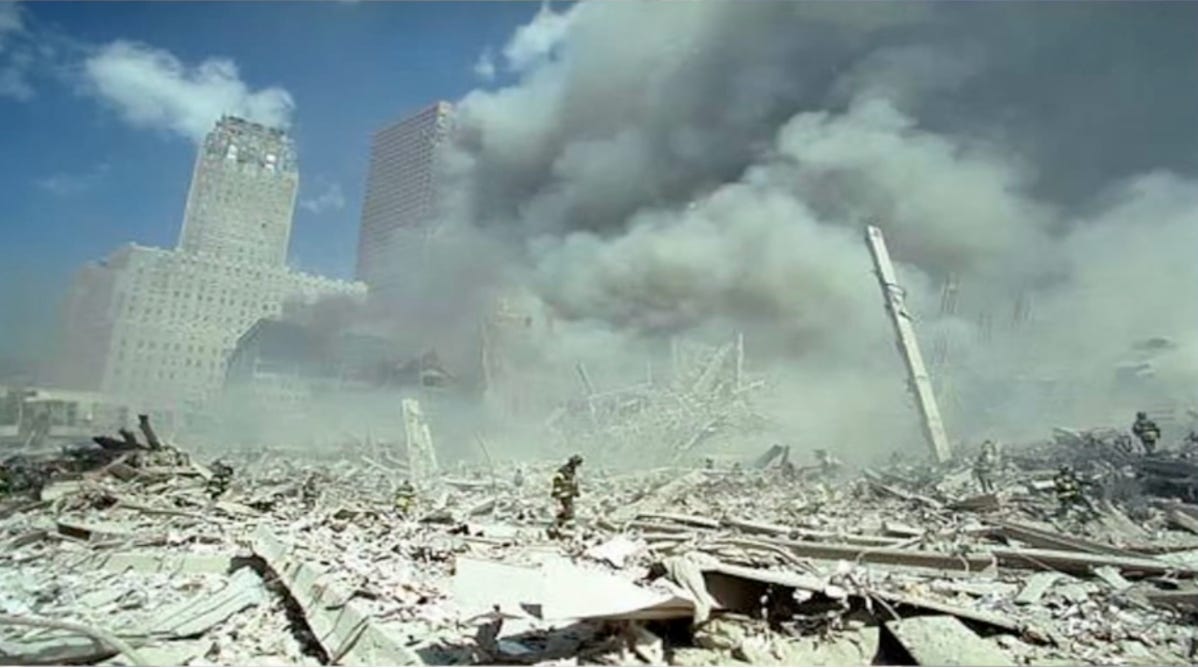
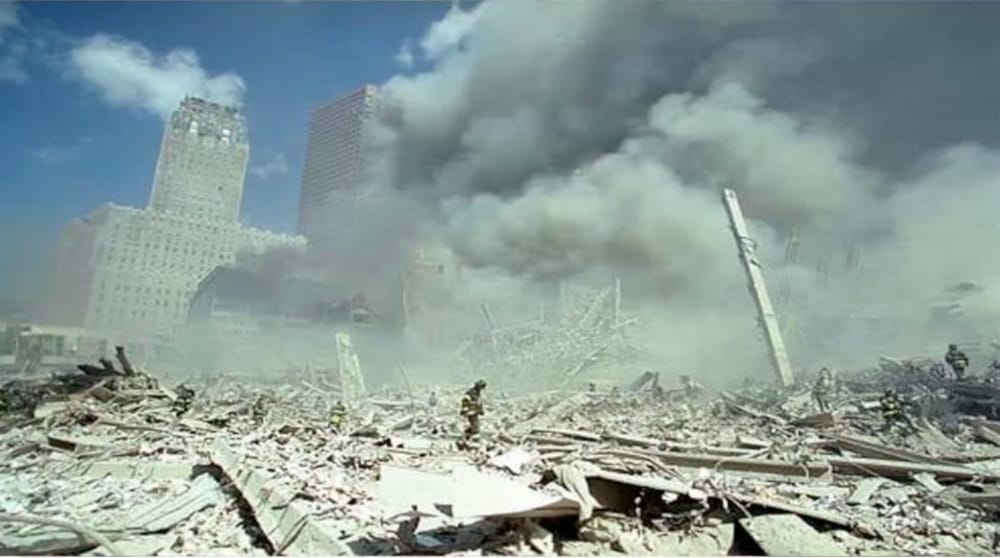
The photograph above, with WTC7 still standing and the short shadows indicating an overhead sun around midday (within hours of the Twin Towers being destroyed) shows the debris at or very close to ground level.
According to Knightly, “Statements that structural steel is ‘missing’ rely on subjective interpretation of photographs for evidence, no scientific data supports this claim and no attempt is made to measure the amount of steel debris.”
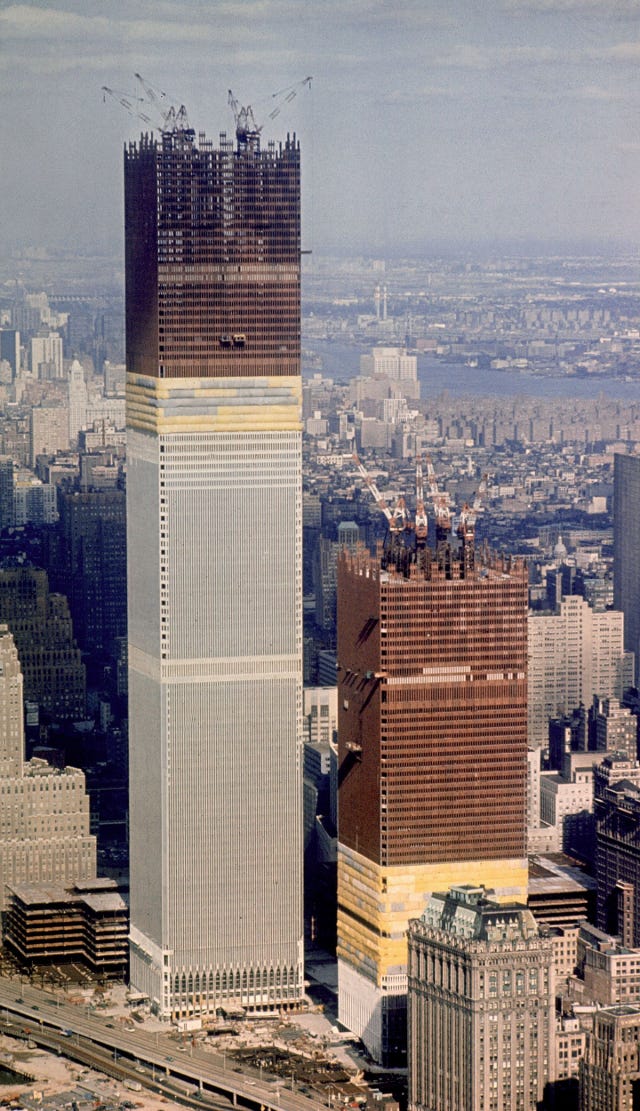
Subjective interpretation, perhaps, but it is hardly a stretch to claim that we are not looking at 200,000 tons of structural steel here. Below is a photograph of the Twin Towers under construction, showing just a fraction of their total structural steel. Where did this massive amount of material go on September 11, 2001?
Source: rarehistoricalphotos.com
Knightly resorts to the ludicrous argument that the buildings were mostly “empty space,” as though that waves away the problem of 200,000 tons of structural steel.
He then rehashes the AE911T line that the debris was “spread out over the 5 acre area of the World Trade Center plaza.” According to his own calculations, this means that the debris pile, across the entire 5 acres, should have been “between 2 and 4 storeys.” Which it wasn’t.
Correcting for this, Knightly allows that “a significant portion of the mass of the buildings (ie. the concrete) was indeed ‘dustified.’” But not the steel, which was “thrown as much as 500-800 feet outside the towers footprint.”
Despite criticising Wood for “subjective interpretation of photographs for evidence,” Knightly interprets a photograph in the attempt to convince us that the debris pile was 45-55 feet high.
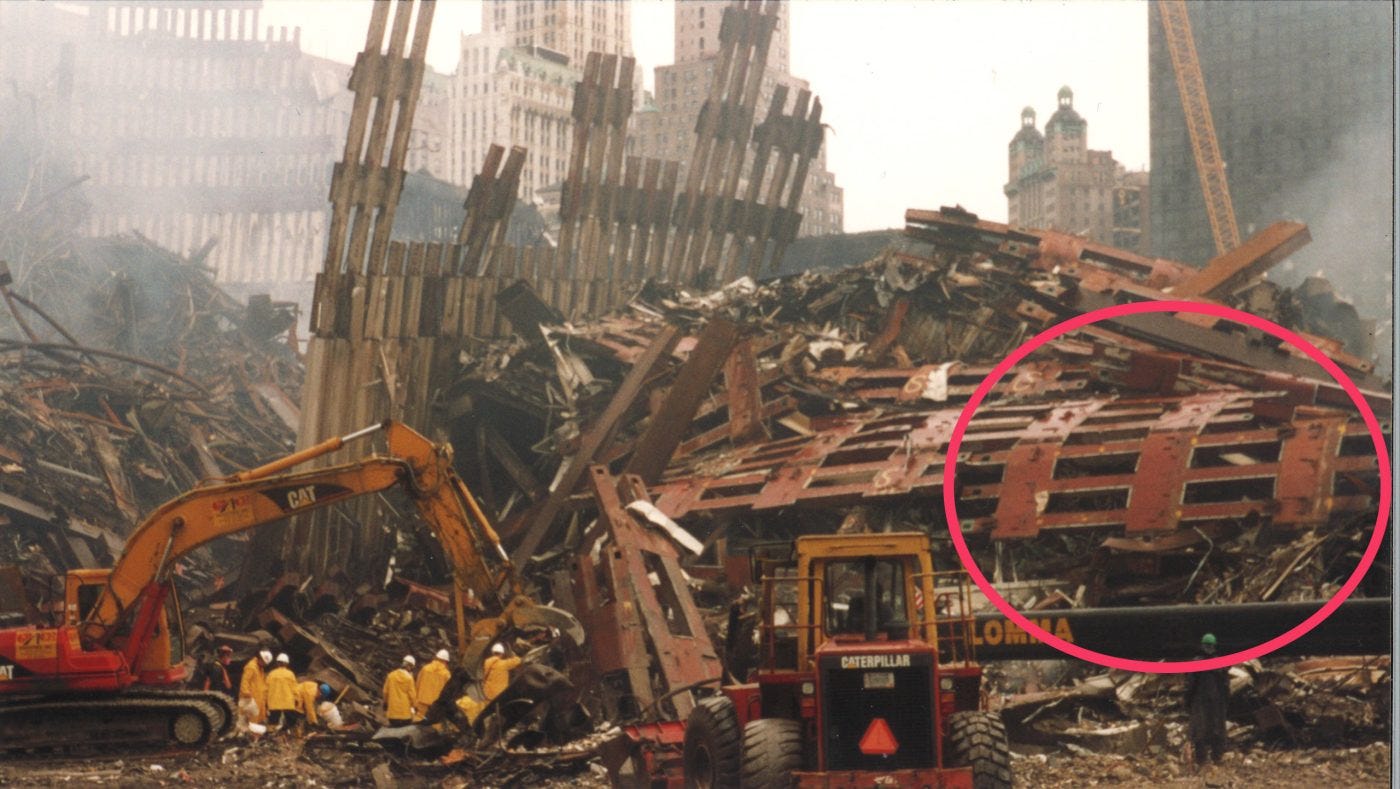
Knightly’s more “scientific” approach rests on looking at LIDAR imagery captured in the days after the attacks:
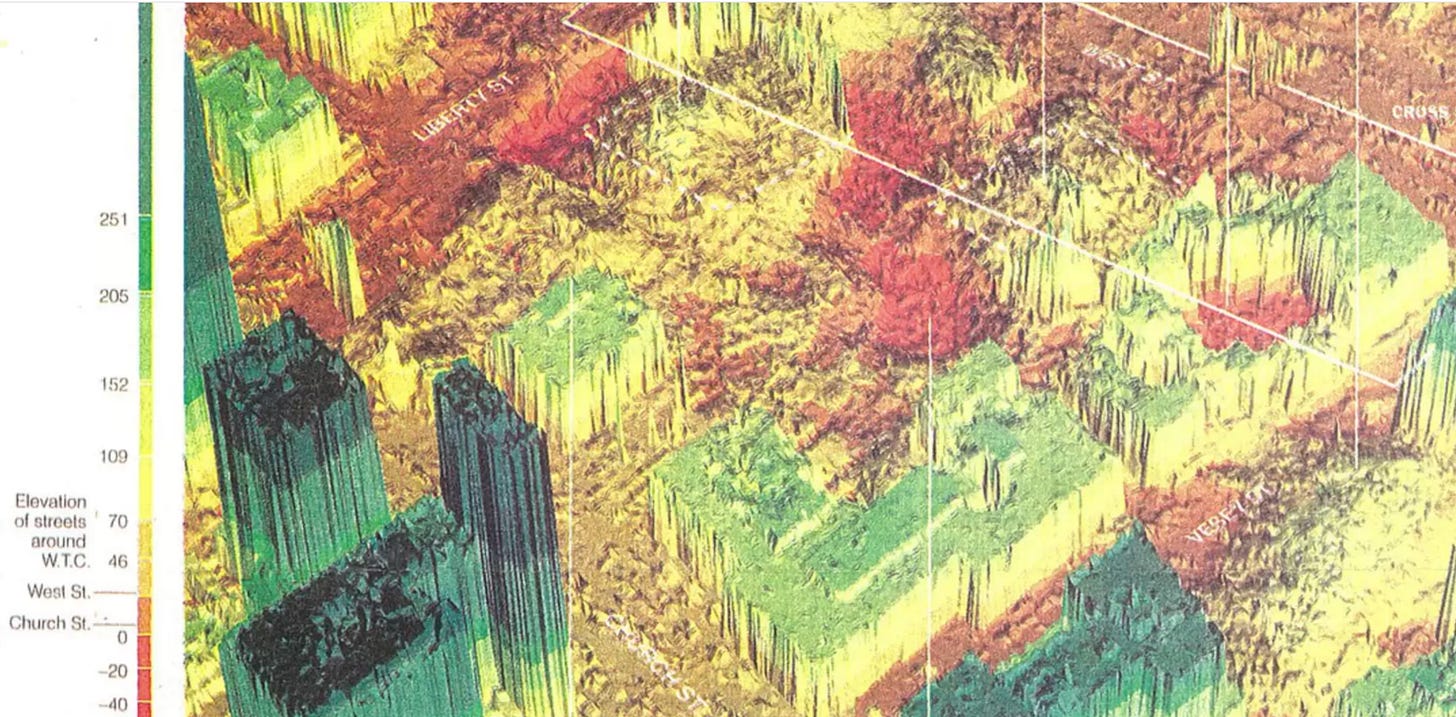
Knightly interprets this as showing “a reasonable average of around 40-60 feet of rubble spread over the footprints of the two towers.”
So, two quarter-mile-high (1,368 feet) skyscrapers were each reduced to a rubble pile only 40-60 feet high. Knightly does not seem to find anything strange or unusual about this.
Presumably that is because the rest of the debris was “spread out” across the WTC site and slightly beyond. Yet, look at the LIDAR imagery. Note how much of it is red, i.e., below sea level. Most of the remaining space between remnants of buildings is the same colour as Church Street and West Street, i.e. approximately ground-level. So we are not seeing much debris above ground.
Inevitably, therefore, Knightly must resort to looking below ground:
And of course, this is only what was above ground. What tends to be forgotten is that below the Twin Towers there was a concourse level, and then 6 further sub-basement levels [...]
Knightly simply ignores Wood’s evidence regarding the relative lack of damage to underground structures such as the PATH platforms and carriages, shopping malls, parking garages, etc., as well as the evidence of this nature that has been provided by 9/11 Revisionist plus the freon tanks that were removed intact. Based on that evidence, it is problematic to posit a “collapse into subbasement levels,” as Knightly does.
If 200,000 tons of structural steel had rained down from a maximum height of a quarter of a mile, it would surely have pierced deep into the basement levels and struck the bottom of the bath tub (remember, the 1993 bomb was enough to blow a hole through four levels of the basement). Yet, even the LIDAR data only goes 40-50 feet down, whereas the bathtub was 70 feet deep.
In sum, Knightly does not provide an adequate explanation of the missing steel.
Conclusion
Knightly concludes that “if these anomalies do not exist, the corollary is there’s no reason to think any theoretical ‘directed energy weapon’ was deployed on 9/11.”
The trouble is, anomalies 3-7 do exist. The seismic signals make no sense, the “toasted cars” require adequate explanation, the bathtub was not destroyed by 1 million tons of material slamming to the ground, primary empirical evidence clearly shows the Twin Towers being dustified, and the near total disappearance of two of the largest buildings in the world remains a mystery.
I stand by my contention that it is because Wood’s work points strongly in the direction of classified military technology having been used to destroy the Twin Towers that Wood is so relentlessly attacked, typically with the same failed arguments and smears being endlessly recycled.
Support My Work
If you valued this content and are not a paid subscriber, please consider leaving a one-off tip for an amount of your choosing.
If you would like to make a one-off or recurring donation to help fund my work in general, I would be most grateful. There are numerous ways of doing so, including wire transfer, Paypal, UK cheques, and Buy Me A Coffee.
Please consider taking out a subscription – free, paid, or gold-tier.