Remembering the Marches
At a time of uncertainty among "the Resistance," it is salutary to remember the marches against government overreach during Covid
Introduction
One of the concerns I sometimes hear from those who get in touch with me is that there are too few people who are “awake” and aware and willing to resist the rolling attacks on freedom and democracy as global technocracy is engineered.
In that context, it is salutary to remember the scale and spread of the marches that took place against the “Covid-19 public health measures.” The protests began in 2020 (including some massive ones in Berlin), but once it became evident that the “vaccine” rollout was intended, not just for the most vulnerable groups in society (as was first promised), but rather for everyone, the marches grew significantly in size and transnational coordination.
The legacy media either failed to report on the marches or significantly downplayed the numbers involved. A recurrent tactic was to denigrate the protestors as “far right,” “fringe,” crazy, violent, etc., with the numbers involved typically being radically under-represented (Hughes, 2024, p. 293). In reality, huge numbers of people from virtually all segments of society moved peacefully and lawfully through the streets of major cities to protest against the “measures.”
There has been a deliberate attempt by the legacy media to expunge the marches from the historical record. A lot of social media footage has been removed, for example. In general, all that remains of the marches in mainstream sources is the image of relatively small numbers of extremists clashing with police.
Lamentable as this may be, it is also a sign of weakness on the part of the control system that the extent of public resistance needs to be systematically concealed. In rendering it visible again here, I hope to remind readers of the rich vein of protest that was evident transnationally and which culminated in the “Covid-19” operation being wound down in early 2022.
The Marches
Happily, there were too many large protests against the “Covid-19 health measures” to mention them all here. Nevertheless, it is worth remembering some of the main ones.
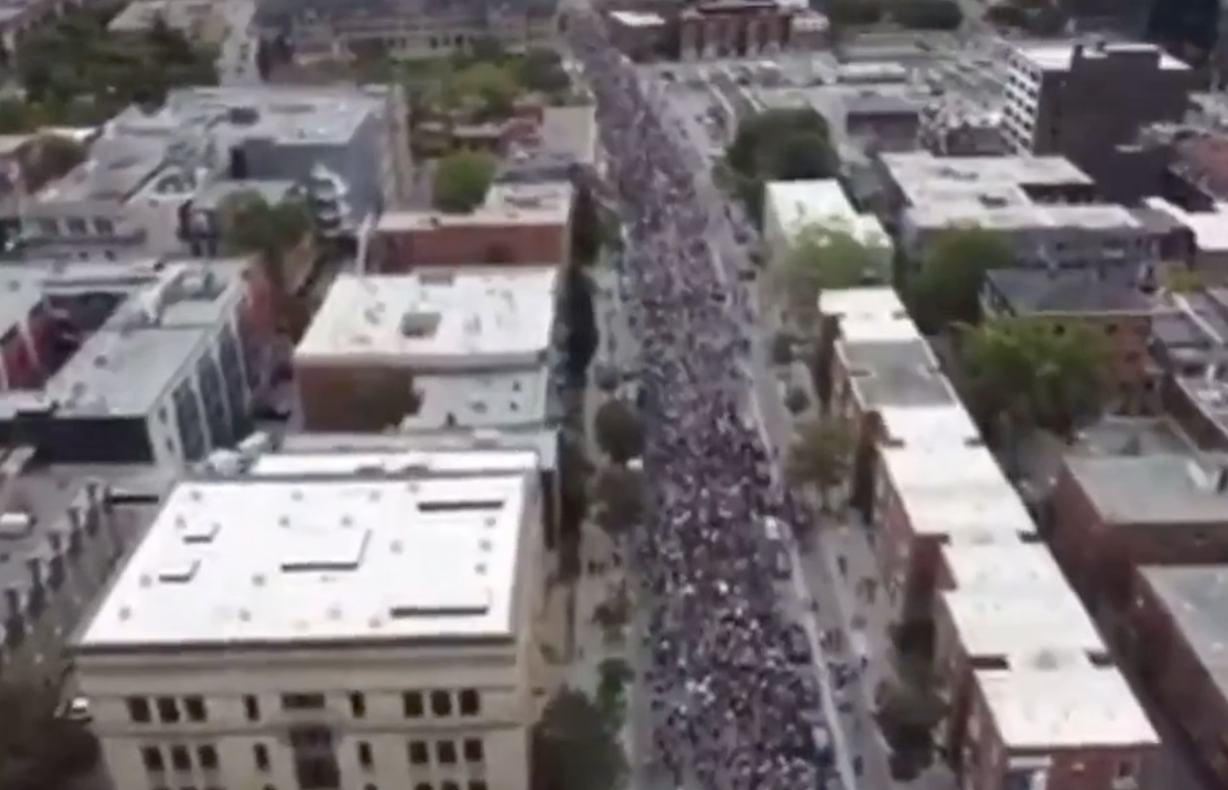
For example, a large protest took place in Montreal, Canada, on March 13, 2021.
As can be seen above, thousands of protestors moved peacefully through the streets of Montreal, yet the legacy media chose to focus on ten arrests that were made plus 144 tickets issued for non-mask-wearing (La Presse Canadienne, 2021).
On March 20, 2021, the Worldwide Rally For Freedom and Democracy took place in many large cities around the world. Among them, hundreds of thousands of people marched through the streets of London.
While showing the streets of London lined with protestors, Sky News farcically reported on the mere “hundreds of people protesting.”
The Worldwide Rally For Freedom and Democracy was the largest global demonstration since the protests against the Iraq War in 2003. Yet, the BBC’s main news page on the day made no mention of it, instead making “vaccination” numbers and summer holiday bans the lead items.
One article the BBC did run that day, titled “Coronavirus: Protests should be allowed during lockdown, say 60 MPs and peers,” was not about the protests taking place globally. Rather, it was a response to criticism of police arresting women attending a vigil the previous weekend following the killing of Sarah Everard.
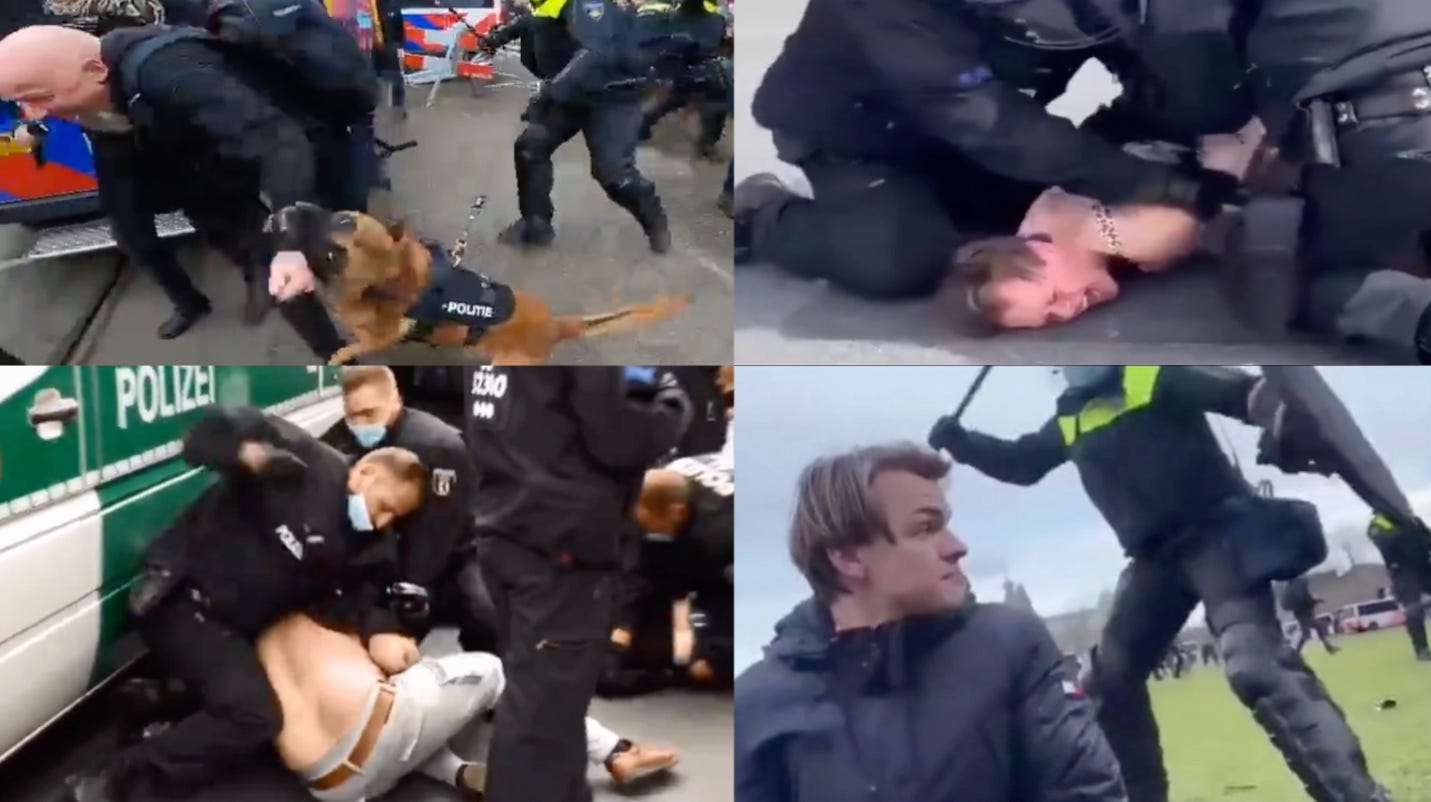
Contrary to the legacy media’s dishonest efforts to associate the protestors with violence, the reality was that heavy-handed police tactics were primarily responsible for any violence that did occur. A gruesome medley of such tactics can be viewed in a presentation that Daniel Broudy, Lissa Johnson, and I produced in December 2022.
In Amsterdam on March 20, 2021, armed forces veterans formed a line of defence between police and protestors, concerned by the overly aggressive policing of previous protests. This drew into sharp focus the public’s loss of trust in the police to use proportionate force when dealing with protests against perceived abuses of state power.
In Kassel, Germany, that same day, the police used water cannon, pepper spray and batons against protestors marching under the slogan “Free citizens Kassel - basic rights and democracy!” As we will see, this was by no means the only time such methods were deployed by police against protestors transnationally.
In April 2021, there were large protests in Spain,
Serbia,
Denmark,
Argentina,
and Rome, Italy.
When hundreds of thousands, possibly half a million, people took to the streets of London on April 24, 2021, the BBC failed to cover it; then, a day late, it reported on it in terms of “senseless violence against police,” even though footage from the event clearly shows the police provoking the crowd (06:00–25:00).
In May 2021, the marches continued in, among other places, Brighton, England,
London (where a solidarity with Palestine march was organised for the same day, May 15),
and Toronto, Canada.
In London, another major protest took place on “Freedom Day” (July 19, 2021) and saw further tensions with police:
Meanwhile, in France, hundreds of thousands protesters took to the streets following President Macron’s announcement that mandatory “health passes” would be rolled out for all restaurants, bars, hospitals, shopping malls, trains, planes and other venues (Smith, 2021).
At least eight consecutive weekends of protests followed in France, including the one below in the first week of September, 2021.
In Amsterdam, a “seemingly endless column of protesters” marched against vaccine passports on September 5, 2021.
The same was true in Montreal:
Bern, Switzerland, saw multiple protests against “Covid-19” restrictions in September 2021, including the one below following the government’s announcement that a “Covid pass” would be needed to access many public places.
On September 16, 2021, the Swiss police used water cannon, rubber bullets, and tear gas to disperse a crowd of protestors outside the parliament building.
Three days later, in Melbourne, riot squad police used rubber bullets, pepper spray, “stinger” grenades, and an armoured vehicle to disperse non-violent protesters. It was a massively disproportionate show of force.
On Ocrober 2, 2021, thousands of people protested the restrictions in Romania.
On October 9, 2021, thousands of demonstrators in Rome marched against the “Green Pass” requirement for employees to enter their offices.
The Freedom Rally in Melbourne in November 2021 was described as “the largest ever political demonstration in the city with estimates of 250,000-500,000 Victorians in attendance, equating to approximately 1 in 20 Victorians.”
The Dutch government tried banning fireworks in the name of tackling “Covid-19.” Below is the response of the Dutch people on New Year’s Eve 2021:
Similarly in Naples, Italy, fireworks were banned for a second straight New Year’s Eve. Neapolitans responded as follows:
In Austria, following a government announcement that “Covid-19” vaccines would become mandatory from February 4, 2022, tens of thousands of people took to the streets weekly.
Finally, and perhaps most significantly, the Canadian Truckers Convoy, which began on January 22, 2022, brought out huge numbers of supporters all across the country. It led to the Emergencies Act being invoked on February 14, 2022, with occupied areas of Ottawa finally being cleared on February 20, 2022.
The “Covid -19” operation was finally wound down and the next deep structural event was instigated with Russia’s invasion of Ukraine on February 24, 2022.
Conclusion
The above protests represent just a fraction of the total. The simple fact is that there was massive transnational resistance to government overreach during the Covid era (albeit no large protests in the United States), and rightly so.
Given that the modus operandi of those running the "Covid-19" operation was to push the oppressive restrictions as far as they could get away with, it seems reasonable to conclude that they only backed down once resistance had reached the point of requiring something as radical as the Canadian Emergencies Act to deal with it. The transnational nature of the resistance meant that similar would follow in other countries.
It is telling that the legacy media went to such lengths to mischaracterise and discredit the protests, for any honest reporting would clearly have reflected the illegitimacy of the “measures,” as expressed by the actions of millions of people worldwide.
That the protests were repeatedly met with police brutality and attempts to provoke violence is also significant, as it reveals the iron fist beneath the velvet glove of public health in the biosecurity state.
Although “the Resistance” has since appeared fractured through all manner of psy-ops and infiltration of the independent media, it is important to remember that there are people everywhere who understand that their constitutionally enshrined rights and freedoms are under threat and are willing to resist.
As the global technocratic noose continues to tighten, we have surely not seen the end of transnationally coordinated resistance on a worldwide scale.
Support My Work
If you valued this content and are not a paid subscriber, please consider leaving a one-off tip for an amount of your choosing.
If you would like to make a one-off or recurring donation to help fund my work in general, I would be most grateful. There are numerous ways of doing so.
If you have not done so already, please consider taking out a subscription or upgrading an existing one.