Why Reiner Fuellmich Was Guilty - Part 4
Part 4 - Lessons for the "Alt Media"
The first three parts of this series analysed the Judgment against Reiner Fuellmich, argued that his conviction for embezzlement was justified, and exposed the nature of the grift which he perpetrated upon the public.
This final part asks why so many voices in the "alt media" were, and remain, ardent supporters of Fuellmich, not least given his connections to Scientology. There are also some reflections on the Crimes Against Humanity Tour.
Support for Fuellmich
Despite the accumulated evidence, supported by a criminal conviction, that Reiner Fuellmich is a conman who has repeatedly abused the public’s trust to line his own pockets, most “alt media” commentators who have taken a view on the issue appear to have defended Fuellmich.
For example, Dr. Simone Gold instantly leaped to his defence: “We have to speak up before we have all the evidence, we have to speak up based on what know about a person’s character [...] We are going out on the record long before we have all the facts” (11:13).
According to Seba Terribilini and Cynthia Salatino,
Fuellmich is clearly a political prisoner, punished for having spoken the truth. His case demands the attention of international human rights organizations, as well as the indignation of worldwide public opinion.
This is exactly the kind of press that Fuellmich sought to achieve via his performances in court.
Cafe Locked Out, Global Research, Ariyana Love, and the World Council for Health all uncritically amplified Terribilini’s claims.
Outside the court, meanwhile, supporters gathered with their “#FreeReinerFuellmich” banners.
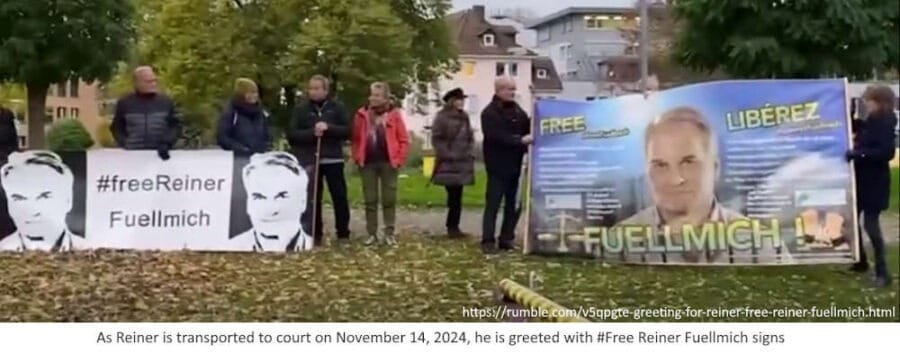
[Source: Rumble]
The Reese Report defended Fuellmich, wrongly claiming that he “beat Deutsche Bank and VW.” So did Mark Crispin Miller and Andrew Bridgen.
For Bert Oliver, Fuellmich is a “fearless,” "indefatigable" “persecuted hero of the Resistance” and a “paradigm of courage and commitment.”
There are serious lessons here for the “alt media.” A gigantic lack of discernment has been revealed. Those in Camp 2 are not willing to do the necessary work, or think critically enough, about the fake heroes being offered up for public consumption. Anything that appears to challenge Camp 1 is good enough for them.
Two notable exceptions are worthy of mention. Eric Coppolino in 2024 asked some critical questions regarding Fuellmich's legal approach, arguing
This guy is incapable of thinking like a fraud lawyer. He gets [the science of PCR tests] wrong to the point where if this came through on a high school paper, I would fail it. [...] All his is doing is repeating the fraudulent public relations position of the manufacturers. [...] His complete lack of mastery of the facts reveals that he is working for the other side [...] What he is saying is not serving the cause of truth [...]
The other exception is Uwe Alschner, who did think to dig into Fuellmich’s past. What he found was shocking.
Scientology
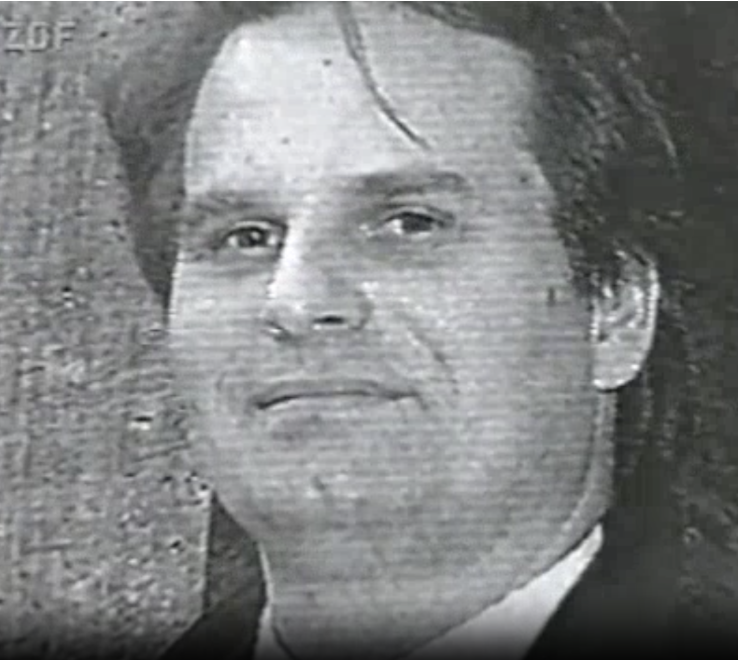
Alschner cites a 1999 documentary broadcast on ZDF in 1999 which links Fuellmich to Scientology. Alschner summarises the key points as follows:
Fuellmich clearly slandered a woman, Renate Hartwig, with “black propaganda,” who had made things very difficult for the Scientology organization. He worked together with another woman, Ursula Caberta, who had been officially commissioned to curb the influence of the sect, but seems to have been “flipped” by Scientology.
When Hartwig took Fuellmich to court, he frequently called one prominent witness to substantiate his claims: Ursula Caberta. Caberta’s attempt to win an injunction against the ZDF documentary was rejected in a court ruling of June 2000.
Instead, the court found that Caberta had supported Fuellmich in his attempts to cast Hartwig in a bad light and to damage her reputation. The court found that “discrediting her reputation serves the interests and strategy of the Scientology organization.”
Despite Hartwig accusing Fuellmich of “doing the dirty work for Scientology” nation-wide in the ZDF report, he did not sue her for defamation.
Hartwig had become a sought-after expert for German Captains of Industry who wanted to keep the ideology and technology of L. Ron Hubbard out of their organizations.
A leading German real estate company, managed by the Schaul brothers in the 1990s, fired a consultant who had recommended such technology when it became obvious that he was a Scientologist. Immediately, their company became the target of slanderous accusations by Fuellmich, according to Alschner.
Deploying so-called “mirror tactics,” Fuellmich (allegedly acting on behalf of Scientology) accused the Schaul brothers of being Scientologists in order to discredit them and cause them to lose business. Scientology was thereby able to expand its influence in the German real estate market.
Scientology is said to have originated as an intelligence operation with the US Office of Naval Research. It is known for infiltrating organisations, for its “black propaganda” tactics, for driving companies out of markets, and for its highly litigious nature when challenged.
One has to wonder – not least given Fuellmich’s unexplained bilingualism and perfect American accent, which can only have been formed during childhood and not during a stint as an exchange student at UCLA – whether he might be a US intelligence asset.
The fact that Fuellmich has a short, bland Wikipedia page despite all the controversy surrounding him points towards a whitewash. A search for his name on X reveals a never ending torrent of support for him with virtually no criticism, which looks obviously manufactured.
If Fuellmich is indeed an asset, then his role with the CIC, as Alschner has suggested, may have been to induce “depression about fallen angels” (i.e., to demoralise the opposition when their heroes turn out to be anything but) (17:45). There can be no doubt that Fuellmich and the CIC have soaked up an enormous amount of public attention, hope, and good will. When the public finally starts to recognise that millions of Euros in donations ultimately went nowhere useful because of bad actors, the disappointment and demoralisation could be huge.
Fuellmich’s claim in September 2022 that he did not “not even know what [Scientology] was” in 1999 rings hollow. He had already contacted Caberta in 1998 to obtain material from her for use against the Schaul brothers, whom he accused of being Scientologists.
Alschner claims that similar mirror tactics (or DARVO tactics) deployed by Fuellmich in the 1990s (i.e., acting on behalf of Scientology by accusing opponents of being Scientologists) were again evident during Fuellmich’s trial. For example, he accused Viviane Fischer of having psychological problems, of being unprofessional, and of funnelling donations to private channels.
Alschner further points to a video in which Fuellmich addresses Die Basis in 2021, noting that a scandal over donations was a way to derail any organisation, not just a political party. Did Fuellmich know more than he was letting on?
The Crimes Against Humanity Tour
I was surprised, following the publication of Part 3 of this series, to receive an email from Patrick Wood announcing his resignation from the Study Group on Technology and Power and his non-participation in any future Omniwar symposia. The reason:
Reiner is a friend of mine. I travelled with him all over the country on the Crimes Against Humanity tour and talked frequently with him since. He is a bright and gentle soul, even if naive to the people he associated with in Germany [...] Because of my close association and friendship with him, you have discredited my work as well.
I had forgotten about that short-lived tour, but the logic of Wood's remarks is telling: friendship and alliances over evidence and truth – antithetical to the ethos of the Study Group.
The Crimes Against Humanity Tour entered crisis when three of its four original members – Wood, Fuellmich, and Judy Mikovits – withdrew. The response of the remaining participant, Richard Fleming (who was subsequently joined by other speakers) was highly revealing:
Reiner Fuellmich is not interested in a criminal case. He was offered an opportunity to be part of the International Criminal Court case that Kevin McKernan, Luc Montagnier and I provided affidavits for. He was offered that opportunity twice. First, to simply join the case to go after these criminals. And secondly, he was offered to be lead counsel, he didn’t even have to do the work, and he adamantly turned that down, stating that he wanted nothing to do with a criminal case. And yet, he uses the term Grand Jury [...]. People have repeatedly been shocked to find out that Reiner Fuellmich has not been trying to get criminal charges. (06:13-08:00)
According to Fleming, Mikovits and Wood were talking about snake venom in the "vaccines," which would not pass muster in a court of law. Fuellmich, meanwhile, "clearly misstated asymptomatic spread using a Wuhan paper that was published in the research literature saying it shows that asymptomatic cases don’t exist, when in fact the paper shows the exact opposite" (06:13-08:00). In other words, their behaviour was not serious in terms of criminal law.
Furthermore, Fleming revealed, Fuellmich had only been allowed into the United States because of an exemption letter written by him, which was "based on affidavits that I now find out are false" (10:57), constituting perjury in his eyes (18:20).
Fleming accused Fuellmich of "attacking" him behind the scenes and of
not telling me anything, but smiling at me with the same deceptive approach. If this is his practice in real life, which it is, imagine what type of lawyer he is. It’s no wonder that he failed in Germany with the PCR test, and the document that he had online, supposedly going to the Canadian courts where he was suing the Queen of England (?) and the Pope (?), in Canada – that’s not a real case. It was never a real case. He has spent the better part of two years getting people to do interviews that tell him what he wants. If you’re an attorney going to court, you’d better be doing the interviews of people who don’t tell you what you want. You can’t tell the general public to listen to what I have to say if you’re not availing both sides of the story to people. (15:15)
Whatever the ostensible purpose of the tour, it must have been lucrative, given that it was staged at large venues such as the Mesa Convention Center in Arizona, which can accommodate 1,500-1,800 people, and was planned for the Plano Events Center in Dallas, Texas, which comfortably holds 5,000 people. Tickets for the latter event, which was cancelled, were priced between $105.60 and $288.
Assuming, for argument's sake, that the average ticket price was $150, and that the average audience side was 1,500 (a conservative estimate), then each event would raise around $225,000. For a planned 9-city tour, the total revenue would then be well over $2 million for four speakers. True, there were venue hire, travel overheads, marketing, etc., to pay, but this is still a very large sum of money, even pro-rated to account for the missing dates.
As always with Fuellmich, the question is where did the money go, and what was actually achieved?
Which brings me back to Wood's resignation from the Study Group. No mention was made of the donations which the Study Group has received through his website.

Similar to Fuellmich and the CIC, all the money was received into an account controlled by Wood. To date, as far as I am aware, the only money to have been paid out has been to Logan Howse, for producing the Omniwar symposia, plus one payment to one member of the Study Group after the first symposium.
In light of his decision to side with a criminal who has been convicted of embezzlement over the Study Group, I am therefore issuing a public request to Patrick Wood that the funds be returned to the Study Group in full and with immediate effect.
How Much Money Did Fuellmich Take?
Fuellmich embezzled €700,000 of CIC funds, most of which was not recoverable because of commingling (p. 61).
Yet, that is just the thin end of the wedge.
Unbeknownst to the other committee members, Fuellmich also paid himself €25,000 per month plus VAT out of CIC funds for 19 months, totalling around €570,000. And he tried purchasing €1,000,000 of gold in his sole name with CIC funds. Viviane Fischer intervened and the gold is now sitting in a Berlin bank in both their names, having since doubled in value to €2,000,000.
These figures alone indicate that Fuellmich tried to take at least €2,270,000 of CIC funds. And that is just what we know about. Because the public has not seen his accounts, or those of the CIC, it could even be more.
That is in addition to the minimum €1,440,000 raised through the class action lawsuit scam he was running with Templin, who himself came away with €1,158,250.
And it is in addition to whatever his cut was from the Crimes Against Humanity Tour.
These are vast sums of money, considering that all the public ever received was a professionally produced podcast with hundreds of long-form interviews, plus a few live appearances in front of large audiences in the United States.
Conclusion
In the end, Fuellmich was sentenced to 3 years and 9 months in prison, including 13 of the 18 months of his pre-trial detention (p. 2), meaning that he had a further 2 years and 8 months to serve as of April 24, 2025 (the date of the Judgment).
His supporters claim that all 18 months of his pre-trial detention should have been offset against his total prison sentence. However, the missing five months relate to the period between November 2024 and April 2025, when Fuellmich deliberately prolonged the trial through the abuse of process described in Part 2.
Assuming he is actually in prison (rather than the whole thing being a psy-op), it seems difficult to disagree with the verdict. He embezzled €700,000 of CIC funds through the means described in Parts 1 and 2.
He also secretly paid himself €25,000/month plus VAT out of CIC funds. And he tried purchasing €1 million of gold in his sole name with CIC funds (and is now the co-owner of gold said to be worth €2 million). And he and Templin made at least €1,440,000 through their promised transnational class action lawsuit that never materialised. And he made money through the Crimes Against Humanity tour, which again delivered no substantive legal result.
Justus Hoffmann and Antonia Fischer also do not emerge in a favourable light. According to Viviane Fischer (admittedly not an impartial source), those two proposed a severance agreement in the summer of 2021, whereby half of the committee’s assets should be assigned to them: “it was essentially stated that this was the price to be paid so that questions that were perceived as unpleasant would not be pursued further” – in other words, a pay-off for keeping their mouths shut about the financial irregularities.
In response, Fuellmich and Viviane Fischer sought to cut Hoffmann and Antonia Fischer out of the CIC by forming a new organisation.
Hoffmann and Antonia Fischer are now pursuing Viviane Fischer for €1.5 million, alleging that she should have carried out better background checks on Fuellmich. Fischer has published a detailed and robust-looking response. Previously, in July 2024, they launched a criminal complaint against her for misappropriating the gold, which the Public Prosecutor’s Office discontinued.
The picture that emerges is unseemly. The public donated millions of Euros to the CIC in good faith that it would be used to get justice for those afflicted by the crimes of the Covid era. Instead, large amounts of money were embezzled by Fuellmich, questions remain over Weissenborn's role in actioning the transfers, Templin's role in the undelivered class action lawsuit and the house sale seems fishy, and two of the remaining three CIC lawyers have turned on the third in a bid to secure a large slice of the pie for themselves.
For many people, the CIC provided a beacon of hope amidst the darkness cast by the "Covid-19" operation. The fact that it has ended up the way it has may seem demoralising to some, but as Alschner has argued, demoralising the opposition may have been Fuellmich’s mission all along.
The key takeaway from this scandal is that the public needs to be much more vigilant when it comes to identifying bad actors in Camp 2. For example, why did no one think to perform basic due diligence around Fuellmich’s claims in relation to VW and Deutsche Bank? Why did only Alschner think to dig deeper into Fuellmich’s past? Why were so many commentators blindly willing to praise Fuellmich as a hero, and why are they still defending him? There are some painful lessons here going forward.
Support My Work
If you valued this content and are not a paid subscriber, please consider leaving a one-off tip for an amount of your choosing.
If you would like to make a one-off or recurring donation to help fund my work in general, I would be most grateful. There are numerous ways of doing so.
If you have not done so already, please consider taking out a subscription – free, paid, or gold-tier.