Why Reiner Fuellmich Was Guilty - Part 3
Part 3 - The Grift
The first two parts of this series analysed the Judgment against Fuellmich and explained why his criminal conviction makes sense.
This part goes beyond the Judgment and considers further the nature of the grift carried out by Fuellmich.
Deutsche Bank, Volkswagen, and Kuehne + Nagel
Fuellmich introduced himself in the context of his work for the CIC as follows:
I have been practicing law primarily as a trial lawyer against fraudulent corporations such as Deutsche Bank, formerly one of the world’s largest and most respected banks, today one of the most toxic criminal organizations in the world; VW, one of the world’s largest and most respected car manufacturers, today notorious for its giant diesel fraud; and Kuehne and Nagel, the world’s largest shipping company. We’re suing them in a multi-million-dollar bribery case.
His supporters uncritically amplified those claims. According to Route66Post in 2021, for instance,
Reiner Fuellmich, the lawyer who succeeded in exposing the Volkswagen emissions cheating scam in the case of the tampered catalytic converters (Largest fine in history $2,800,000,000), is going after those behind Covid misinformation and promotion.
The Alberta Press Leader described Fuellmich as “a top German trial lawyer who won lawsuits against Deutsche Bank and Volkswagen.”
According to The Gold Report, Fuellmich “brought down” Deutsche Bank and Volkswagen (11:00).
Totality of Evidence states that Fuellmich is “an international trial lawyer who has successfully sued large fraudulent corporations like Volkswagen and Deutsche Bank.”
According to Seba Terribilini and Cynthia Salatino,
Dr. Reiner Fuellmich is known and respected internationally for his work as a consumer defense lawyer and for having won major lawsuits against corporate giants such as Volkswagen, Kühne & Nagel, and Deutsche Bank.
Even some critics of Fuellmich, such as VICE, claimed that he was “best known for his involvement in high-profile corporate fraud cases against companies including Deutsche Bank and Volkswagen.”
But Is Any Of It Actually True?
Did Fuellmich really win major lawsuits against VW, Deutsche Bank, and Kuehne + Nagel?
According to ChatGPT,
Major databases do not publish any court documents listing Reiner Fuellmich as counsel of record, lead attorney, or plaintiff in a lawsuit against VW — whether civil, criminal, or class action — in Germany, the U.S. or any other jurisdiction.
Reputable sources describing the Volkswagen diesel emissions scandal (civil and criminal proceedings against the company and executives) do not mention him as a party or attorney in official cases. Those include filings from the U.S. Department of Justice and various courts.
Granted, AI is often unreliable, but it is hard to prove a negative. The onus is on Fuellmich's supporters to provide positive evidence of his involvement in these cases.
As for the Deutsche Bank case, Fuellmich told the court:
[...] I was involved in two class actions. Most recently, this involved a class action pending in Southern California against Deutsche Bank in 2017 with a value in dispute of 85 billion dollars. I worked pro bono, that is, without asking for or receiving any money, by informing the court through an amicus curiae brief that Deutsche Bank regularly not only negligently violates applicable law, but does so intentionally, for example, by committing systematic litigation fraud in German courts in order to win lawsuits by lying. Two or three weeks after my brief and after I had reported on it at Deutsche Bank’s Annual General Meeting in front of the entire Management Board, the entire Supervisory Board and thousands of shareholders, Deutsche Bank suddenly settled on terms that have not yet been made public. I wonder why? (p. 4)
Note the way this is phrased. Fuellmich invites the reader to believe that he was somehow responsible for Deutsche Bank settling. Yet, he himself was not suing Deutsche Bank or representing those who were.
He merely claimed to have provided an amicus curiae brief, which is a legal document filed by a person or organization not directly involved in a case, aimed at providing the court with additional expertise. Even if it is true that Fuellmich submitted an amicus curiae brief (there is no evidence of it in the public domain), such briefs do not decide outcomes.
We do know that Fuellmich was a shareholder of Deutsche Bank and that he criticised the bank’s litigation conduct in a 2016 General Meeting (see p. 6), along with 14 other shareholders. This is rather different, however, from his claim to have been a “trial lawyer against fraudulent corporations such as Deutsche Bank.”
According to ChatGPT,
❌ There is no reliable evidence that Deutsche Bank was “exposed as a criminal enterprise” in Fuellmich’s litigation. Claims that he proved criminal liability or that Deutsche Bank was forced to pay huge penalties because of his work are not corroborated by trustworthy legal reporting or court records.
Fuellmich moderated a panel at the University of Göttingen in 2018 on the justice system's protection of VW and Deutsche Bank and whether those two behemoths could be forced to pay damages. Again, however, that is not the same as taking legal action himself.
Wikipedia states that Fuellmich "allegedly played an important role in proving the Volkswagen emissions scandal and successfully sued Deutsche Bank, where he previously worked, in a few small mortgage cases." Allegedly. No footnote, evidence, or case references are provided.
As for Fuellmich’s claim to have been suing Kuehne + Nagel in a “multi-million-dollar bribery case,” ChatGPT finds that
Independent news, legal databases, and fact-checked sources do not show any current, verifiable lawsuit filed by Reiner Fuellmich against Kuehne & Nagel in German, European, or US courts. Searches for case records or official filings returned no legal documents or case numbers available to the public.
In sum, unless Fuellmich’s supporters can present hard evidence to corroborate his and their claims that he was a trial lawyer in major cases against VW, Deutsche Bank, and Kuehne + Nagel, with major victories having been won as a result of his actions, we are probably looking at a confidence trickster who won people’s trust by presenting himself in 2020 as something that he was not.
Money For Old Rope
Recall that Fuellmich and Templin had declared a class action lawsuit, to be carried out through the Anglo-American legal system, on behalf of German entrepreneurs harmed by government Covid measures in Germany, and that clients wishing to file suit each paid €800 net (p. 17). According to t-online, at least €1,440,000 was raised, despite the seeming absurdity of Anglo-American law being invoked to prosecute the German government.
The way Fuellmich managed to sell that absurd proposition to desperate people during “Covid” was to threaten a "trillion-dollar lawsuit" against the perpetrators of the “Corona fraud.” According to t-online,
Business owners, hairdressers, and restaurateurs who suffered losses during the lockdowns were encouraged to join Fuellmich in the lawsuit. He demanded an advance payment of 800 euros plus VAT and promised co-plaintiffs a share of the later, supposedly enormous, damages award.
The lawsuit never materialised. Legally speaking, however, Fuellmich had done nothing wrong, because he had not promised to deliver results or even go to court. He had only invited buy-in to his scheme. Investigators therefore discovered no fraud. Furthermore, the contracts were in Templin’s name, not Fuellmich’s.
The CIC
Viviane Fischer has been keen to stress her distance from Fuellmich's bogus transnational class action lawsuit.
The CIC’s stated purpose – to “investigate why federal and state governments imposed unprecedented restrictions as part of the Coronavirus response and what the consequences have been and still are for people” – is purely educational, not legal.
The question remains: does the CIC, or has it ever, had legal teeth? What exactly are the millions of Euros that flowed into CIC coffers supposed to be funding?
The receipt of donations by the CIC was technically legal, because those donations were to support its work. No promises were made in terms of taking specific legal action. Nor was there ever financial transparency in terms of the total amount received or the uses to which it was being put.
The 1999 ZDF Documentary
Remarkable footage broadcast by the mainstream German broadcaster ZDF as early as 1999 includes the following remarks by Heinz Gerlach, editor of the trade magazine Direkter Anlegerschutz (Direct Investor Protection):
What attorney Fuellmich does as a so-called investor protection lawyer, in my opinion, verges on fraud. He pretends – verging on deception – [...] that he’s doing something for investors. He stages great events, he does Entertainment. This is American Style.
And this is different from other lawyers, who litigate quietly on behalf and to the benefit of investors and who have already won against Bayrische Hypotheken-und Wechselbank, respectively against HypoVereinsbank, as its successor. In my opinion, such a lawyer is acting professionally. Fuellmich is not!
According to the ZDF documentary, the Association for Protection of Livelihoods, which defends investors who have suffered harm, managed to achieve settlements with HypoVereinsbank for about 100 victims; Fuellmich achieved only one such settlement. Meanwhile, he lost two lawsuits against HypoVereinsbank and was denied legal aid in a third, because he was judged to have no realistic prospect of success. When asked “What did Fuellmich do in these cases?,” the Association for Protection of Livelihoods replied “Nothing, actually.”
Thus, in 1999, as in 2020, a model appears to have been in place of “staging great events,” entertainment-style, for the purpose of taking money off people who had been harmed. Why have Fuellmich’s champions not picked up on this?
Fuellmich told his clients in the promised transnational class action lawsuit with Templin that
We anticipate being able to inform you of the outcome of our ongoing efforts to initiate large-scale legal proceedings on three continents in approximately two to three weeks. One of these proceedings is the second class action that our colleague Michael Swinwood has been preparing for some time (for which we have already made an advance payment).
Swinwood, however, has confirmed to me that he did not receive any money from Fuellmich and that his class action lawsuit would not have been able to help Germans.
Given that €500,000 of the money raised by Fuellmich and Templin was diverted into Fuellmich's private account and used to pay off private expenses (p. 54), it is questionable whether there would have been enough money left for the class action lawsuit in any case.
The House Sale Revisited
A striking paragraph in the Judgment is
Upon further questioning, he [Fuellmich] stated that if money had actually been needed for the committee, he could have borrowed it from solvent acquaintances at any time. He neither wanted nor, due to his past lawsuits against banks, obtained a bank loan. He could have secured these private loans with his property. (p. 31)
So, here is a man who does not borrow money in the usual way (suggesting lack of creditworthiness), but rather relies on “acquaintances,” even for very large sums such as the €500,000 interest-free loan facilitated by Marcel Templin. It all has something of an underground feel to it. Fuellmich and Templin were obviously working together.
The €500,000 loan, secured against Fuellmich’s property, resulted in the land charge that meant he was unable to sell the property unencumbered. At which point, Templin managed to obtain €1,158,250 of the €1,345,000 purchase price for himself.
It is unclear whether Templin was acting privately or on behalf of the promised class action lawsuit he was involved in with Fuellmich. It is also unclear why he demanded far more than the €500,000 that constituted the outstanding land charge, and why Fuellmich did not challenge this arrangement in a court of law, despite claiming to have been sabotaged.
Yet, the end result was that no funds were returned to the CIC, while €1,158,250, including €700,000 of publicly donated funds, found their way into the hands of Fuellmich's erstwhile collaborator, Marcel Templin. Could this be yet another scam, disguised by allegations of sabotage and betrayal?
The Crowd Funder
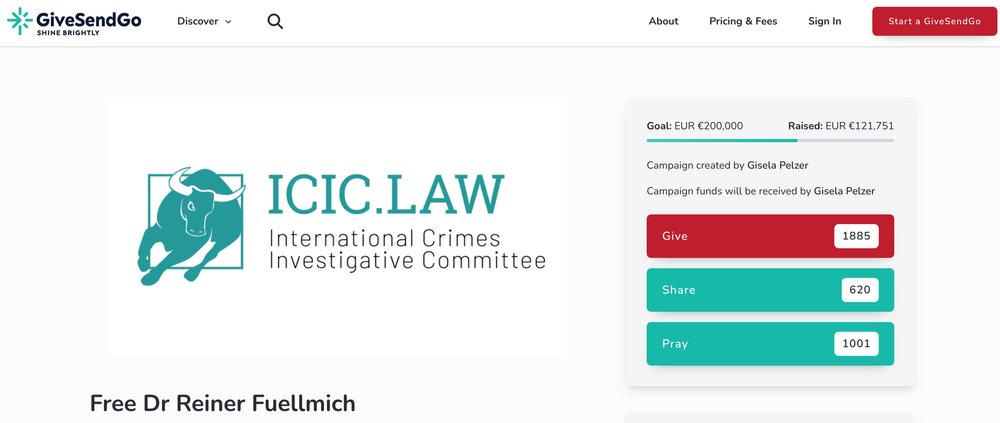
Even while in prison, Fuellmich continued to raise money from the public. A GiveSendGo crowd funder organised by a certain Gisela Pelzer has a €200,000 target and has so far raised €121,681. The funds will allegedly be used to “alleviate the overall situation that is affecting Dr. Reiner Fuellmich and his family." Any funds remaining after Fuellmich’s imagined release will “support ICIC.law’s ongoing mission for transparency and justice.” The irony is palpable.
PART 4 will conclude this series by considering Fuellmich's background in Scientology and the lessons to be learned from the CIC scandal by the "alt media."
Support My Work
If you valued this content and are not a paid subscriber, please consider leaving a one-off tip for an amount of your choosing.
If you would like to make a one-off or recurring donation to help fund my work in general, I would be most grateful. There are numerous ways of doing so.
If you have not done so already, please consider taking out a subscription – free, paid, or gold-tier.