Omniwar 4: The Capture of Academia
October 10-11, 2026. Sign up now to register your interest!
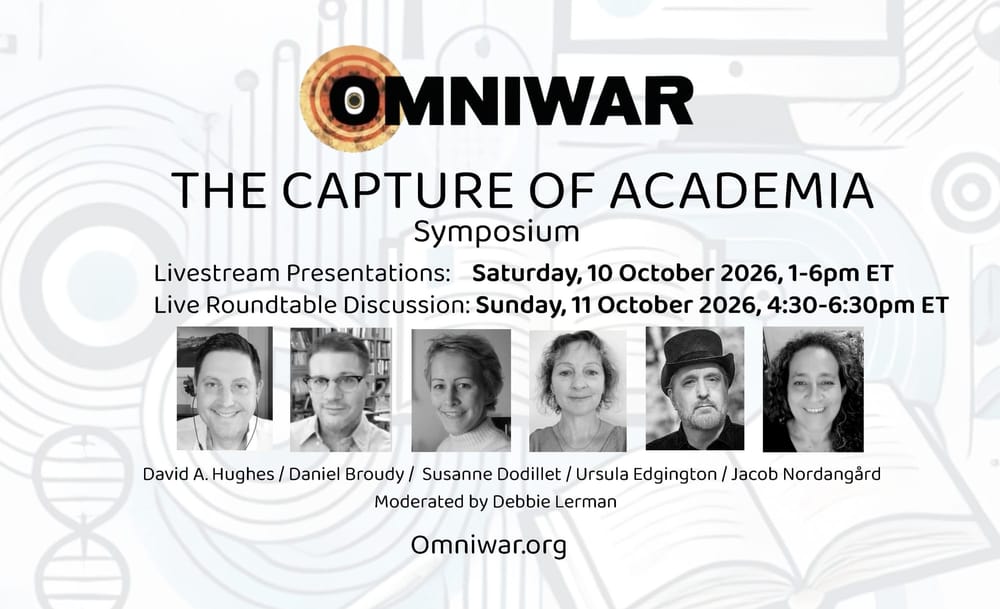
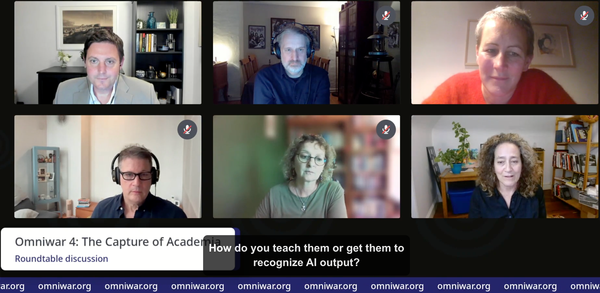
It gives me great pleasure to announce the fourth Omniwar symposium, due to take place on the weekend of 10-11 October, 2026. The theme of the symposium will be The Capture of Academia, and we are delighted to announce Debbie Lerman as moderator.
The Study Group on Technology and Power returns bigger and better than ever. This time, there will be five presentations instead of four. They will go out on Saturday October 10. A roundtable discussion will be livestreamed on Sunday October 11.
Please sign up at https://www.omniwar.org/ to register your interest.
Donations to support the work of the Study Group on Technology and Power can be made at https://opencollective.com/omniwar.
Abstracts
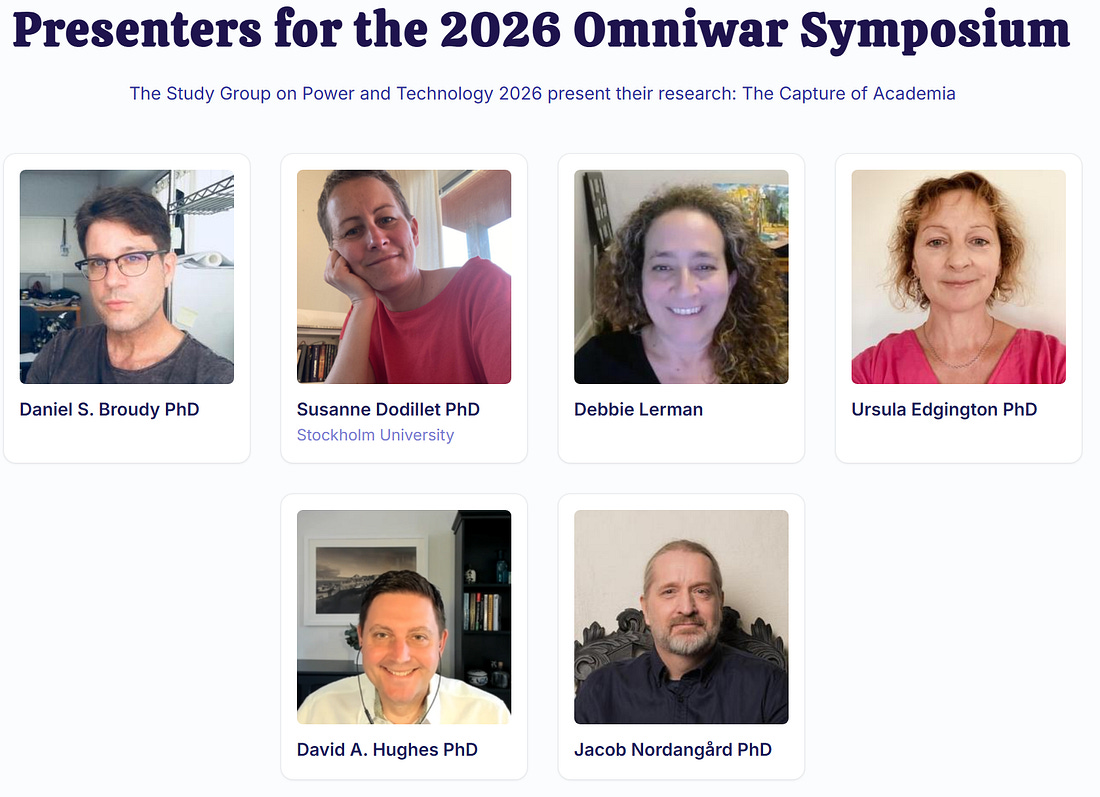
David A. Hughes, Ph.D., “Academia and the National Security State”
Contrary to claims about “academic freedom,” Anglo-American academia has been deeply embedded within the national security state since World War II at least, when scientific knowledge was secretly harnessed by the military, e.g., in the Manhattan Project. After the war, 70% of research funding in the United States came from federal agencies, with most of the rest coming from foundations such as Ford, Rockefeller, and Carnegie.
The CIA exerted a powerful influence, as, for instance, when 44 US universities participated in MKULTRA research, or through the CIA’s covert control of social science research at leading universities to find more efficient ways of controlling human behaviour through “social engineering.” A new breed of “defence intellectuals” arose whose purpose was to serve power rather than apply any kind of critical thinking that might benefit society. They included war apologists, counterinsurgency experts, and specialists in psychological operations.
When the extent of these problems was revealed in 1967/68, there was an outcry, yet decades later the capture of academia remains evident in its refusal to apply critical thinking to deep structural events such as “9/11” and “Covid-19” and its cheerleader role for official narratives. This marks a significant failure in academia’s much-vaunted civic duty and gives the lie to the idea that academia speaks truth to power in any fundamental sense.
Jacob Nordangård, Ph.D., “The Capture of Academia – The Case of Climate Change”
In 1988, the threat of anthropogenic climate change was declared as a common concern for mankind by the United Nations General Assembly. The same year, the International Panel on Climate Change (IPCC) was founded by WMO and UNEP to assess the science of humaninduced climate change. The Cold War was about to be replaced by the “Warm War”.
This marked a remarkable paradigm shift in which researchers confirming this theory would henceforth be allocated enormous resources compared to researchers questioning the “scientific consensus” and highlighting natural climate variations. The former would be heralded as heroes whereas the latter would to a large degree be ostracized and branded as climate deniers funded by the oil industry. How did this happen?
My lecture outlines the roots of the anthropogenic climate change theory, its close connections to eugenics, the technocratic management of human and natural resources, and how climate change became anchored as a key concern for academic research in natural as well as social sciences. This refers in particular to how the Rockefeller Foundation, Rockefeller Brothers Fund and affiliated organizations methodically worked to influence the direction of academic research —through key institutions such as the Scripps Institution of Oceanography in California and the International Meteorological Institute (IMI) at the Stockholm University—since the 1950s, with the ultimate goal of establishing a world-wide digital climate mitigation system. As stated in the Rockefeller Brothers Fund’s 2005 Annual Review: “The warming of the climate is […] a global issue that touches every conceivable facet of human society. Therein lies our opportunity.” Climate change is ultimately about global social, political and economic control.
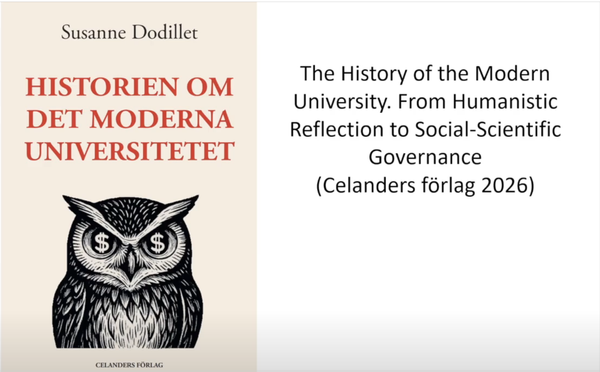
Susanne Dodillet, Ph.D., “From Humanist Reflection to Social-Scientific Governance: The Corruption of the Modern University”
The university is usually pictured as a free sphere, a place of disinterested inquiry, critical thinking and individual responsibility, insulated from politics and the market. Even its critics tend to treat whatever falls short of this ideal as an unfortunate aberration rather than an expression of the institution itself. This talk takes a more sober starting point. My claim is not that particular studies are biased or particular fields compromised, but that the modern university as a whole operates as a propaganda instrument: not an autonomous sphere but both an object and an instrument of governance, and the keystone of the technocratic expert society we inhabit.
Working from the Swedish case, I trace how the university was remade over the twentieth century from a site of humanist reflection into an apparatus of social-scientific governance. The decisive impulse came from American research philanthropy, whose large-scale investments built up an empirical social science designed to make society measurable and steerable: an instrument of social control. Once social questions were recast as objects of measurement, the social ceased to be a moral and political matter and became a technical one, and those who paid for the mapping also defined the problems to be mapped and the direction in which they were to be solved. A welfare state grew up around these structures that cared for people while quietly disarming their capacity to resist the concentration of power that built it. What made this possible was not any single discipline but the institution as a whole: nothing conceals an apparatus of governance better than the good name of free, truth-seeking science.
This is what makes the modern university corrupt in a structural rather than an anecdotal sense: it is not the quality of thought but the interests of its funders that decide which questions are asked and which answers gain authority. Today the expansion of steerability takes new forms: information-gathering intensified through digitalization and ever denser surveillance, with the university still serving as the developer that realizes it, as newly endowed research centres present new technologies as science and public benefit that everyone is expected to welcome.
This talk draws on my book Historien om det moderna universitetet. Från humanistisk reflektion till samhällsvetenskaplig styrning (Celanders, 2026).
Ursula Edington, Ph.D., “How & Why Corruption & Propaganda Infiltrates Teacher-Education”
“How did we get into this mess?”…is a common question in this post-Covid era. The widening recognition that our current global turmoil is the result of a strategic plan, rather than a series of mistakes (and that the labelling of that strategic plan as a ‘conspiracy theory’ is itself, an intrinsic part of that same plan) often amplifies our ‘freeze’ response to fear. That’s why it’s crucial to objectively uncover the corporate playbook strategies that indoctrinate generations: teacher-education.
Educational policies therefore present valuable analytical tools. Here, I take a root cause analysis approach to examine teacher-education curricula, presenting insights into how and why populations are vulnerable to the technocratic weapons of this silent war.
Drawing on Australasian and UK data as case-studies, I expose how universities’ teacher education programmes suppress ‘uncomfortable knowledge’ and silence dissenting voices. Student-teachers’ access to broad curricula, good quality teaching and unbiased learning resources are restricted. The institutions that train schoolteachers are devoid of opportunities that develop critical thinking skills and authentic debate. This is because hidden forces limit, manipulate and cancel research publications and thereby skew learning resources, preventing academic freedoms. Awareness of, and ways to navigate academia’s corporate playbook, including recognition of propaganda used in behavioural science, have been censored. This exacerbates the distortion of facts for student-teachers and future pupils. The subsequent negative impacts on schools, families and wider societies are catastrophic. Finally, I suggest ways to counter this infiltration of globalist agendas in teacher-education programmes.
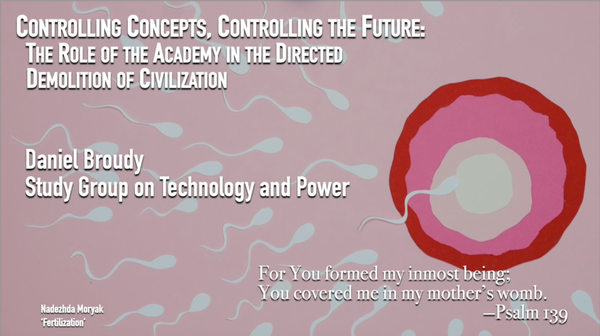
Daniel Broudy, Ph.D., “Controlling Concepts, Controlling the Future: The Role of the Academy in the Directed Demolition of Civilization”
In 2015, during his tenure as Chairman of the World Economic Forum, Klaus Schwab described the Fourth Industrial Revolution as a transformation that changes not what we do but who we are. His description of some mysterious inexorable process, which few members of the public appeared to notice at the time, offer profound insights about actors in places of power and influence and how their mental processes work to conceptualize the masses.
Since concepts precede words, language serves as the common denominator for our intellectual transactions, both in the academy and in broader society, and therefore must also be the first site where the modification of meaning is made to alter basic conceptual categories. The reconstruction of society toward the “New Normal” is typified by how we think and speak about the ongoing sacrifice of the center of societal and cultural reproduction: the family unit. As envisaged by the major investors in global governance by technological means, elite institutions of higher learning such as Harvard, Princeton, Yale, Cambridge, and Oxford have lead the global campaign in dismantling key concepts that, for millennia, delineated males from females.
The capture and control of academic discourse point to the successful capture of the Western academy now responsible primarily for remolding young minds to fit a future of total unquestioning servitude. This presentation considers the disintegration of the Western academy in the Covid-19 world as another causal link in the long chain of events organized to disrupt, disintegrate, and deploy anti-scientific thinking about the natural world, about creatures and creation. Enlisted in the effort to critique the reengineering of our perceptions of the human body are theories in Gestalt psychology and cognitive linguistics.
Support Our Work
Please help to support the work of the Study Group on Technology and Power by visiting https://opencollective.com/omniwar.