Manufacturing Compliance
Reliance on Public Acquiescence; Rule Following; Internalising New Behaviours; Public Transport; Maladaptation; Waning Compliance; Omicron; Learned Helplessness; Accepting the Unacceptable
I am publishing sections of “Covid-19,'“ Psychological Operations, and the War for Technocracy, Volume 2, in advance on my website.
In what follows, I consider the extraordinarily high level of public compliance with the “measures” during Covid, arguing that the public was essentially subjected to a complex form of obedience training.
Reliance on Public Acquiescence
The entire “Covid-19” operation rested on public acquiescence to tyranny.
Of course, it was not framed that way. Officially, the narrative was that the public had to comply with “the measures” in order to “save lives” and prevent hospitals from becoming overwhelmed (a myth, see Hughes, 2024a, pp. 128-133).
According to minutes from the Scientific Advisory Group for Emergencies on March 16, 2020, “Compliance with the measures by the public is key” (SAGE, 2020). The gamut of techniques from applied behavioural psychology was used to promote compliance.
“Will a majority of us — or not — abide by the rules?,” asked Schwab and Malleret (2020, p. 28). Evidently, “Covid-19” was, at one level, a gigantic compliance test.
The public was instructed to consent to new forms of behaviour that were typically harmful and/or absurd, especially in the absence of symptoms of illness. These included not leaving the house (“lockdown”), standing six feet apart from other human beings (“social distancing”), deliberately not seeing other people (“self-isolation”), closing businesses (even if it meant going out of business), not visiting friends and family, standing on one’s doorstep and beating pots and pans at a prescribed time (“clap for carers”), obsessively sanitising hands, following pointless one-way systems, standing on designated floor stickers, allowing a (temperature) gun to be pointed at one’s forehead and providing contact details to enter buildings, impeding one’s own airways (“masking”), not meeting in groups larger than six people, not hugging people, downloading contact tracing apps and obeying their instructions, taking invasive swab tests, and receiving unlicensed, experimental injections with no long-term safety data into one’s own body.
Despite some well-known cases of police overreach (e.g. using drones to photograph and shame hikers in Derbyshire [Mendick & Hymas, 2020], telling fish and chip shop workers to wear face masks in the heat, and inspecting people’s shopping trolleys for “non-essential” items [Bienkov, 2020]), the “measures” were, in general, not rigidly enforced by the state — how could they be? Rather, they were heavily reliant on public acquiescence and getting the public to police itself (Hughes, 2024a, p. 289).
David Martin observed as early as April 20, 2020, “This is a giant exercise in social engineering and social research. We are being studied. We’re being studied to see how complicit we get” (Martin, 2020). The starkest example of this, for Martin, was mask wearing in a non-clinical setting, an overt sign of compliance and susceptibility to propaganda. The “Covid simulation,” as he referred to the fake “pandemic” (cf. Hughes, 2024a, pp. 221-227), was a test of how much the public was willing to surrender its standard of living. The answer, for Martin (2020), was “exceptionally willing. In fact, many friends are now shaming one another, because they’re not complicit and compliant enough.”
A drop in compliance levels was seen as cause for concern. Tony Blair, for instance, told Imperial College’s Neil Ferguson in November 2020:
One of the huge problems we have in the UK is compliance has dropped. [...] One other issue which is very difficult is the degree to which – I think politicians find this very challenging – how far are the public prepared to go in accepting quite tough surveillance in order to get on top of the disease. Because if you look at a country like South Korea, they [have taken measures on surveillance pretty close to China] even though South Korea is a democracy and China isn’t. [...] Personally I think the public is prepared for some quite draconian measures if they see it’s according to a plan and it actually can work. (cited in Johns & Mehta, 2020)
In other words, why can the West not be more like China with its compliant populace? This has been a recurrent theme among Western politicians (Hughes, 2024a, p. 19).
Rule Following
The “rules” were a form of obedience training, getting the public more and more used to obeying instructions (“following government guidelines”), even though the consequences were harmful to individuals and society at large.
In a spoof designed to satirise the disturbingly high level of public compliance, a man in a tracksuit displaying no security credentials stood at a store entrance, got people to raise their arms out wide by modelling that behaviour, then pointlessly swept them with a lint brush — and apparently no one objected (see Tyler Thompson, 2021, 56:00).
For those with enough self-respect, dignity, and independence of mind, it was obvious that the “measures” were all about control and not public health (Devlin, 2020). The overwhelming majority of people, however, did exactly as they were told, exhibiting “blind faith and robotic obedience” to the cues directing their behaviour (Scott, 2021).
The more ridiculous or dangerous the rules were, and the more the public acquiesced to those rules entering into every space of their lives, including the most private spaces where the government had no right to intrude, the more powerful the conditioning became.
The UK Government, for instance, “banned” having sex with people from other households and maintained that “rule” into 2021 (Cole, 2020; Steafal & Hall, 2021). The Terrence Higgins Trust advised that “people avoid kissing, wear a face covering and choose positions that aren’t face-to-face” during sex (“Sex and Covid: What are the Rules?,” 2021). The British Columbia Centre for Disease Control recommended the use of “glory holes” to “prevent close face-to-face contact” (“Covid-19 and Sex,” n.d.).
From Legal Requirement to Social Norm: Internalising New Behaviours
In March 2021, UK Health Secretary Matt Hancock claimed that he hoped face masks would become the norm on public transport as a matter of “personal responsibility” (Roberts, 2021a). In May, the Prime Minister likewise emphasised “personal responsibility” with respect to “social distancing” as part of the way out of “lockdown” (HM Government, 2021, p. 3). The public was thus primed to internalise those anti-human behaviours as moral.
On July 5, 2021, Prime Minister Boris Johnson stated explicitly what the government’s next move was:
We will change the basic tools that we have used to control human behaviour. We will move away from legal restrictions and allow people to make their own informed decisions about how to manage the virus. (Prime Minister’s Office, 2021a)
In order to facilitate government “control of human behaviour” (!), so-called “experts” all propounded the same line that mask wearing was the “right” thing to do, in order to “protect others,” regardless of any legal requirements.
The Evening Standard, for example, cited a host of healthcare leaders in an article from July 5, 2021, including:
- the chairman of the BMA, Chaand Nagpaul (“at a time when we have a high level of cases, we cannot understand why we would knowingly want people to become infected”),
- the medical director of Primary Care for NHS England, Nikki Kanani (“if there is advice to keep wearing masks, I know I will and I’ll be encouraging others to do so as well”), and
- the national medical director of NHS England, Stephen Powis (“There may be occasions in the next few months in a crowded environment where I might choose to wear a mask and I’m sure others will make similar choices”). (cited in Murphy, 2021)
No science was provided to support those claims; the public was simply expected to trust authority figures (also including SAGE’s Callum Semple and the Mayors of London and Manchester, Sadiq Khan and Andy Burnham).
The government wanted businesses to act as enforcers of the “norm of responsibility” — for instance, no mask, no entry/service. As SAGE’s Semple told Times Radio,
There’s no reason why businesses which have made their own assessments cannot say actually, If you come in here we still want you to wear a mask. They can’t mandate it, but neither are businesses mandated to have to serve you [...]. (cited in Sharman, 2021)
Yet, it was equally possible for businesses, if they so choose, to do the opposite, viz. a sign seen on a business in Texas in May 2021:
STOP. Your mask makes everyone inside uncomfortable. NO MASKS ALLOWED. Violators are trespassing.
The “norm of responsibility” obviously looked very different, depending on whether one believed in controlling human behaviour through psychological operations or not.
England’s Chief Medical Officer, Chris Whitty, set out three scenarios in which he would continue to wear a mask from July 19, 2021, namely, in crowded indoor spaces; if required to do so by a “competent authority”; and in order to make others feel more comfortable (Glover, 2021).
Health Secretary Sajid Javid claimed that anyone refusing to wear a mask in an enclosed space was “just being irresponsible” and that for the “foreseeable future I will be carrying a face mask because it is the sensible thing to do” (cited in Mackay, 2021 and Robinson, 2021).
The “Vaccines Minister,” Nadhim Zahawi, stated, “We’re moving from ‘you must’ to ‘you are expected’ to wear a mask in indoor spaces” and that wearing the mask “will help the whole country” (cited in Mackay, 2021).
Mask wearing thus moved from being a legal requirement in certain settings to a social norm promoted by government ministers and “experts” and enforced, in certain settings, by private companies. The pressure to comply remained.
Public Transport
Public transport would be the key testing ground for compliance regarding mask mandates. Health secretary Javid said that masks would be “recommended” on public transport, though there would be no fines for the unmasked from July 19 (“Covid: Bus and train firms must decide whether to require masks,” 2021). This effectively turned enforcement obligations for mask wearing over to private companies.
Transport For London announced that mask wearing would remain compulsory on the Underground. National Rail’s position was that “Operators will be implementing the government’s new guidance and at a minimum expecting customers to wear a face covering in crowded spaces, out of respect for others [...]” (National Rail, 2021). The budget airline EasyJet announced it would be retaining the face mask requirement (Robinson, 2021).
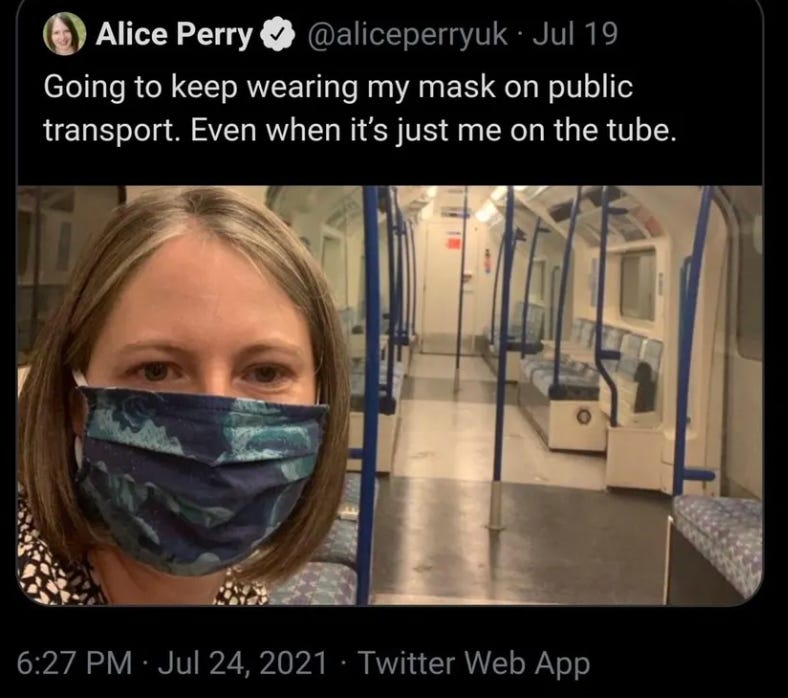
Labour’s Alice Perry (2021) tweeted a farcical picture of herself in an empty tube carriage on July 19, 2021, adding, “Going to keep wearing my mask on public transport. Even when it’s just me on the tube.”
The same kind of virtue-signalling nonsense persisted as late as January 28, 2022, when “TV doctor” (propagandist) Amir Khan tweeted “On the train to London, still wearing my mask. Thinking of those more vulnerable than myself.”

On July 22, 2021, the UK Government and NHS released a propaganda piece fronted by Khan, pushing for the public to continue adopting measures previously in place, e.g. mask wearing, social distancing (the piece showed someone dangerously jumping into the road to avoid other people), hand washing, twice weekly testing, self-reporting positive test results, using the NHS app to check into venues, opening windows, etc. “Even if you have been vaccinated,” Khan (2021) claimed, “you can still get Covid-19 and you can still pass it onto others.” It was as though “vaccination” were pointless and as though restrictions in the UK had not been lifted 72 hours earlier.
By mid October, over 215,000 people had reportedly been prevented from using public transport unless they wore a mask (“Covid-19: Thousands prosecuted,” 2021).
Maladaptation
In the Stanford Prison Experiment, those who adjusted most rapidly to the experimental conditions of prison life were able to minimise the degradation and harassment meted out by the guards (Perlstadt, 2018, p. 52).
The same idea of going along to get along was evident with respect to the Covid “measures.” Those who adapted most easily to being “locked down” did not have to deal with the angry stares coming from mask wearers, the social ostracisation, the awkward conversations with colleagues, vilification by the legacy media, “vaccine” apartheid, etc. (cf. Hughes, 2024a, Chap. 7). Life was comparatively easier for them.
The obedience training was so powerful that even when mask mandates were lifted in most places in the UK on July 19, 2021, there were still many people who voluntarily wore masks in shops and elsewhere, even when there was no legal requirement to do so.
The Guardian reported on August 20, 2021, that nine in ten people were still wearing masks at least some of the time (Rawlinson, 2021), although this was likely an exaggeration to encourage the practice.
Similarly, in the United States, many Americans still wore masks outdoors even after the CDC had told them there was no longer a requirement to do so (Stein, 2021).
At this point, it was evident that large numbers of people had been trained like animals to comply at all times, even when there were no consequences for non-compliance.
After enough time, trained habits can become ingrained, even pathological ones. It is known, for instance, that long-term prisoners can become institutionalised and may struggle to cope with “normal life” upon their release, sometimes deliberately reoffending in order to go back to jail. For some Gulag prisoners, Adler (2010, p. 228) notes, “a psychophysiological adaptation [needed to cope in the prison environment] persisted beyond the prison experience, rendering it a pathophysiological maladaptation” in everyday society.
Wearing a mask when not “required” to do so constituted a similar maladaptation, especially outdoors or if nobody else was nearby.
Waning Compliance Levels
Notwithstanding the maladaptations in people, levels of compliance did wane into autumn 2021. For example, according to the BBC on October 22, 2021, Brits had become “increasingly lax on masks and social mixing,” with only 39% claiming to observe “social distancing” (down from 63% in July) and an alleged 82% claiming to wear the mask (down from 97% in mid-June, but still a high proportion if true) (Roberts, 2021b).
Health Secretary Sajid Javid cautioned that restrictions may need to return “If people don’t wear masks when they really should [...]” (cited in Roberts, 2021b).
On November 18, 2021, the World Economic Forum published an article titled, “Is physical distancing on the decline?,” which expressed concerns about the “gradual decline in compliance with recommended COVID-19 behaviors” (Dabla-Norris et al., 2021).
On November 24, 2021, Mick Lynch, the General Secretary of the Rail, Maritime and Transport union, claimed that mask wearing was being “openly ignored on a large scale” on the London Underground (“Mask-wearing ‘openly ignored on a large scale,’” 2021).
Omicron
As if by magic, a new “Variant of Concern” was reported to the WHO on November 24, 2021 and was formally named “Omicron” two days later.
On November 27, 2021, the UK government announced that face coverings would be made compulsory again on public transport and in shops (implying lack of faith in the “vaccines”), though Health Secretary Javid went on to state that the mandate would be rescinded if Omicron proved less dangerous than Delta (Sparrow, 2021).
Chief Medical Officer Chris Whitty claimed that his “greatest worry” was public non-compliance: “can we still take people with us?” (Parkinson, 2021).
Only two “cases” of Omicron had been detected in the UK at that point. More rational minds might have agreed with the Spectator: “We should all refuse to comply with this illegitimate mask edict until the government backs down or shows that there is indeed an emergency that can justify such a [measure]” (Lilico, 2021).
Psychological warfare is designed to prevent rational thinking, however.
The “threat” from Omicron existed only in the predictably scary forecasts by SAGE, which consistently proved to be grossly exaggerated (Spectator, n.d.), and in rhetoric of an imminent “tidal wave” or “tsunami” of Omicron cases emanating from Boris Johnson and Scottish First Minister Nicola Sturgeon, respectively (Prime Minister’s Office, 2021b; First Minister, 2021).
The first death linked to Omicron in the UK did not occur until December 14, 2021. By December 18, 2021, the number of such deaths was just seven, with 85 hospitalisations linked to Omicron (Fahey, 2021).
As always with “Covid-19,” it was impossible to discern causation because a positive test result (for specific nucleotide sequences) does not imply an infection (active virus), which in turn does not imply disease (because of the immune system), let alone death from that disease (because of other possible causes).
Eventually, “Omicron” was dismissed as no more severe than the common cold.
Learned Helplessness
When the government’s “threat” level for the Omicron variant was raised to four out of five in December 2021, a well-trained British public did not need to be told what to do. Britons started locking themselves down:
Without so much as a new law, statutory instrument, or prime ministerial request, Nativity plays, office Christmas parties and pub bookings [were] cancelled. Stocks of lateral flow tests ran dry. People queued for eight hours for their boosters. (Dodsworth, 2021)
“I can’t believe it’s not lockdown,” (Littlejohn, 2021) observed, “with Christmas in disarray, city centres once again deserted and shops, bars and restaurants bereft of customers.”
We are looking here at a form of learned helplessness. Seligman (1972) showed that two thirds of dogs subjected to electric shocks and unable to escape from their environment did not even try to escape in subsequent experiments where, like the control group, they could have simply jumped over a small barrier to get away. The dogs had been conditioned to believe that nothing they could do would make any difference (not unlike depression in humans). Seligman’s later research on “positive psychology” sought to help people overcome learned helplessness, but was twisted by the CIA in the early 2000s into ways of inducing learned helplessness in target subjects (Corbett, 2025).
In the “Covid-19” context, a significant segment of the population did not even think to look for a way out from the oppressive measures that had been imposed upon it, even when the door was wide open.
The maladaptations in such cases were severe, yet were deliberately encouraged by, for instance, footage of a “boosted” President Biden walking along a beach with a mask on next to his unmasked wife (Nerozzi, 2021) — completely irrational behaviour that presumably was staged to encourage similarly irrational behaviour in members of the public.
When the UK Government rescinded mask mandates in most public places in January 2022, over 100 head teachers shamefully wrote to parents warning that children must continue to wear face masks in classrooms (Turner, 2022). They had been conditioned to believe that restricting the airways of children and forcing them to live in a surreal environment in which facial expression was significantly hindered was a good thing.
On the other hand, social tensions regarding the “measures” were evidently rising. For example, when masks were made compulsory in UK supermarkets and local stores on December 10, 2021, the Association of Convenience Stores, representing 33,500 local shops, stated that it did not expect staff to challenge unmasked customers as it could be “a major trigger for abuse” (Byrne, 2021). The British Retail Consortium, representing shops across the UK, claimed that enforcement was a matter for the police.
2022: Measures Rescinded, Norms Remain
The “Covid-19” operation was unexpectedly wound down in early 2022, with most “measures” being rescinded in most places.
Nevertheless, the norms that had been established around those measures remained.
For example, with “Covid-19” having officially become “endemic,” the UK Government announced its “Plan for living with Covid,” in which “vaccines and other pharmaceutical interventions” were still the “first line of defence,” supported by “surveillance systems” and “increased testing capacity” where necessary (Prime Minister’s Office, 2022). In other words, there was nothing wrong in principle with the “measures”; biosecurity had been normalised.
Face masks were perversely retained in healthcare settings, such as GP surgeries, hospitals and care homes, as though they were beneficial rather than harmful (cf. Hughes, 2024a, p. 89). In line with “government guidelines,” major retailers continued to ask staff and customers to wear masks, and Transport for London “strongly encouraged” mask wearing even though it was no longer “mandatory” (“What are the latest rules for face coverings and masks?,” 2022).
Mask zealots would not let go of their obsession. Oxford’s Trisha Greenhalgh, for instance, as late as March 18, 2022, claimed on national television “Let’s get used to wearing masks until the pandemic is actually over” (Good Morning Britain, 2022). Susan Hopkins, the Chief Medical Adviser of the UK Health Security Agency, claimed the following week that “the pandemic is not over” and urged Britons to wear masks in enclosed spaces, limit contact with others, and get “vaccinated” (cited in Craig, 2022).
On April Fool’s Day, 2022, the UK Health Security Agency (2022) reiterated the “simple things you can do in your daily life that will help reduce the spread of COVID-19 and other respiratory infections,” including “get vaccinated,” “let fresh air in,” “practice good hygiene,” and “wear a face mask.” The situation had changed, but the advice had not.
Looking to the Future
In the sober assessment of Whitehead & Whitehead (2022),
What has unfolded over the past few years has been a test to see how well “we the people” have assimilated the government’s lessons in compliance, fear and police state tactics; a test to see how quickly “we the people” will march in lockstep with the government’s dictates, no questions asked; and a test to see how little resistance “we the people” will offer up to the government’s power grabs when made in the name of national security.
What lessons, then, were learned?
For critics such as Bell (2023), there is reason to be pessimistic about the public’s apparent willingness to comply with tyranny:
The public’s acquiescence to increasing and institutionalizing of restrictions seems likely, as the German public acquiesced to similar measures in the 1930s. An underlying fear of death, fed by a false but very broadly supported narrative, worked in the 1930s, worked from 2020 to 2022, and seems likely to work again. Keeping “us” safe in the context of a threat that causes individuals to feel powerless is a difficult paradigm to oppose.
Professor David Halpern, the head of the UK’s “nudge unit,” told the UK Covid Inquiry that the public would comply with future “lockdowns,” because it “know[s] what the drill is” (cited in Investigations Team, 2023). For once the public has learned a new behaviour, “in principle, you can switch it back on.” As with muscle memory, “once you’ve exercised those muscles, they’re more likely to be reused again.”
Halpern here treats members of the public like trainable animals. Like a horse that has been trained to accept the bridle, the public has, on Halpern’s view, been trained to accept “lockdowns.” It has been tamed and made easier to control. This has nothing to do with conscious thought processes or a rational evaluation by the public that “lockdowns” are a good thing. Rather, it is about training the “Automatic Brain” so that it responds instinctively, like muscle memory.
Troublingly, Halpern also told the UK Covid Inquiry that major disasters leave an “enduring trace on society.” This recalls Klaus Schwab’s observation in 2020 that “the cut which we have now is much too strong in order not to leave traces” (cited in Hughes, 2024a, p. 98). As I argued in Volume 1, Chapter 3, we are dealing here with trauma-based mind control aimed at inducing long-term public compliance through a fear of reliving the original trauma. Halpern’s remarks were far from innocent.
Accepting the Unacceptable
Someone who lived through the Third Reich later reflected on his experiences:
On this new level you live, you have been living more comfortably every day, with new morals, new principles. You have accepted things you would not have accepted five years ago, a year ago, things that your father, even in Germany, could not have imagined. (cited in Mayer, 2017, p. 171)
Similar was true of the “Covid-19” operation. The abnormal and the unacceptable were normalised. The fact that “lockdown” is now an accepted term with society-wide application (as opposed to just being a prison term) is a disgrace. No one before 2020, in the West at least, could have imagined that it would ever be considered “normal” to put a piece of cloth over one’s mouth when going out in public. Nor was it conceivable that receiving an experimental substance into one’s body would be deemed necessary to be able to go on holiday or be allowed on campus or do certain jobs or access certain venues. Yet, all these things were accepted by the majority, undermining the standards of civilised society.
Granted, the “measures” were eventually rescinded. But they have not been deemed socially unacceptable, as they should be. Rather, if Halpern is correct, the general public will simply go along with any future “lockdown” (Investigations Team, 2023).
One is reminded of the videos which emerged in April 2022 of passengers on US airlines rejoicing and removing their masks when the end of the federal transportation mask mandate was announced (“Video Shows Exact Moment Plane Mask Mandate Lifted,” 2022). Evidently, the passengers did not enjoy wearing masks, but they were willing to comply anyway. Presumably, they would put them straight back on if told to do so.
Conclusion
Notwithstanding the impact of those who did resist, the obedience training was powerful and largely successful in 2020/2021. Most people simply went along with what they were told to do, no matter how ridiculous, degrading, unscientific, or harmful to themselves and others.
It did not take long before the public had been conditioned to accept a range of anti-human behavioural modifications, including queueing two metres apart (even if meant vulnerable people standing outside in the cold), following traffic light systems to get into supermarkets, wearing masks, sanitising hands, robotically following one-way systems, and suffering the indignity of having a (typically young) employee provide instructions about how to shop in store. It was orchestrated insanity, and the majority went along with it.
The power of propaganda and of the law was enough to get the masses to do as they were told in the first instance. But even when legal requirements were dropped and measures were formally rescinded, the internalised norms of the “new normal” meant that people continued to display maladaptive behaviours and learned helplessness. They had been trained to behave a certain way.
The concern going forwards is whether the majority will simply fall back into behaving like trained animals in the event that a future “lockdown” is declared (and it could be an "energy lockdown" or a "climate lockdown"). Is Halpern right that the public will “know what the drill is” (Investigations Team, 2023)? Has a dangerous precedent been set which normalises the unacceptable?
Or will enough people learn the power of non-compliance, so that they no longer need to live like dogs doing their master’s bidding?
References
Adler, N. (2010). Enduring repression: Narratives of loyalty to the party before, during and after the gulag. Europe-Asia Studies, 62(2), 211-234. https://doi.org/10.1080/09668130903506797.
Bell, D. (2023). Pandemic preparedness and the road to international fascism. The American Journal of Economics and Sociology, 82, 395–409. https://doi.org/10.1111/ajes.12531.
Bienkov, A. (2020, April 9). A police chief threatened to start checking shopping trolleys for ‘unnecessary’ items during the UK coronavirus lockdown. Business Insider. https://www.businessinsider.com/coronavirus-uk-police-chief-threatened-to-check-shopping-trolleys-2020-4.
Byrne, F. (2021, December 29). “I visited Aldi, Tesco and Waitrose and was shocked with the lack of masks in one of the shops.” MyLondon. https://www.mylondon.news/whats-on/shopping/i-visited-aldi-tesco-waitrose-22584181.
Cole, W. (2020, November 30). Sex ban for couples living apart in tier 2 areas WILL continue, confirms Matt Hancock at Downing Street briefing.” Daily Mail. https://www.dailymail.co.uk/news/article-9002657/Sex-ban-couples-living-apart-Tier-2-areas-continue-confirms-Matt-Hancock.html.
Corbett, J. (2025). Episode 483 — Dissent into madness. The Corbett Report. https://corbettreport.com/dissent-into-madness/.
COVID-19 and sex. (n.d.). BC Centre for Disease Control. https://web.archive.org/web/20200801031710/https://www.bccdc.ca/health-info/diseases-conditions/covid-19/prevention-risks/covid-19-and-sex.
Covid-19: Thousands prosecuted over London Transport mask rules. (2021, October 20). BBC News. https://www.bbc.co.uk/news/uk-england-london-58982948.
Covid: Bus and train firms must decide whether to require masks. (2021, July 13). BBC News. https://www.bbc.co.uk/news/business-57813402.
Craig, E. (2022, March 24). Covid’s comeback continues as daily cases hit 98,000, hospital admissions climb 11% and infections rise in EVERY authority in England — as scientists start calling for ‘people to isolate with cold symptoms’ AGAIN. Daily Mail. https://www.dailymail.co.uk/news/article-10643147/Covids-comeback-continues-daily-cases-hit-98-000.html.
Dabla-Norris, E, Lima, F., & Khan, H. (2021, November 18). Is physical distancing on the decline?” World Economic Forum. https://www.weforum.org/agenda/2020/11/physical-distancing-decline-covid19-coronavirus/.
Devlin, M. (2020). A furious rant — How much more are people going to take? Why is no one getting mad? [Video]. Bitchute. https://www.bitchute.com/video/EDivwThVn7dQ/.
Dodsworth, L. (2021, December 18). A week of life under the ministry of fear. Laura Dodsworth.
Fahey, R. (2021, December 18). Seven dead with Omicron Covid variant as people in hospital with new strain soars to 85. Daily Mirror. https://www.mirror.co.uk/news/uk-news/breaking-omicron-covid-deaths-rise-25732706.
First Minister. (2021, December 10). Coronavirus (COVID-19) update: First Minister’s statement – 10 December 2021. https://www.gov.scot/publications/coronavirus-covid-19-update-first-ministers-speech-10-december-2021/.
Glover, E. (2021, July 6). Chris Whitty on the three times we should still wear a mask after July 19. The Independent. https://www.independent.co.uk/news/uk/home-news/chris-whitty-masks-lockdown-covid-b1878776.html.
Good Morning Britain. (2022, March 18). Let’s get used to wearing masks until the pandemic is actually over. Dr Trisha Greenhalgh disagrees and believes now is [Tweet]. Twitter.
HM Government. (2021). Social Distancing Review. https://assets.publishing.service.gov.uk/government/uploads/system/uploads/attachment_data/file/999413/Social-Distancing-Review-Report.pdf.
Hughes, D.A. (2024). “Covid-19,” Psychological operations, and the war for technocracy, volume 1. Palgrave Macmillan.
Investigations Team. (2023, July 6). Britain drilled to accept lockdown in future pandemics, says ‘nudge unit’ chief. The Telegraph. https://www.telegraph.co.uk/news/2023/07/06/britain-drilled-to-accept-lockdown-in-future-pandemics/.
Johns, S., & Mehta, R. (2020, November 4). J-IDEA symposium: Tony Blair on the challenges of the COVID-19 pandemic. https://www.imperial.ac.uk/news/207673/j-idea-symposium-tony-blair-challenges-covid-19/.
Khan, A. (2021). Let’s keep life moving. Department of Health and Social Care. YouTube.
Lilico, A. (2021, November 27). The problems with Boris Johnson’s mask mandate. The Spectator. https://www.spectator.co.uk/article/the-tyranny-of-boris-johnson-s-mask-mandate.
Littlejohn, R. (2021, December 16). Welcome to I can’t believe it’s not lockdown, with Christmas in disarray, city centres once again deserted and shops, bars and restaurants bereft of customers.” Daily Mail. https://www.dailymail.co.uk/debate/article-10318927/Welcome-Believe-Not-Lockdown-writes-RICHARD-LITTLEJOHN.html.
Mackay, H. (2021, July 11). Covid-19: Masks still expected to be worn indoors after 19 July - Zahawi. BBC News. https://www.bbc.co.uk/news/uk-57795409.
Martin, D. (2020, April 20). Butterfly of the week: Inside the simulation. YouTube.
Mask-wearing “openly ignored on a large scale” on London underground. (2021, November 24). ITV News. https://www.itv.com/news/london/2021-11-24/mask-wearing-openly-ignored-on-a-large-scale-on-london-underground.
Mayer, M. 2017 [1955]. They thought they were free. University of Chicago Press.
Mendick, R., and Hymas, C. (2020, March 26). Fed-up police take more extreme measures to ensure the public follow lockdown rules. The Telegraph. https://www.telegraph.co.uk/news/2020/03/26/fed-up-police-take-extreme-measures-ensure-public-follow-lockdown/.
Murphy, J. (2021, July 5). Experts clash with Boris Johnson as he moves to scrap compulsory mask-wearing in shops and on transport. Evening Standard. https://www.standard.co.uk/news/uk/boris-johnson-face-masks-transport-tube-experts-freedom-day-b944135.html.
National Rail. (2021, July 26). Face covering exemptions. https://www.nationalrail.co.uk/stations_destinations/250461.aspx.
Nerozzi, T. (2021, December 29). Biden mocked for wearing mask outside on Delaware beach: “Mask theater is so absurd.” Fox News. https://www.foxnews.com/politics/biden-wears-mask-delaware-beach-walk-first-lady.
Parkinson, J. (2021, November 27). Chris Whitty: Public would need to back more Covid curbs.” BBC News. https://www.bbc.co.uk/news/uk-59434196.
Perlstadt, H. (2018). How to get out of the Stanford prison experiment: Revisiting social science research ethics. Current Research Journal of Social Sciences, 1(2), 45-59. https://journalofsocialsciences.org/pdf/vol1no2/Harry%20Perlstadt.pdf
Perry, A. (2021, July 19). Going to keep wearing my mask on public transport. Even when it’s just me on the tube [Tweet]. Twitter.
Prime Minister’s Office. (2021a, July 5). PM statement at coronavirus press conference: 5 July 2021. https://www.gov.uk/government/speeches/pm-statement-at-coronavirus-press-conference-5-july-2021.
Prime Minister’s Office. (2021b, December 12). Prime Minister’s address to the nation on booster jabs: 12 December 2021. https://www.gov.uk/government/speeches/prime-ministers-address-to-the-nation-on-booster-jabs-12-december-2021.
Prime Minister’s Office. (2022, February 19). Prime Minister to set out plan for living with Covid. https://web.archive.org/web/20220219223307/https://www.gov.uk/government/news/prime-minister-to-set-out-plan-for-living-with-covid.
Rawlinson, K. (2021, August 20). Nine in 10 in UK still wearing masks despite end of Covid controls.” The Guardian. https://www.theguardian.com/world/2021/aug/20/uk-still-wearing-masks-despite-end-of-covid-controls.
Roberts, M. (2021a, March 8). Coronavirus: What are the rules for face masks or face coverings?” BBC News. https://www.bbc.co.uk/news/health-51205344.
Roberts, M. (2021b, October 22). Covid: Brits increasingly lax on masks and social mixing.” BBC News. https://www.bbc.co.uk/news/health-59009284.
Robinson, A. (2021, July 6). EasyJet has no plans to axe face masks even if Prime Minister lifts rule on July 19. The Express. https://www.express.co.uk/travel/articles/1458873/Easyjet-flights-face-mask-rules-travel-july-19-boris-johnson-latest.
Schwab, K., & Malleret, T. (2020). Covid 19: The Great Reset. World Economic Forum.
Scientific Advisory Group for Emergencies. (2020, March 16). Sixteenth SAGE meeting on Wuhan Coronavirus (Covid-19). https://assets.publishing.service.gov.uk/government/uploads/system/uploads/attachment_data/file/888784/S0384_Sixteenth_SAGE_meeting_on_Wuhan_Coronavirus__Covid-19__.pdf
Scott, B. (2021, May 2). We are all Pavlov’s dogs now. UK Column. https:// www.ukcolumn.org/article/we-are-all-pavlovs-dogs-now.
Seligman, M.E.P. (1972). Learned helplessness. Annual Review of Medicine, 23, 407–412. https://doi.org/10.1146/annurev.me.23.020172.002203.
Sex and Covid: What are the rules? (2021, May 11). BBC News. https://www.bbc.co.uk/news/newsbeat-53736087.
Sharman, J. (2021, July 6). Covid: Shops should be able to tell customers to wear masks, says SAGE adviser. The Independent. https://www.independent.co.uk/news/business/news/lockdown-covid-masks-shops-uk-b1878862.html.
Sparrow, A. (2021, November 29). Sajid Javid implies new restrictions will be abandoned if Omicron no more dangerous than Delta – as it happened. The Guardian. https://www.theguardian.com/politics/live/2021/nov/29/uk-covid-live-omicron-cases-england-scotland-health-minister-vaccines-coronavirus-latest-update.
Spectator, The. (n.d.). SAGE scenarios. https://data.spectator.co.uk/category/sage-scenarios.
Steafal, E., & Hall, A. (2021, February 22). Can you have sex in lockdown? The government rules if you live apart.” The Telegraph. https://www.telegraph.co.uk/women/sex/sex-new-national-lockdown-3-rules-law-covid-dating-allowed/.
Stein, A. (2021, June 13). Asking people why they wear their masks outside against CDC guidelines? [Tweet]. Twitter.
Turner, C. (2022, January 21). Schools defy Boris Johnson as they insist face masks must stay in class. The Telegraph. https://www.telegraph.co.uk/news/2022/01/20/schools-defy-boris-johnson-insist-face-masks-must-stay-class/.
Tyler Thomson, L-L. (2020). Are we being traumatized by fear? [Video]. Bitchute. https://www.bitchute.com/video/Aprl7bUR9Oay/.
UK Health Security Agency. (2022, April 1). Living safely with respiratory infections, including COVID-19. https://www.gov.uk/guidance/living-safely-with-respiratory-infections-including-covid-19#:~:text=If%20an%20infected%20person%20coughs,when%20you%20cough%20or%20sneeze.
Video shows exact moment plane mask mandate lifted in the middle of flights. (2022, April 19). NBC New York. https://www.nbcnewyork.com/news/national-international/watch-video-shows-exact-moment-plane-mask-mandate-lifted-in-the-middle-of-flights/3652497/.
What are the latest rules for face coverings and masks? (2022, March 16). BBC News. https://www.bbc.com/news/health-51205344.
Whitehead, J.W., & Whitehead, N. (2022, January 19). Totalitarian paranoia run amok: Pandemics, lockdowns & martial law. The Rutherford Institute. https://www.rutherford.org/publications_resources/john_whiteheads_commentary/totalitarian_paranoia_run_amok_pandemics_lockdowns_martial_law.