Hughes-Knightly 3
Knightly makes some good points, some not so good points, and occasionally misses the point. Nevertheless, this exchange is valuable
Introduction
I have reflected carefully upon Kit Knightly’s reply to my reply. I think he makes some good points, some not so good points, and occasionally misses the point.
Notwithstanding the snarkiness of his reply, I am pleased to be having this exchange with him, because it is pushing both of us (and our readers) towards the truth about how the Twin Towers were destroyed, which should be everyone’s shared aim.
For me, there are still many unresolved questions, and I think it is important to have open and honest intellectual exchanges if those questions are ever to be answered.
I will address Knightly’s concerns in the order he raises them. This is a long article. For those who don’t have time to read it all, I would suggest that Misapprehensions 2 and 8/9 are the most important sections. They deal with the dust sample analyses and the debris field.
Misapprehension 1 – Who first said the beam was “in orbit”
Knightly notes that
Dr Wood explicitly DID claim the DEW was “in orbit” over New York on 9/11, during an interview with Dr Jim Fetzer on the 11/11/06 edition of his Non-Random Thoughts radio show.
Indeed she did – four years before Where Did The Towers Go? was published. There is nothing of that nature in the book itself, however, and it is the book that Knightly was reviewing.
Thought processes develop over time. If Wood still thought that the weapons used to destroy the Twin Towers were “in orbit,” she would have included that in the book. After all, other exotic ideas, e.g. regarding Hurricane Erin and the Hutchison effect, are included, so why not “space beams”?
Evidently, Wood’s thought processes had evolved. Rather than speculating about where the weapons that destroyed the Twin Towers were located, she presents evidence in the book that kinetic energy alone cannot account for the observed effects. That is a more mature position.
It is unfair to seize on a single comment from 2006 and present it in the first line of an opening summary of Wood’s book as though it were a central tenet of the book.
Misapprehension 2 - What His Data Shows
Knightly notes that I have misunderstood Bob Greenyer’s analysis of the dust sample. He is right. I stand corrected.
The chemical composition of the dust is an important issue, and one to which I should have paid closer attention.
Prima facie, it stands to reason that if the structural steel were dustified, one would expect to find large amounts of iron in the dust – certainly much more than the amounts that appear to have been present.
Given that NIST puts the mass of structural steel in each tower at ~100,000 tons, and that each tower is said (possibly erroneously) to have weighed 500,000 tons, at least 20% of the total mass was structural steel. As Knightly argues, we should therefore expect to find ~20% iron in the dust samples had the steel been dustified.
If the 500,000 tons figure relates to both towers, then 40% of the mass was structural steel and we should expect to find ~40% iron in the dust samples.
In 2007, Gregory J. Ulrich estimated the mass of WTC1 to be 317,500 tons (99,451 tons of structural steel, 94,700 tons of concrete floor slabs, and 123,349 tons of other permanent loads, foundations, and contents). To the extent that these figures are accurate, the structural steel would then account for ~31% of the total mass (roughly the midpoint between 20% and 40%) and we would expect to find ~31% steel in the dust samples.
The actual iron levels found in the dust were nowhere close to that.
I initially questioned the reliability of Knightly’s two sources pointing to low levels of iron in the dust. However, I have explored the issue further and there are several additional analyses of the dust samples that confirm the low iron levels.
For example, a 2002 study that analysed dust from three separate locations found it was made up as follows:
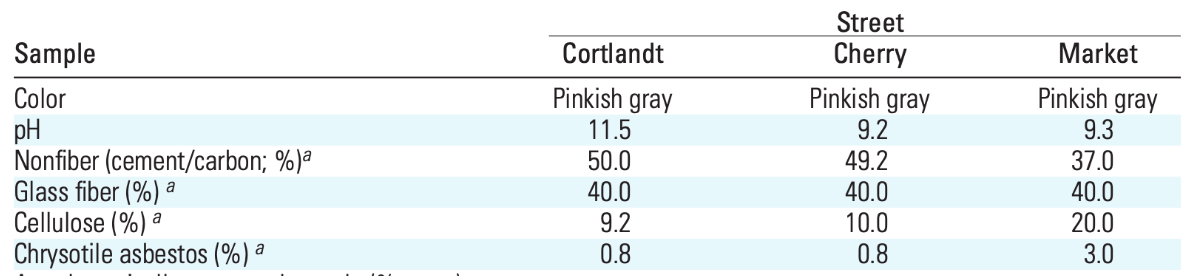
The Cortlandt Street sample was
mainly composed of construction debris [including vermiculite, plaster, synthetic foam, glass fragments, paint particles, glass fibers, lead, calcite grains, and paper fragments], quartz grains, low-temperature combustion material (including charred woody fragments), and glass shards.
The other samples were very similar. Iron is barely mentioned.
A 2003 study finds that
Levels of elements that could be attributed to metal wiring (Cu), plumbing (Fe, Cu, Pb), structural steel (Fe, Mn), and communication and computer equipment (Cu, Fe, Zn, others) are also low.
A 2005 study finds that the dust samples
have inorganic chemical compositions that result in part from the variable chemical contributions of concrete, gypsum wallboard, glass fibers, window glass, and other materials contained in the buildings.
According to the 2009 USGS report, the major inorganic components in 36 dust samples were
concrete materials, gypsum, and man-made vitreous fibers. These components were likely derived from lightweight Portland cement concrete floors, gypsum wallboard, and spray-on fireproofing and ceiling tiles, respectively. [...] Components found at minor and trace levels include chrysotile asbestos, lead, crystalline silica, and particles of iron and zinc oxides.
A 2017 study finds that iron or iron oxide was present in spherical magnetic particles – but that those particles accounted for only 0.1% of the sample. The authors assume the spherical form was caused by the particles becoming molten from on-site cutting and grinding operations carried out during the Twin Towers’ construction.
Thus, there is more than enough evidence to indicate that iron was not present in significant quantities in the WTC dust.
Which obviously creates a significant problem for Wood’s contention that most of the structural steel of the Twin Towers was dustified (“FACT” 34 on p. 483).
It does not seem sufficient to me to argue that the dust samples were unrepresentative or that iron-rich dust may have been deposited elsewhere. There are multiple samples above, collected by separate actors and analysed independently. They all converge on similar findings.
Wood once called a focus on the dust “a distraction, a magic show type of game” designed to prevent looking at the evidence in its totality.
That may have been the case with the failed attempt in 2009 to prove the use of nanothermite from dust samples. (Dr. James Millette’s dust sample analysis in 2012 shows that thermite and nanothermite were not present.)
However, I do not think it applies here. The above studies were looking to analyse the content of the dust primarily for public health reasons. There is no suggestion they were designed to distract from anything.
Although reasonable doubts have been raised regarding Greg Jenkins’ conduct towards Wood in 2007, I am unaware of any formal rebuttal of his 2007 paper whose key findings can be summarised as follows:
%-weight Fe expected from concrete 1.2%
%-weight Fe expected from dissociated steel 38% USGS average
%-weight Fe content [actual] 1.6 +/- 0.7%
Now, it is possible that dustification caused the iron to be transformed or transported in a way that explains its apparent absence from the samples. But a case would need to be built for that in a way that it has not been so far.
In sum, I think Knightly makes a good case with respect to the dust samples.
Misapprehension 3 – Why a subjective assessment of damage isn’t enough
Knightly does not find it self-evident that a gravity-driven collapse of two 110-storey skyscrapers weighing an estimated 500,000 tons each (plus the destruction of the 47-storey WTC7) would have destroyed the bathtub.
He writes:
What I require from qualified mechanical engineers asserting something “isn’t damaged enough” is mathematics showing their working. For example, equations on expected tolerances, or potential energy, or the strength of concrete vs compression, or a survey of the known damage and how much force would be needed to create that damage.
Yet, where are his workings showing that it is damaged enough? He merely describes the localised damage to the bathtub. There is no attempt to calculate, using physics and mathematics, what the damage should have been. He simply assumes that what was witnessed was to be expected – that there were no anomalies.
How does he know, scientifically, that the concrete bathtub should not have been destroyed by a million tons of material (“the equivalent of 50,000 full ten-ton dump trucks,” as Wood puts it on p. 70) falling straight down, much of it close to or onto the slurry wall?
In truth, the required workings have not been done on either side. If Wood’s position is “unquantifiable subjectivity,” then so too is Knightly’s.
Misapprehension 4 – How “Could” and “did” are different
Knightly cites lead on-site engineer George Tamaro’s claims that “use of [...] heavy equipment adjacent to the slurry walls or over the basement structure itself could cause the collapse of the slurry walls or any remaining basement structures,” the emphasis being on “could.”
He notes that this is different from Wood’s claim that “More damage was done to the bathtub by earth-moving equipment during the clean-up process than by the destruction of more than a million tons of building above it” (p. 481), the emphasis being on “was.”
Fair enough.
But this misses the thrust of Wood’s argument in Chapter 5, which is that if the bathtub was so fragile following the destruction of the buildings, why was it not destroyed by a million tons of material falling on it from a great height?
For example, with respect to the decision to pull the remains of WTC6 rather than use explosives, Wood asks
They were worried about damaging the bathtub by bringing down the fragments of an eight-story building with a few sticks of dynamite, yet the alleged gravity-driven collapse of two 110-story buildings [was] nothing to worry about? (pp. 58-59)
Similarly, given the engineers’ concern that use of heavy equipment could damage the bathtub, she asks
How is it possible that earth-moving equipment can do more damage to the bathtub than the destruction and alleged collapse of two 500,000-ton buildings that stood directly over them? (pp. 52-53)
Note that Wood here is challenging the official vertical “collapse” explanation, and her work on the bathtub should be read in that light.
Had the Twin Towers really gone straight down like a pile-driver, what would the impact have been near bedrock, especially at the locations closest to the slurry wall? Keep in mind that over 95% of the total structure was above street level.
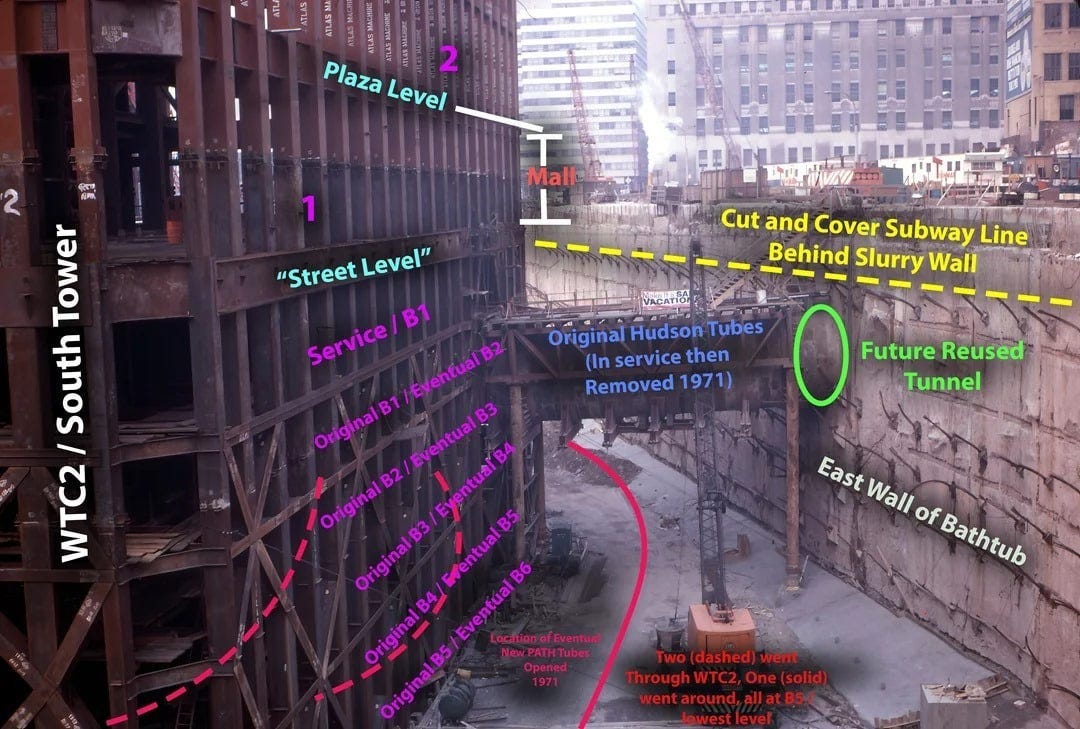
It does not take precise calculations to realise that the downwards force generated would have been incredible and that, when met with resistance from the bedrock, it would have been directed outwards in significant measure. It is hard to see how sections of the slurry wall such as the one shown above could have survived.
Knightly argues that
The engineers’ post-9/11 concern was that the bathtub was already so unstable because [...] of the destruction of the buildings that any further disturbance by heavy equipment might worsen the damage or cause it to fail completely.
Yes, there was damage to the bathtub, which Wood recognised, but the real question she was addressing is whether the level of damage was commensurate with the equivalent of 50,000 full ten-ton dump trucks falling straight down.
Semantic quibbles about “could” vs. “did” and what counts as “significant damage” miss the point.
Misapprehension 5 – What the bathtub was for
Knightly resorts to hyperbole (“fatally misunderstand,” “It is not possible for a sentence to be more wrong. Hughes clearly doesn’t understand what he is talking about”) in order to correct my claim that the bathtub was “never intended” to have heavy machinery hollowing it out.
Well okay, but what difference does that make to Wood’s contention that the bathtub would not have withstood the gravity-driven “collapse” of two 110-storey buildings?
Misapprehension 6 – What “toasted” means
Further semantic squabbles break out here.
I am not really interested in what Wood means by “toasted.”
I agree with Knightly that the cars could simply have been “burned out” in some cases, e.g., through engine fires. But I remain open-minded to other explanations.
The really significant question is the one I posed: “what did ‘toast’ the cars on ‘9/11’?”
I do not find Knightly’s answer very convincing:
Now, what could have burned the cars?
Burning debris from nearby office fires, explosive residue, hot wreckage or droplets of molten metal in the dust cloud. All of which were reported by eyewitnesses and/or confirmed by laboratory testing. Or perhaps, who knows, some unknown factor involved in the destruction of the towers.
Why did all this alleged hot wreckage and droplets of molten metal not burn the thousands of people caught up in the dust clouds?
The “toasted car park” several blocks northwest of the WTC – beyond the main debris field – is especially interesting. What caused the cars there to catch fire? If not “droplets of molten metal in the dust cloud” (the AE911T line), then what? Could it possibly be “some unknown factor involved in the destruction of the towers”? And if so, what?
I am not persuaded that any adequate explanation of the “toasted cars” has so far been offered, by anyone.
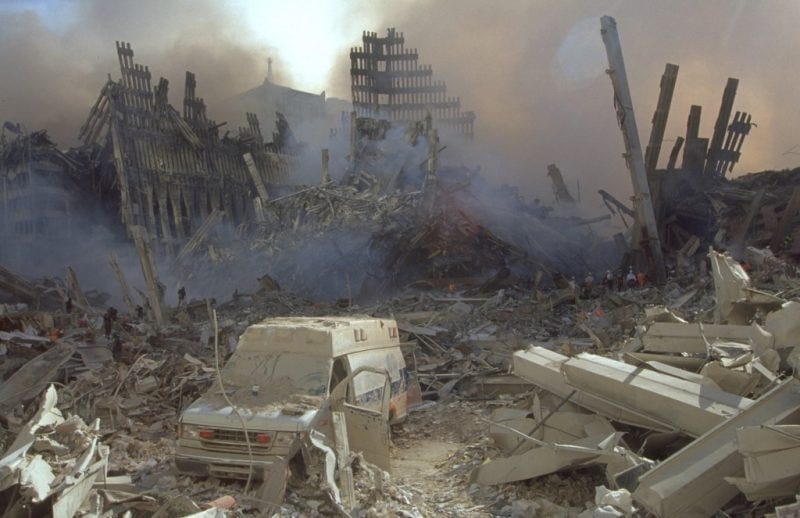
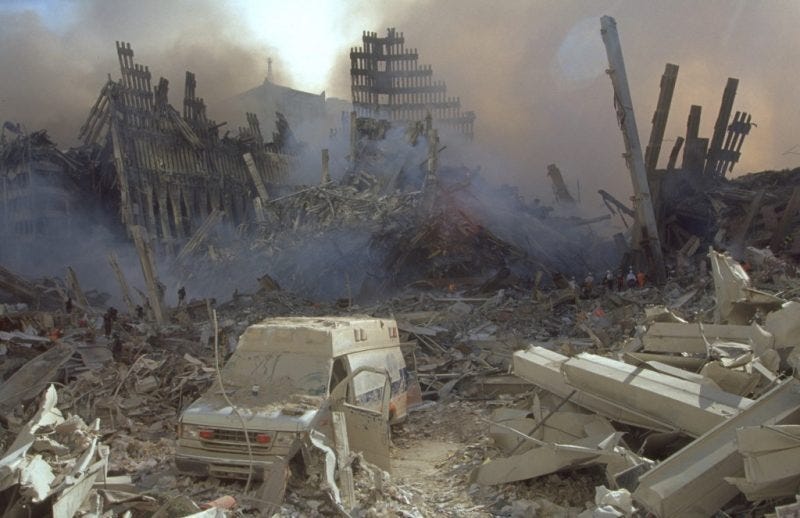
Later we will come to the ambulance twice photographed next to the remains of WTC1.
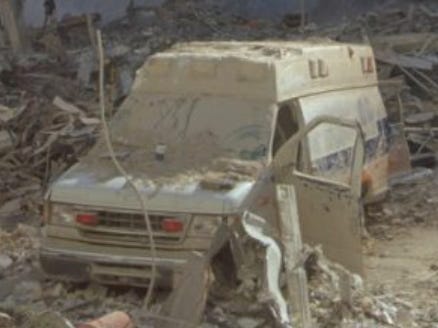
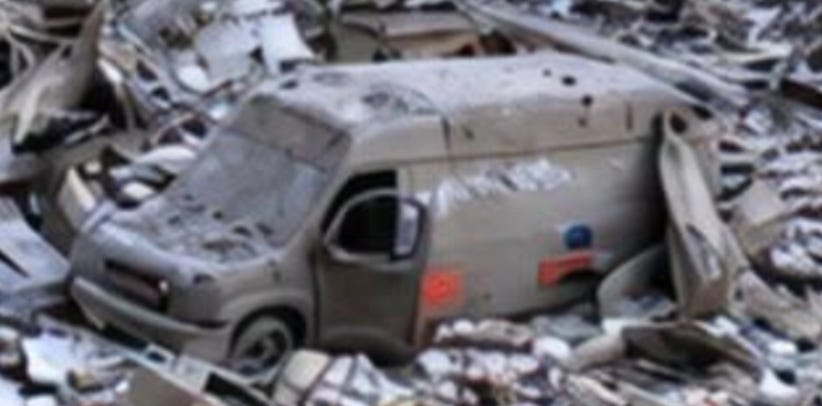
The second image is heavily zoomed in, so the resolution is not as good as the first image. Even so, assuming that this is the same vehicle and that image distortion does not account for the anomaly, we have to ask what happened to the door?
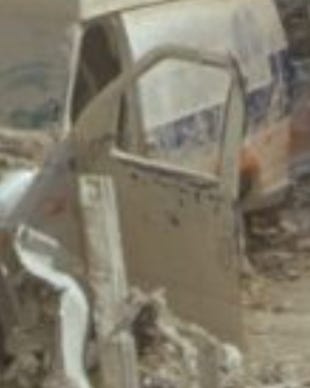
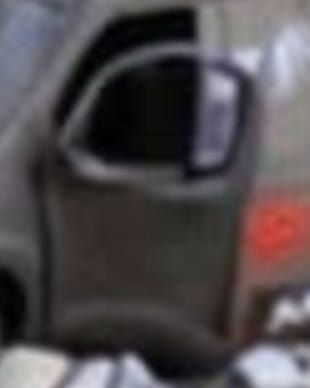
This is exactly the kind of anomaly that Wood seeks to draw attention to, and which ordinary vehicle fires do not explain.
Misapprehension 7 – Why Photos are unreliable
Conventionally, photographic evidence is deemed highly reliable, because of its objective rendering of what lies in front of the camera.
For Knightly, in contrast, it is unreliable. It amounts to “fall[ing] back on pictures,” and “pictures from different positions or angles or at different focal lengths can give different impressions of how much debris there was.”
Knightly argues that although one photograph used by Wood (below) shows the debris next to the remains of WTC1 immediately at ground level, other photographs give a better feel for the extent of the debris field.
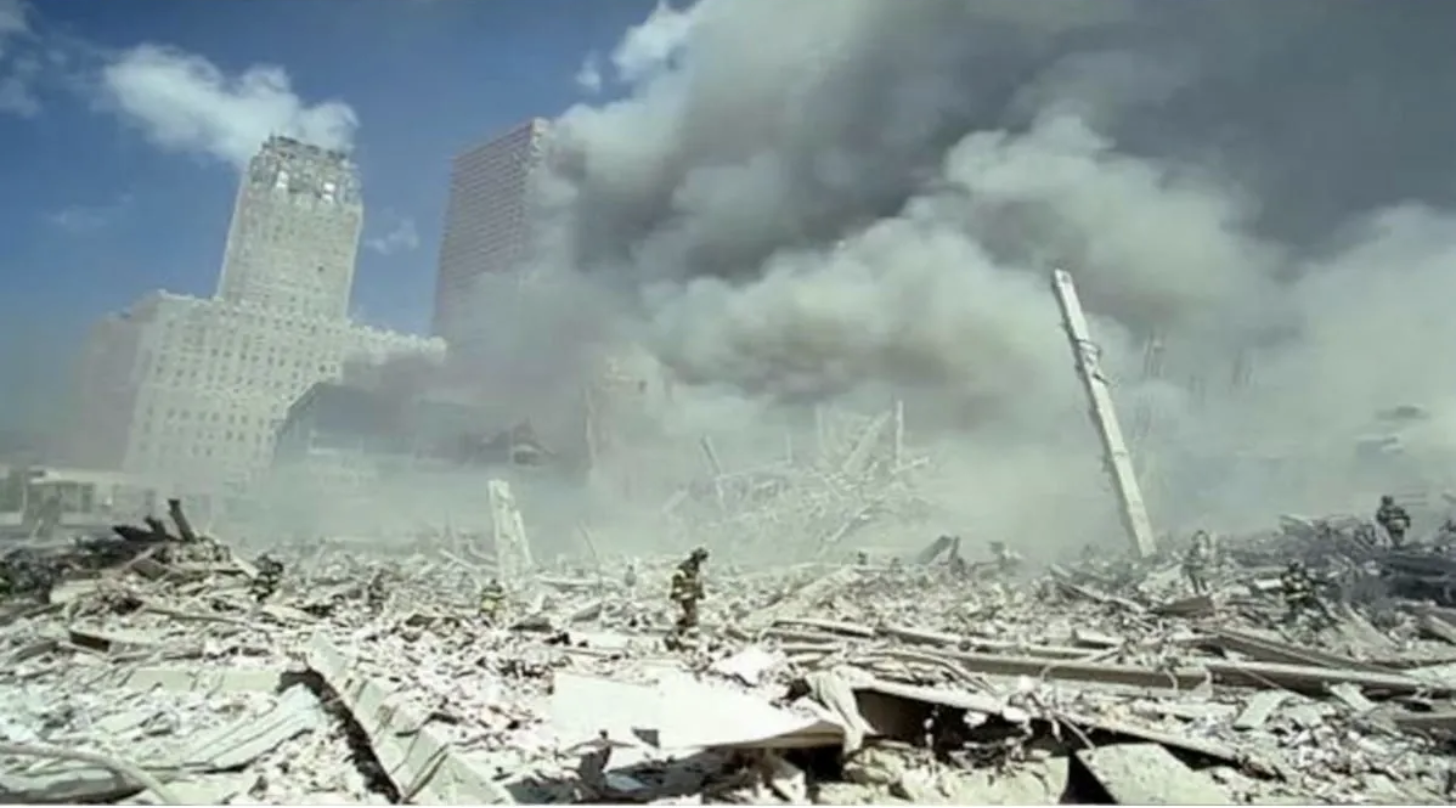
He thus proceeds to fall back on a series of photographic images to show the “rather bigger portion” of the 200,000 tons of structural steel that need to be accounted for:
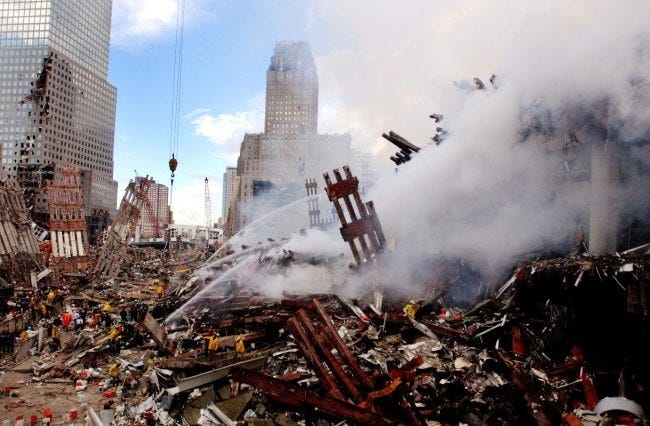
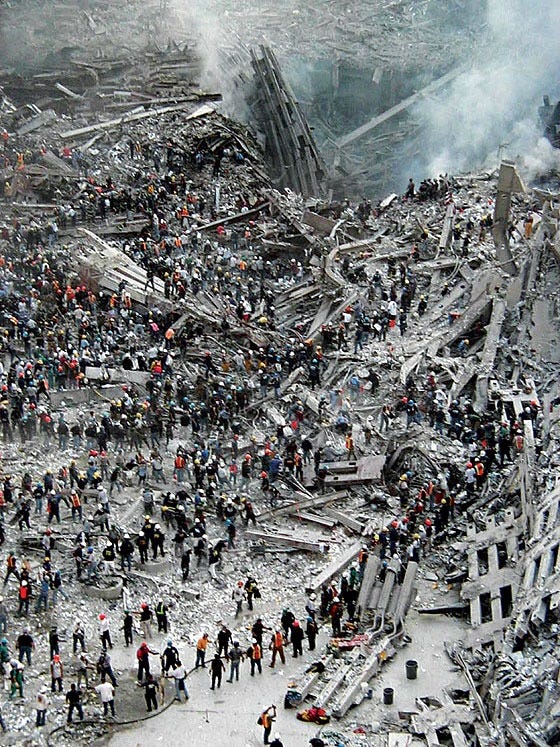
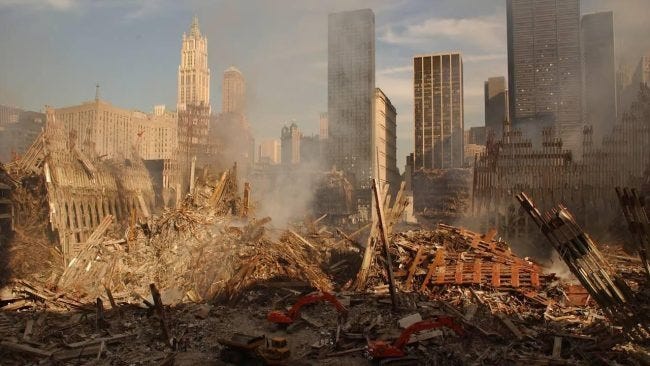
Methodologically, this is the same flaw that he accuses Wood of, i.e., “pointing at pictures” to prove his point, i.e. that there really was a lot of debris.
Perhaps the most remarkable thing about at least three of the four photographs above is that while the camera is pointed at a remnant of the Twin Towers (i.e., the highest remaining debris), the ground itself is clearly visible in places. It is not merely that the debris pile was lower than expected, but that it was demonstrably at or or close to ground level for much of the area beyond the footprints of the Twin Towers.
The latter photograph is particularly pertinent, as the ambulance is at street level and the remains of a 110-storey building are immediately behind it. The ambulance itself appears relatively unscathed. Why did hundreds of thousands of tons of material raining down from the giant building right next to it not destroy it? (We could ask the same about The Sphere on the other side of WTC1.) Knightly does not seem interested in such questions.
Instead, he wants us to focus on the “tiny little orange and grey things [that] are people,” as though to exaggerate the scale of the debris. Yet, those tiny little people (in the second image) stand taller than most of the debris field around them, again illustrating that most of it was immediately at or close to ground level.
In sum, far from Knightly’s photographic evidence persuading me of anything, it only adds to my puzzlement as to why the debris field was so shallow.
Photographic Evidence of Large Amounts of Steel in the Debris Field
Before moving on to Misapprehensions 8 and 9, I do want to say, in Knightly’s favour, that large amounts of steel were visible in the debris field. We will come on to the extent and depth of the debris field in due course, but in keeping with the dust sample analyses, a lot of the steel was evidently not dustified.
Perhaps the clearest early aerial image was captured by NOAA on September 23, 2001. By that time, the surrounding streets plus the area between WTC4 and WTC5 had been mostly cleared, but the entire WTC site that is visible on the image is covered in debris.
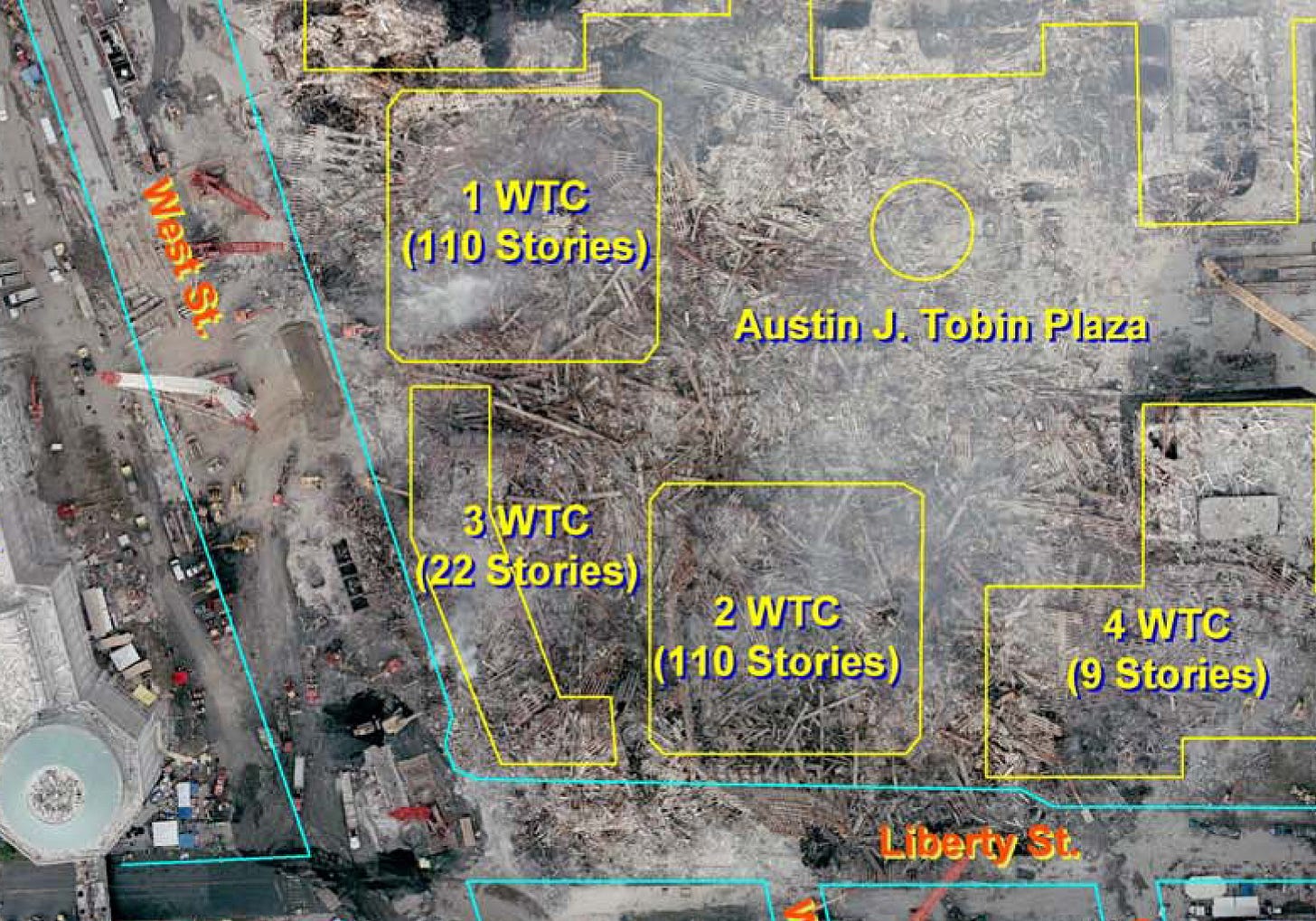
It is worth zooming in on the above image and looking closely. The tridents of the west wall of WTC1 are clearly visible, as are outer wall sections that landed on WTC3, WTC4, WTC5, and the Austin J. Tobin Plaza. None of that steel was dustified.
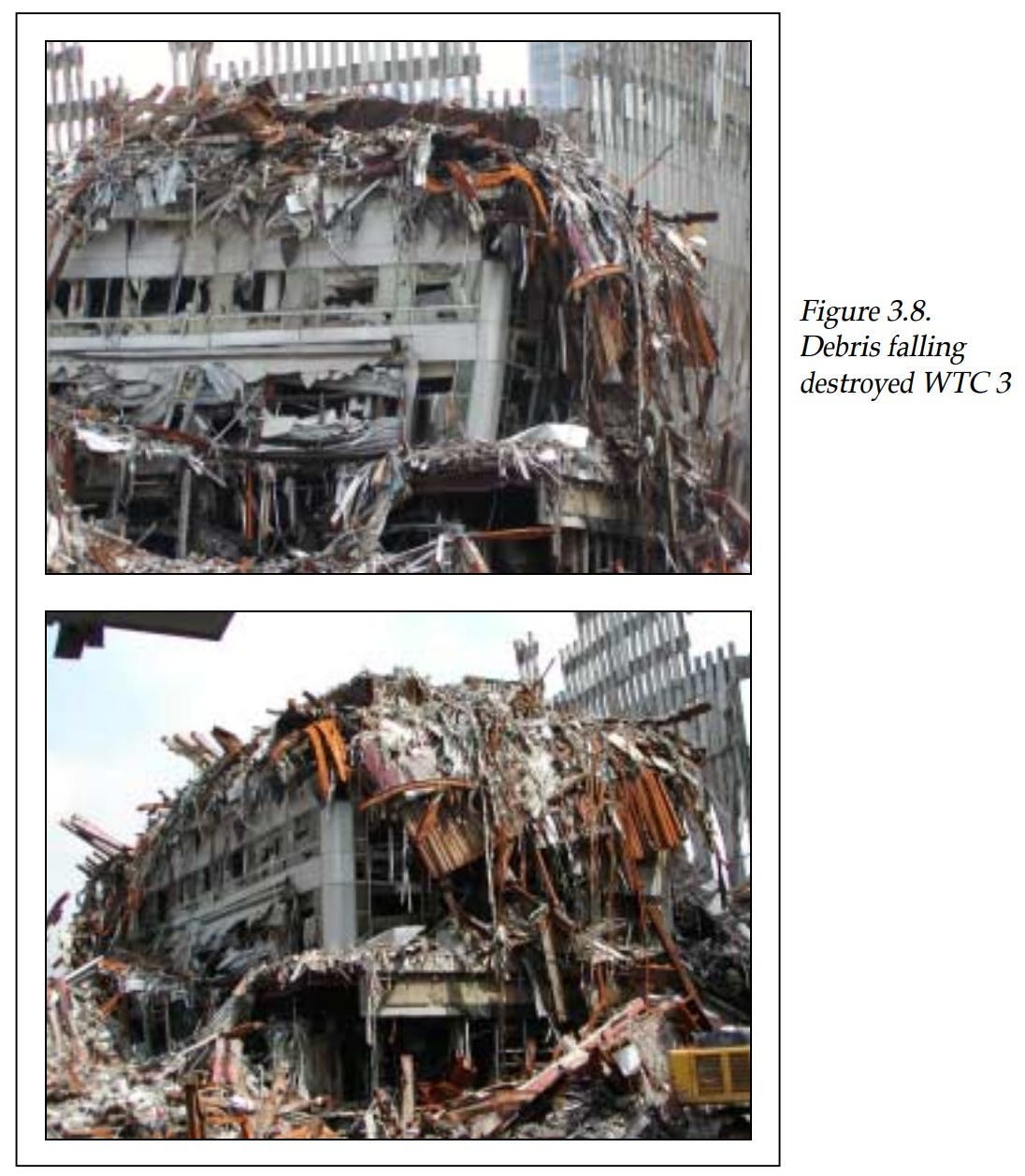
For example, look at all the steel that was left on WT3:
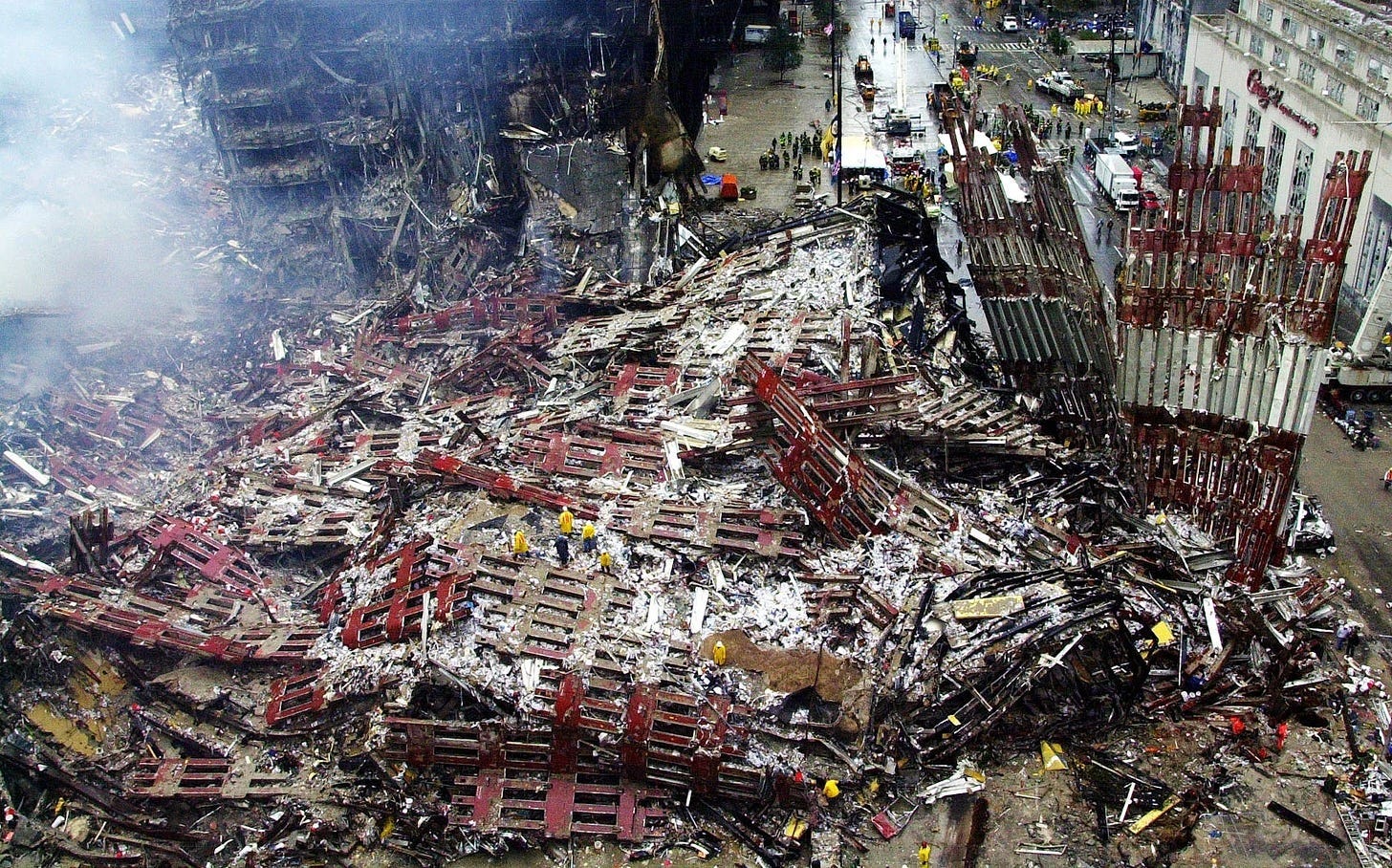
It is no great mystery what sliced WTC4 in two.
I previously noted my suspicion that the large hole in WTC6 was caused by debris falling from WTC1. That suspicion is supported by this testimony from James Glanz, who went below ground at the WTC site in November 2001:
To the west, a giant hole punched through the middle of the U.S. Customs House by falling debris from the north tower continues to the bottom of the basement. Steel beams dangle from the edges of the hole like ragged tapestry and form a wildly chaotic pile in the center.
In addition, large outer wall sections were clearly visible on West Street, destroying the North Bridge and damaging WFC3 and the Winter Garden.
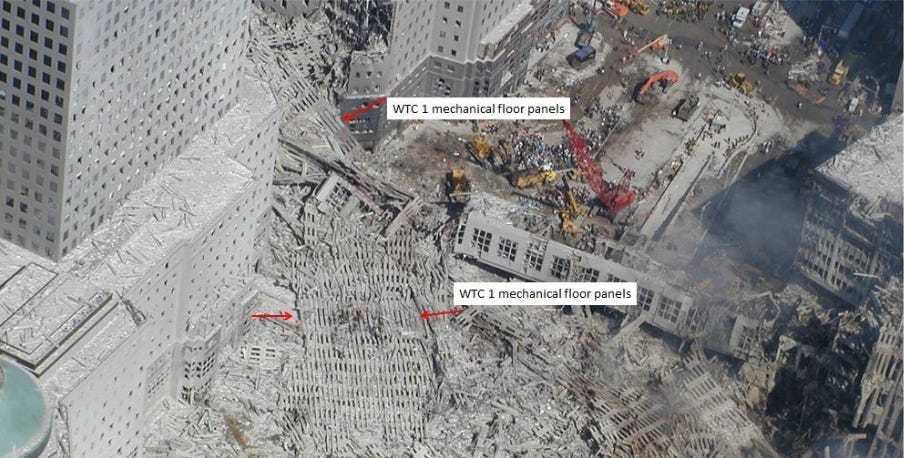
Knightly adds another example: the large section of outer wall that crushed St Nicholas’ Greek Orthodox Church.
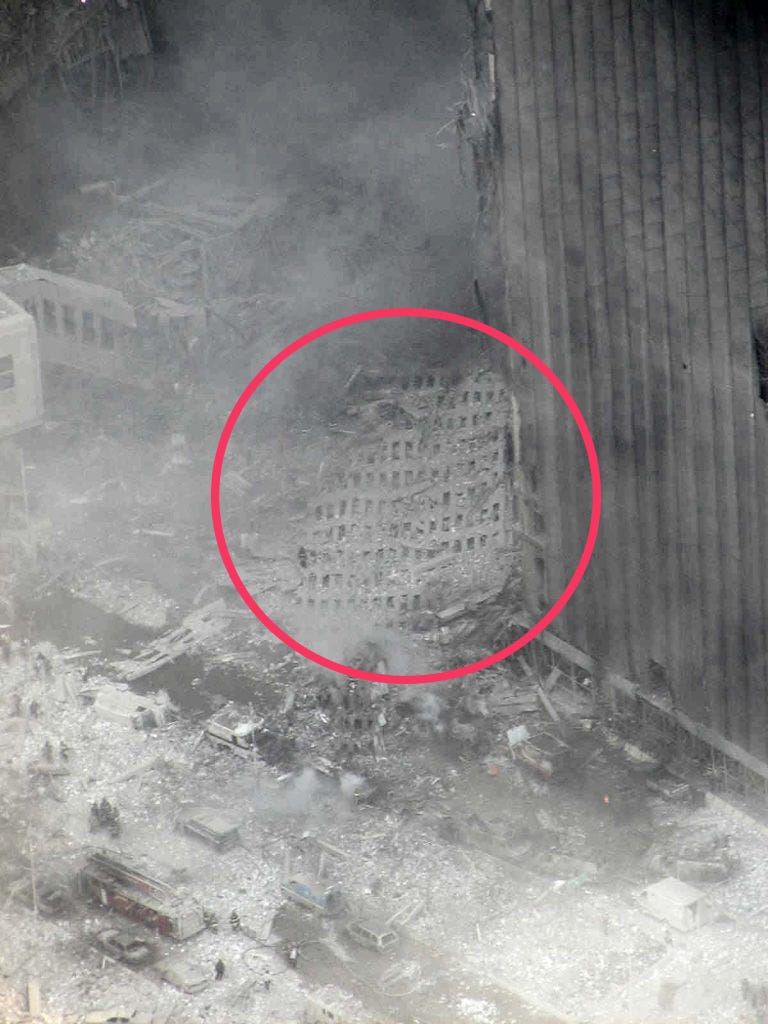
In sum, significant segments of the outer walls can be accounted for through photographic evidence, though quantifying how much would be very difficult.
Misapprehensions 8 and 9 – The Debris Field
The real issue at stake here is not whether I know what a hypothetical is, or what an acre is, but, rather, whether the amount of debris witnessed above ground was commensurate with the amount of solid material contained within the Twin Towers.
Knightly originally calculated that if 5-10% of the total volume of the Twin Towers was solid (the other 90-95% being air), there would have been about 2.9-5.9 million cubic feet of material to account for (per tower). That implies a total of 4.8-11.8 million cubic feet of material for both towers.
He argued that this mass of material, hypothetically spread “over the whole 16 acre area of the WTC complex, [...] would be maybe 9-18 feet high,” which is correct subject to the qualifications below.
In his reply to my reply, however, his numbers have changed. He now claims that
[...] all the solid material of WTC1, spread over an area of 18 acres would be 1.5-3 feet high.
Including both towers, and accounting for ~52% overlap, it would be a debris field of about 26 acres, and stacked ~3 feet high.
A 26-acre area is 1,132,560 square feet. At an average depth of 3 feet, the implied volume is 3,397,680 cubic feet.
That ~3.4 million cubic feet figure is considerably lower (about 43-71% lower) than the original 4.8-11.8 million cubic feet figure. Knightly does not show his workings or account for the discrepancy. He has effectively magicked away one of the Twin Towers. Or maybe more.
Spread across 26 acres, 4.8-11.8 million cubic feet of material hypothetically (using Knightly’s logic) amounts to a debris pile of 4.24 feet to 10.42 feet (height = volume/area).
But that assumes that all the material compacted down perfectly to fit the space, which of course it did not.
A pile of collapsed steel beams, concrete fragments and other debris contains considerable empty space between its constituent pieces. A compacted layer of solid material 4.2 feet to 10.42 feet deep would therefore correspond to a considerably deeper layer of loose rubble.
How much deeper depends on the packing fraction, i.e., the proportion of the rubble pile’s total volume occupied by solid material. Knightly does not consider this.
The packing fraction is hard to estimate, because it depends on such factors as
- the extent to which steel beams remained intact or were fragmented;
- the extent to which concrete was broken into smaller pieces or dustified;
- the extent to which structural elements became entangled;
- the extent to which debris was compacted by falling material; and
- whether voids remained between structural components.
If we consider a range of packing fractions from 20% to 60%, we get a revised hypothetical average depth of between 7.1 feet and 52.1 feet, as per ChatGPT:
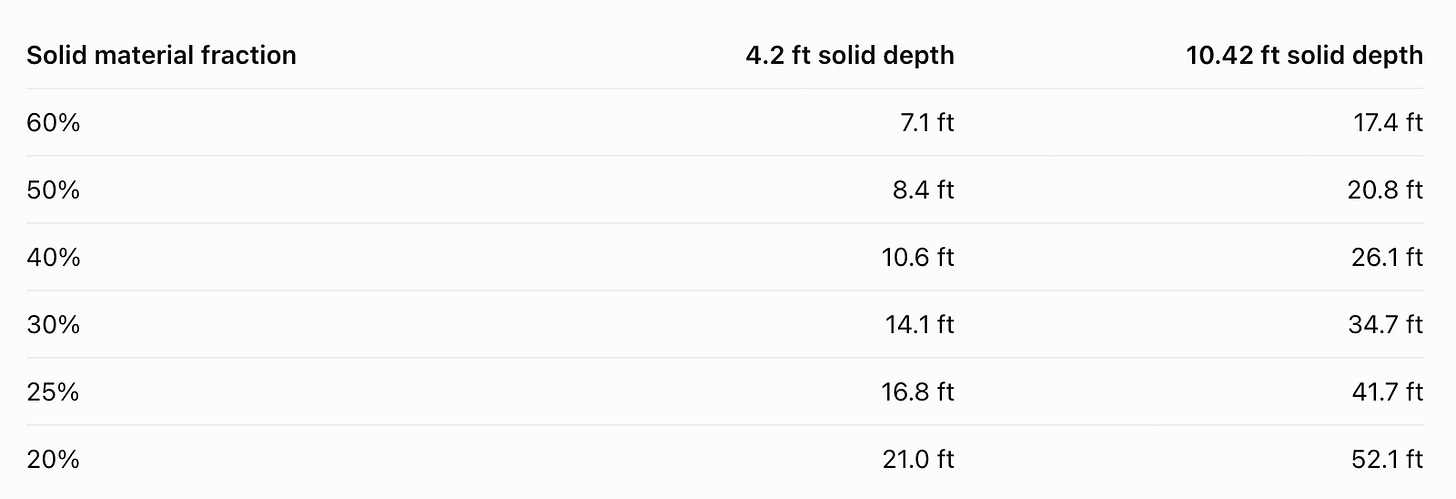
However, as Knightly notes, the hypothetical figures include all the material we know was not left in the above ground debris, such as the amount that disappeared in the dust clouds, as well as any material which disappeared below ground. In practice, the depth of the debris field would be lower than the figures shown above.
What proportion of the total material disappeared in the dust clouds or underground? It is hard to know, and Knightly does not attempt to quantify it, despite his insistence on trying to quantify things.
Instead, he simply asserts that “the average height of the above ground debris pile is basically what you would expect to see,” given that there was “a rubble pile in the footprint averaging 40-60ft in height plus unknown quantities of debris in the sub-basements or hurled outside the footprint or pulverised into layers of dust over Lower Manhattan.”
How do we know that is what one would expect to see, if we do not know how much material was turned to dust and how much went underground?
For example, if we use mid-range estimates and assume a 40% packing fraction (yielding a debris depth of between 10.6 feet and 26.1 feet – let’s call it 18 feet) and (perhaps generously) assume that half the material was not left in the above ground debris pile, then we would expect to see a debris pile 9 foot high on average across a 26-acre area.
That does not appear to have been the case, however. According to one report,
An area roughly two blocks [400-500 feet] around the footprint[s of the Twin Towers] was two to six feet deep in rubble, with dust extending another four to five blocks on all sides.
That in itself appears generous. Consider once more the ambulance photograph with the ruins of WTC1 in the background:
The ambulance appears to be a Ford E350 Type II ambulance, which is ~9-9.5 feet high, roughly the same height as my mid-range estimate above. Despite the debris in the bottom right corner of the photograph, it is clear that the debris field, on average, is nowhere near the height of the ambulance.
Below is what I assume to be the same ambulance, with its back turned towards the ruins of WTC1. Can you spot it?
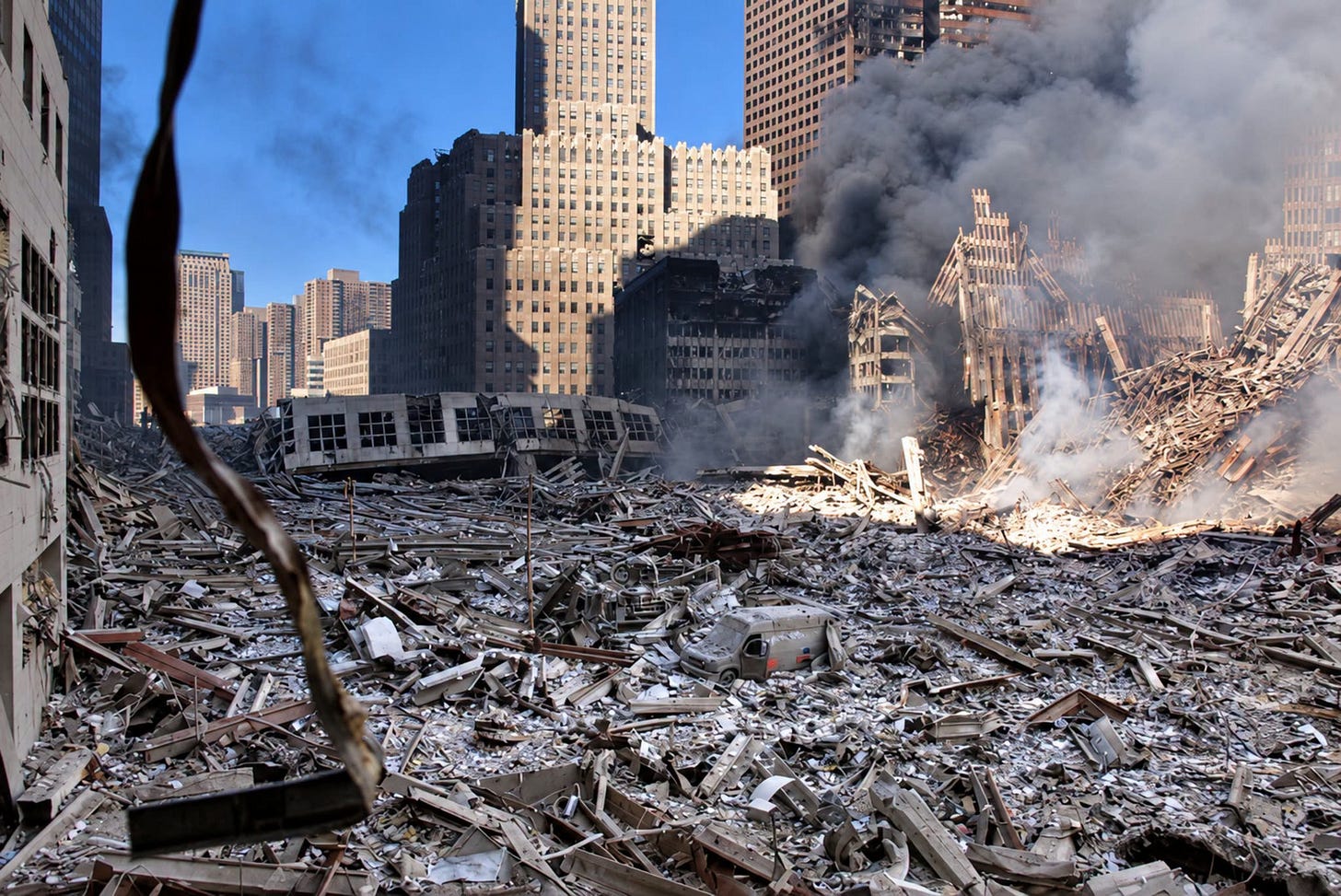
Here we see that the debris is practically at street level for the entire stretch of West Street that is visible. The outer wall of WTC1 can be seen snaking its way up towards the Winter Garden on the left of the photograph.
Remember, WTC1 was right next to West Street, and there would likely have been overlap between the debris fields from WTC1 and WTC2 on West Street. We should therefore expect to see a lot of debris here – indeed among the most in the entire debris field.
Instead, the debris is mostly just lying on the road, without stacking up in any great quantity.
Zooming in, we see that much of the debris field is no higher than the tyres of the ambulance (i.e., 2.5 feet):
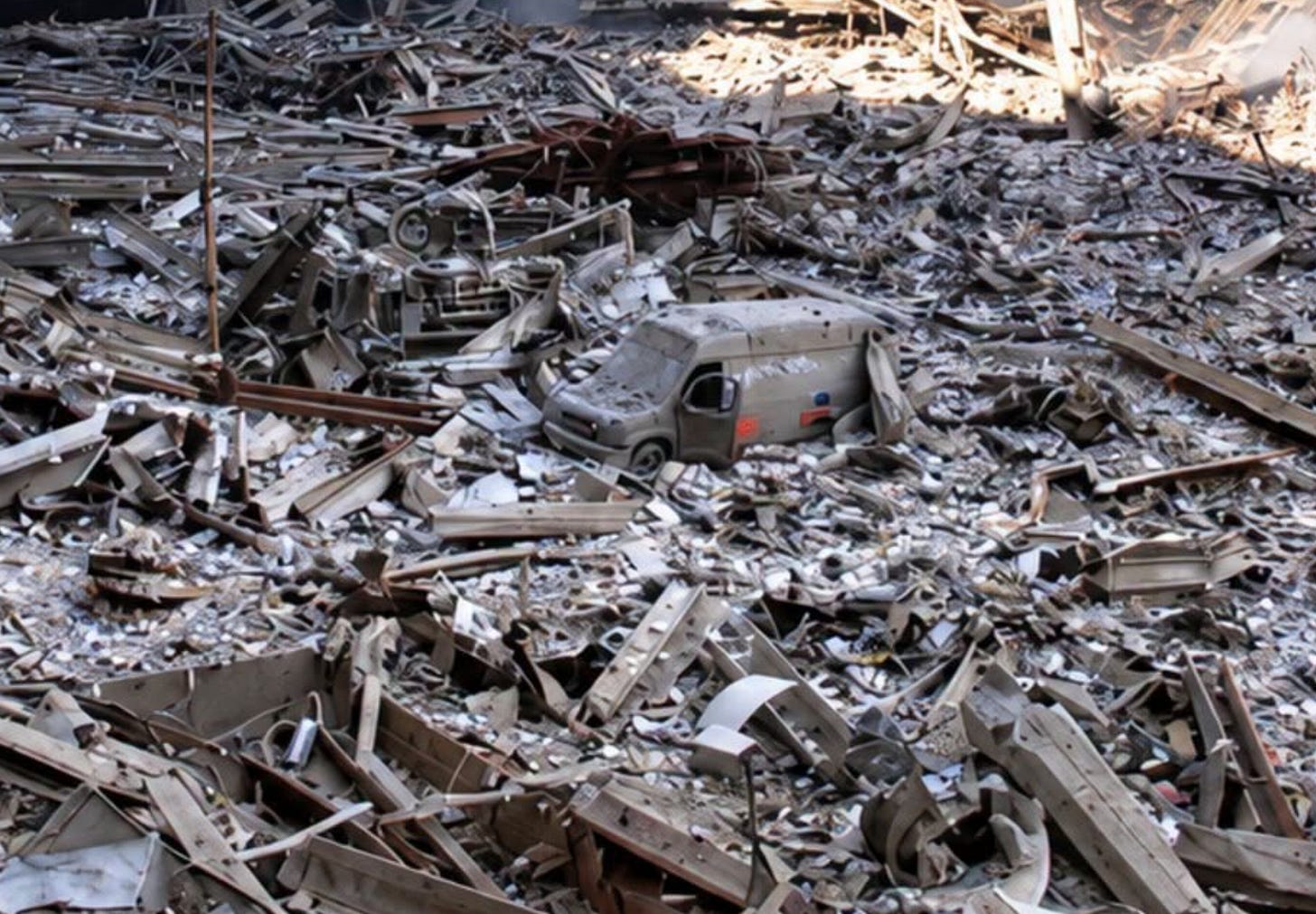
Given that the average depth of the debris field is perhaps best measured against that stretch of West Street – a long, wide, flat expanse close to WTC1, likely also including debris from WTC2, with no evidence of debris having disappeared below ground there – it is reasonable to assume that the entire debris field would have been no deeper than that on average, even if it landed on top of other structures.
“1.5-3 feet high” is indeed what Knightly predicts, but only after magicking away 43-71% of the mass of the towers, ignoring the packing fraction, and subjectively attributing any anomalies to unquantified missing material.
In sum, there are too many unknowns to make a confident estimate of the expected average depth of the debris field. Without knowing the packing fraction, or what proportion of the solid mass was dustified or went underground, Knightly cannot bluntly assert that the observed debris pile is “basically what you would expect to see.”
Was The Debris Field Larger Than Knightly’s Estimate?
Before moving on Knightly’s next point, I want to make his case stronger by considering the extent of the debris fields from WTC1 and WTC2 more carefully.
According to Knightly, each tower generated “a roughly circular potential debris field with a radius of ~500 feet. A circle of radius 500 feet has an area of just over 18 acres [...].”
He also noted that
a significant portion of what was left (ie. large pieces of structural steel, aluminium siding etc.) was thrown as much as 500-800 feet outside the towers footprint, onto streets and buildings nearby.
Indeed. 500 feet is a conservative estimate for each debris field. Based on the observed damage to surrounding buildings, I think that somewhere in the region of 630-670 feet is a more realistic estimate, as per the diagram below.
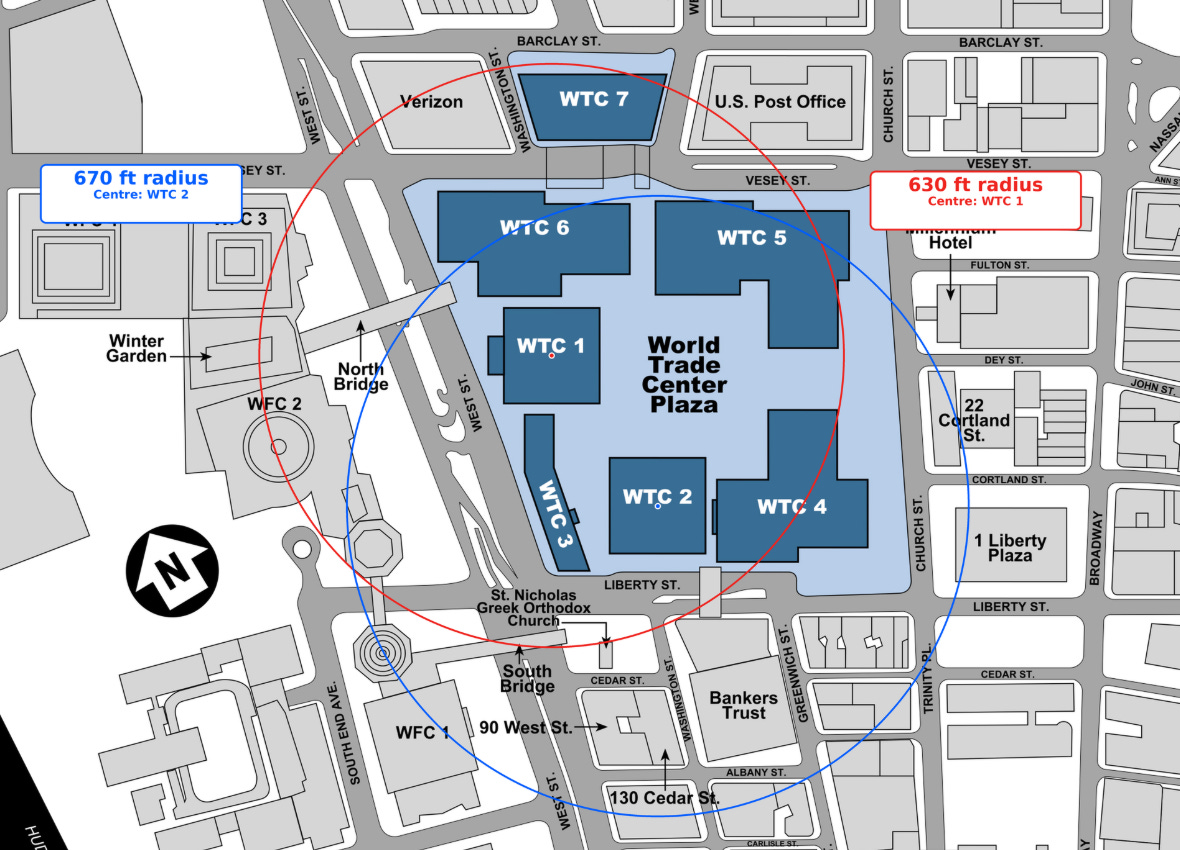
The radius of the two circles is calculated relative to the 208 foot sides of the Twin Tower footprints. Survey-level accuracy of the map itself (which comes from NIST, p. 3) has not been confirmed.
But assuming that the map is survey-level accurate, or close to it, then the Winter Garden damage requires a debris field from WTC1 with a radius of ~630 feet and the 1 Liberty Plaza and WFC1 damage requires a debris field from WTC2 with a radius of ~670 feet.
Wikipedia lists the buildings damaged by the destruction of the Twin Towers, and the damage mostly falls within those circles. For example, even though they are seldom discussed, 90 West Street and 130 Cedar Street (shown on the map above) were damaged, as was the southeast corner of the Verizon building.
The peripheral buildings damaged on September 11, 2001, are identified by FEMA in the diagram below.
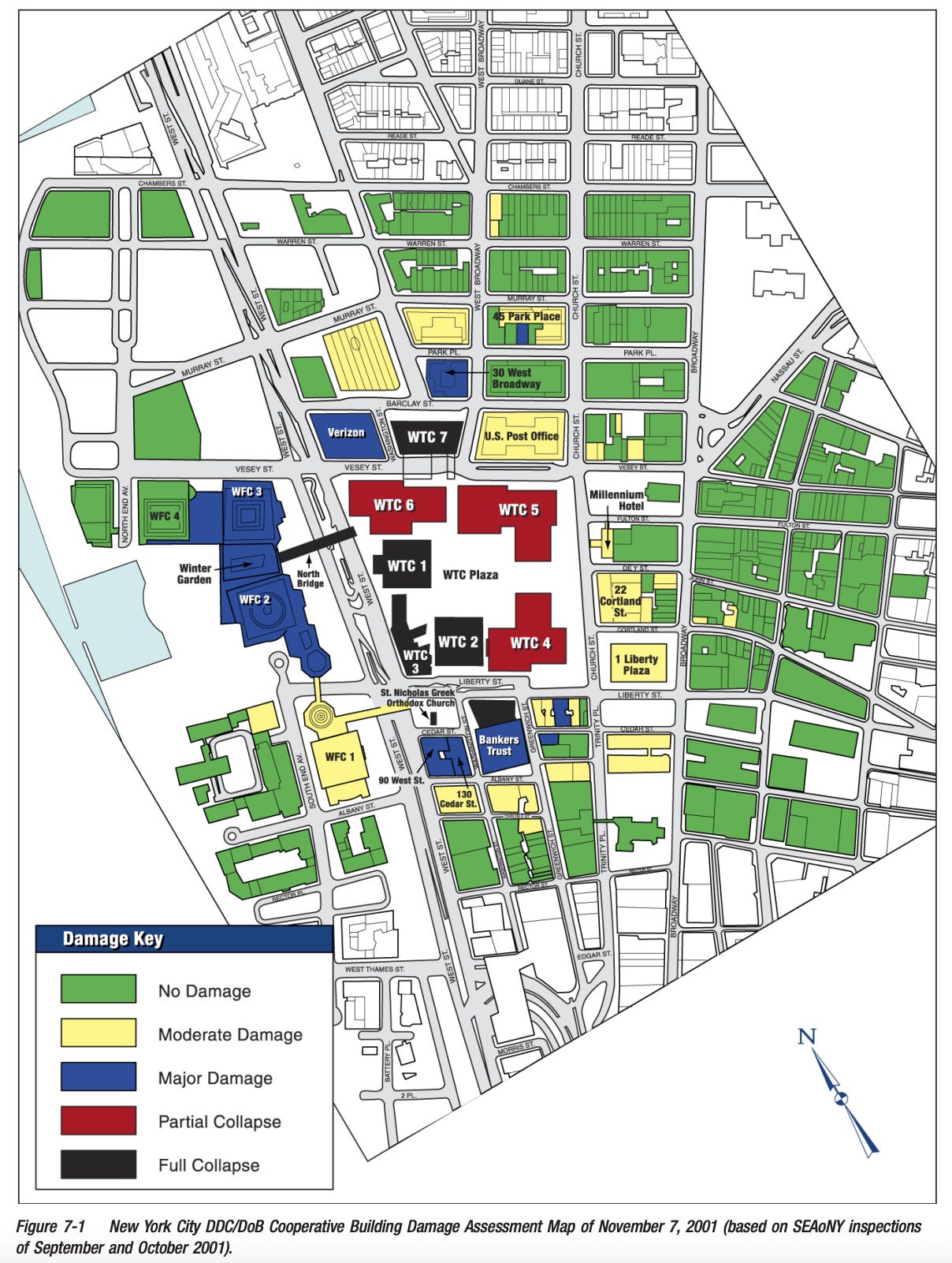
Source: FEMA
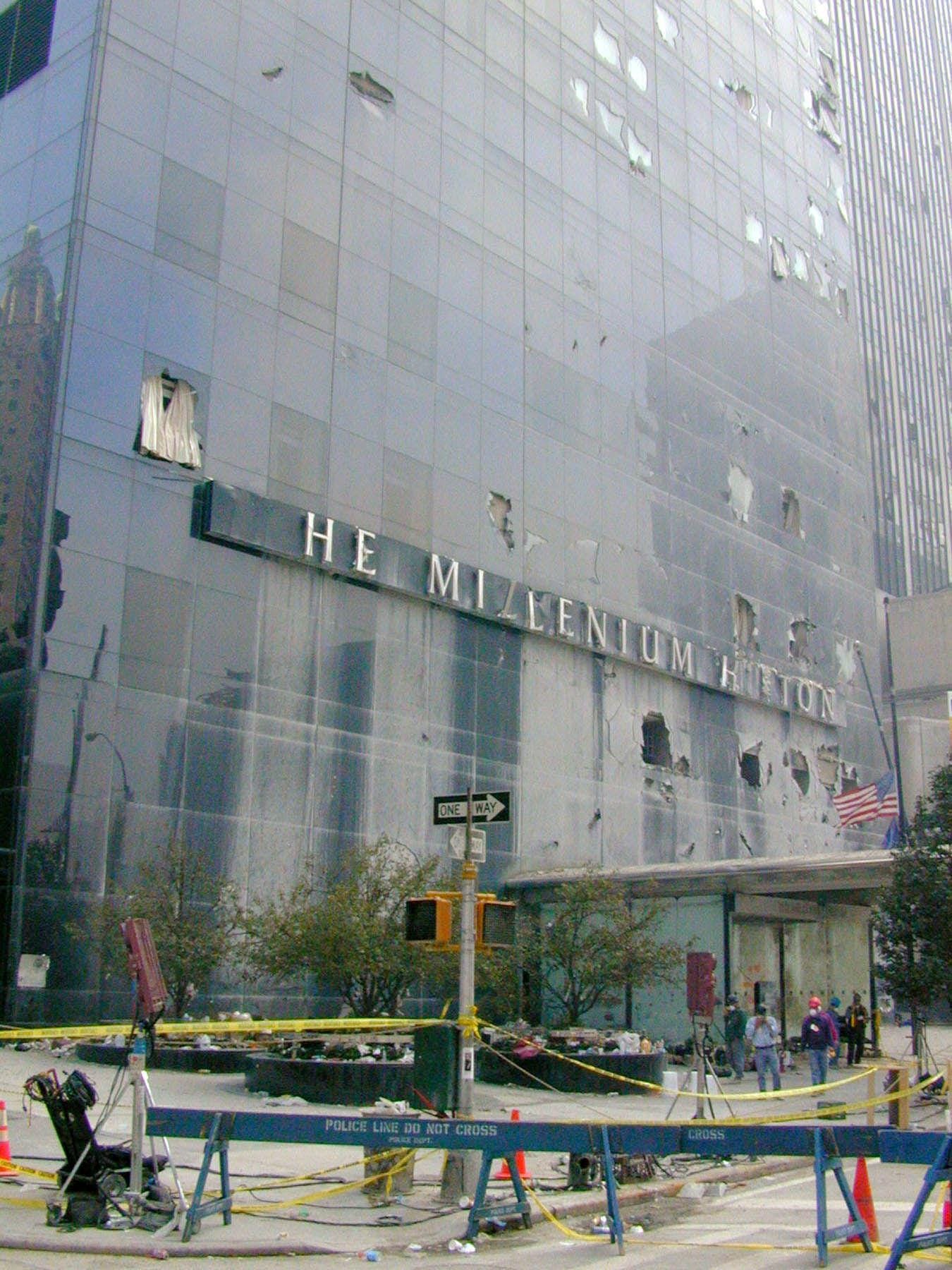
Some projectiles even struck the Millennium hotel, which lies outside the debris fields which I marked above.
Based on latitude and longitude coordinates, ChatGPT calculates that the centres of WTC1 and WTC 2 were 416 feet apart. Assuming a debris radius of 630 feet for WTC1 and 670 feet for WTC2 produces a combined debris-field of ~43 acres, not double-counting the overlap area.
4.8-11.8 million cubic feet of material distributed uniformly across 42.76 acres yields 2.58 feet to 6.34 feet, perfectly compacted. When adjusted for different packing fractions, it looks like this:
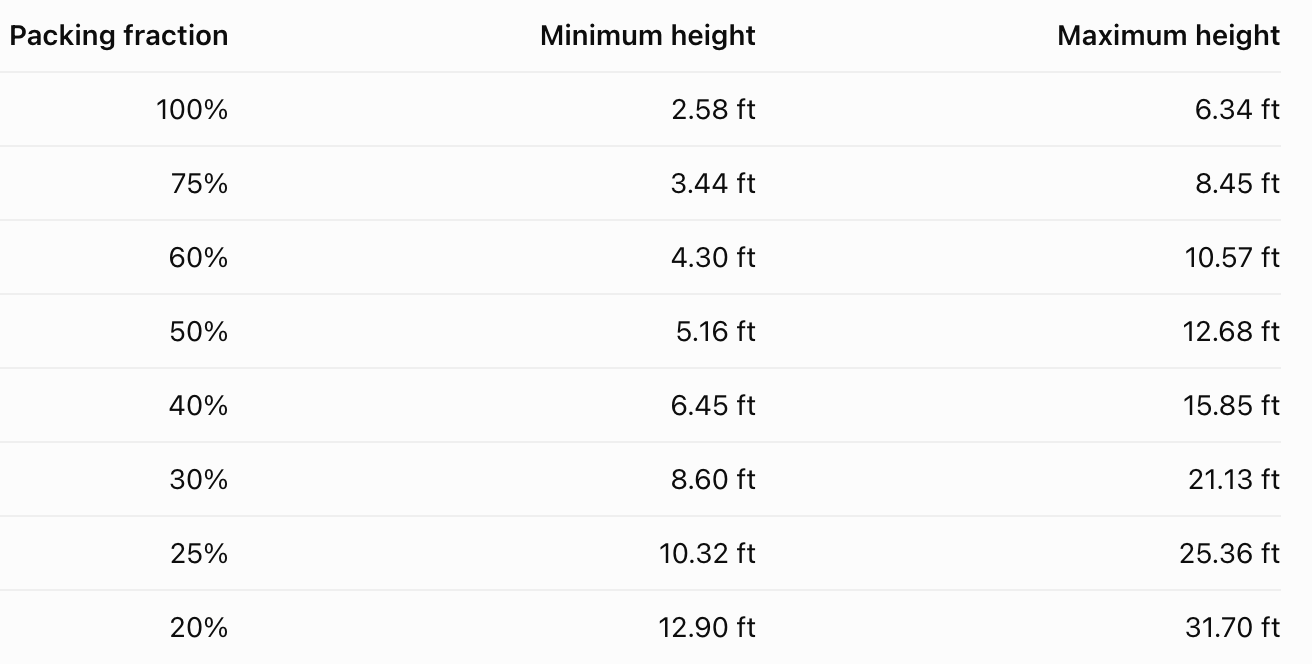
Again, without knowing the exact packing fraction or the proportion of material that was dustified or went underground, it is hard to infer very much from these figures, but hopefully they are useful for reference.
Misapprehension 9 – what was in the underground spaces
Knightly accidentally includes two sections labelled “Misapprehension 9.”
This one relates to the amount of rubble in the below ground areas.
Seeing as Knightly intends to treat this issue in depth in the next part of his series, I will wait until I have read it before responding.
Misapprehension 10 – What “Objective” and “Subjective” mean
This section follows the snarky pattern of insinuating that I do not understand basic things (what a hypothesis is, what an acre is, etc.). I do not think that this manner of argumentation is helpful to anyone when it comes to understanding how the Twin Towers were destroyed.
Misapprehension 11 – Where the burden of proof lies
According to Knightly,
Hughes has fatally misunderstood my review and, indeed, the burden of proof.
I’m not explaining an anomaly, I’m saying the book never satisfactorily establishes any such anomaly exists.
And I’m saying that Knightly never satisfactorily establishes that certain anomalies don’t exist.
For example, what set the cars on fire in the “toasted car park” several blocks away from the WTC? “Office fires” and “droplets of molten metal” don’t cut it.
Why wouldn’t the bathtub have been destroyed if two 110-story skyscrapers had “collapsed” straight down, as per the official narrative?
How do we know that the debris field from two 110-storey skyscrapers, which was close to ground level, is “basically what you would expect to see,” given the flaws and unfalsifiable assumptions baked into Knightly’s calculations?
Conclusion
I am grateful to Knightly for this exchange, because I think it embodies what has been sorely lacking in the “9/11 truth movement” for far too long, i.e., a rigorous, evidence-based exchange of ideas, rather than ossified thinking based on allegiance to one of three positions: nanothermite, directed energy weapons, and nuclear weapons.
Knightly has challenged me – successfully in some instances – to revise my position, and I don’t mind doing so, if that is where the evidence leads. Like him, I was already sceptical of the Hurricane Erin and magnetometer material, and I do think he makes an important case with respect to the multiple dust sample analyses that collectively appear to rule out dustification of structural steel.
But I also think there are weaknesses in his argument. I think he misrepresents Wood’s argument concerning the bathtub, I don’t think he offers an adequate explanation of the “toasted cars,” and I am not persuaded by what he has to say regarding the depth of the debris pile.
That said, this is precisely how these kinds of debates are supposed to work. Knightly does not have all the answers, and nor do I. Remarkably, after a quarter of a century, nor does anyone else other than the perpetrators.
And that is why we must continue to press forwards, in as constructive a fashion as possible.
Support My Work
Please consider taking out a subscription – free, paid, or gold-tier.
If you valued this content and are not a paid subscriber, please consider leaving a one-off tip for an amount of your choosing.
If you would like to make a one-off or recurring donation to help fund my work in general, I would be most grateful. There are numerous ways of doing so, including wire transfer, Paypal, UK cheques, and Buy Me A Coffee.